The History: From the King's Table to "Variety Meats" and Back
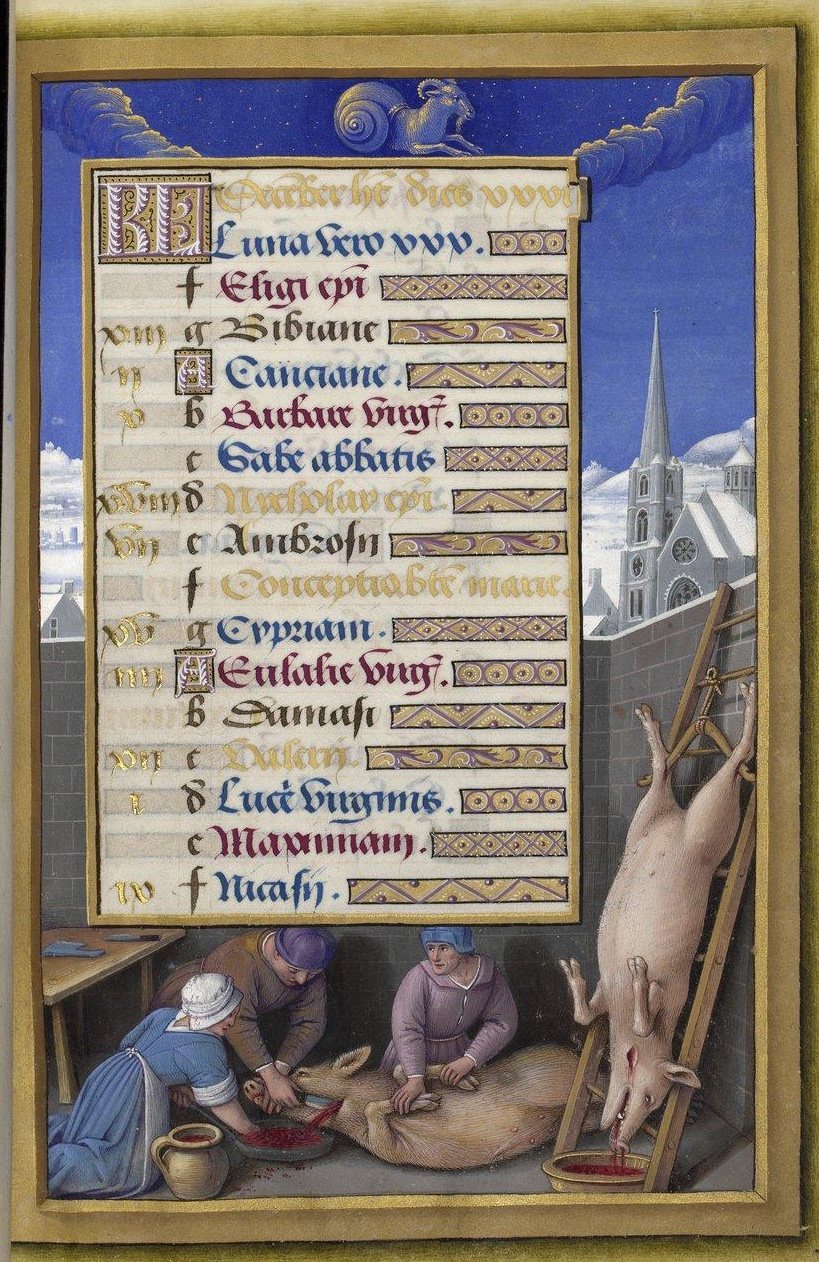
December in the Grandes Heures of Anne of Brittany (c. 1503–08): the pig is killed and its blood caught in a pan — saved, not wasted, for the puddings.
The usual story of offal is short and wrong: poor people ate the scraps the rich threw away, modern prosperity let everyone stop, and a few adventurous chefs brought it back. The record is more interesting. Offal was eaten at royal tables, it was the centrepiece of the year’s great feast wherever pigs were kept, its decline in America was partly a wartime government project in reverse, and the parts Americans stopped eating never stopped being produced — they are shipped abroad by the hundred thousand tonnes.
Offal was never only poor food
The oldest English cookbook in the language puts offal on the King’s table. The Forme of Cury, compiled around 1390 by the cooks of Richard II, serves roast swan with a sauce of the swan’s own liver and offal thickened with its blood; stews the noumbles (innards) of deer with bread, wine, vinegar and onions and “colour[s] it with blode”; and thickens a dish of pig’s numbles with blood and vinegar. Blood, in medieval court cookery, was a thickener and a colourant — the logic of black pudding at a lord’s table.
Haggis is first written down in England, not Scotland. The earliest known recipe, “hagese,” is in the Lancashire verse cookbook Liber Cure Cocorum of about 1430; Gervase Markham’s English Huswife (1615) has one too. The earliest Scottish mention is a little later, before 1520. Burns’s Address to a Haggis (1786) made it Scotland’s. Which country “owns” it is still argued.
The feast of the slaughter
Before refrigeration, muscle could be salted, smoked or dried, but offal spoiled within days. So the day the pig was killed was the day the offal had to be eaten — and in nearly every pig-keeping culture, that day became a feast.
- Spain’s matanza — traditionally around St Martin’s Day, 11 November (hence the proverb “A todo cerdo le llega su San Martín”, “every pig gets its St Martin’s”): two or three days of relatives, neighbours and friends, blood sausages and hams, lard and soap.
- Germany’s Schlachtfest — late autumn, with Metzelsuppe, the broth from the sausage kettle, carried to the neighbours “often… in milk cans,” blood sausage, liver sausage and kettle-cooked meat. In Austria it was the Sautanz, the “pig dance.”
- The American South’s hog-killing day — waiting for an extended cold snap, often between Christmas and February in the Deep South, with tables set up for processing the fresh pork and a feast for the families who came to help. It drew together Native American, African and European pork traditions.
- Greece at Easter — kokoretsi, lamb intestines wrapped around seasoned offal and spit-roasted, eaten while the lamb itself roasts.
In each of these, offal is the centre of a celebration, not the bottom of a hierarchy.
Offal, class and race in America
The story most often told about chitterlings — that enslaved people were given the scraps and invented a cuisine from them — needs care, because part of it is true and part of it is not.
- Enslaved people’s rations were meagre and imposed. Frederick Douglass recorded his monthly allowance as “eight pounds of pork, or its equivalent in fish, and one bushel of corn meal.” Note what the ration was: pork, not guts.
- Offal was part of what enslaved people received and made into a cuisine, and West African traditions of cooking and seasoning innards travelled with them.
- But chitterlings are not an invention of the American South. The word and the dish are English and medieval, eaten by white Britons for centuries — and chitterlings remained a West Country English food into the 1970s. And hog-killing offal was eaten by everyone at the killing, because it could not be kept.
- The honest version: enslaved cooks turned what they were given into a great cuisine; chitterlings were one of the things they were given; and the idea that enslavers never ate them is not supported by the evidence found for this page. (The historians Adrian Miller and Michael Twitty have written on soul food at length; their specific positions on the “scraps” story were not checked for this page, and nothing is attributed to them.)
The term “soul food” dates from the mid-1960s. The “Chitlin’ Circuit” — the venues where Black performers could work safely under Jim Crow — is named after the dish; its first documented use in print is 1966, in the Oakland Tribune, quoting Lou Rawls.
How America learned to stop eating offal — and the war that tried to reverse it
By the Second World War, organ meats carried a class stigma in America. The National Park Service’s account of the home front puts it bluntly: “People with means considered organ meats… ‘poor people food.’” The usual explanations for the long decline — rising incomes and cheap muscle meat, pre-packed supermarket meat, suburban kitchens, the end of home slaughter — are probably right, but no scholarly source stating them was checked for this page, so they are offered as the usual explanation rather than as established fact.
Then the war made the government want Americans to eat hearts and kidneys. From 1942 the anthropologist Margaret Mead directed the National Research Council’s Committee on Food Habits, which studied how to change what Americans ate under rationing. The committee sponsored the psychologist Kurt Lewin, whose 1943 experiment became famous in social science: groups of housewives were either lectured by a nutritionist on why and how to serve beef hearts, sweetbreads and kidneys, or given the same facts and then led to a group decision. A week later, far more of the women who had reached a decision together had actually served the organ meats. The experiment introduced the idea of the “gatekeeper” — the person who controls which foods come into a home.
The exact numbers are quoted two different ways in secondary sources — 3% against 32% in one account, 10% against 52% in another — and the original 1943 report could not be read for this page, so it prints the direction of the effect and not a percentage.
The Army cooked them as a matter of course. The War Department’s field cookbook of 15 August 1944, TM 10-412, Army Recipes — reproduced in full in this collection — carries two dozen organ-meat recipes, each for 100 men:
- eleven liver dishes, from Fried Liver with Bacon to Liver Chow Mein;
- four for tongue, including Tongue with Horseradish Sauce;
- three for heart, including Stuffed and Braised Heart (Beef);
- two each for kidneys, sweetbreads and brains, among them Brains and Scrambled Eggs.
To the Army, these were ordinary meat, filed under “Meat” beside the pot roast.
What the war left behind was a word. “Variety meats” appears in print about 45 times more often in 1943 than in 1940 (see what offal is).
The revival
- Fergus Henderson opened St. John in a former bacon smokehouse near London’s Smithfield meat market in October 1994. His book Nose to Tail Eating (1999; published in America in 2004 as The Whole Beast, with a foreword by Anthony Bourdain) gave the movement its name and its manners: “If you’re going to kill the animal it seems only polite to use the whole thing.” Its roast bone marrow and parsley salad is the dish most associated with the restaurant; the recipe is Roast Bone Marrow with Parsley Salad.
- Anthony Bourdain championed Henderson and offal on television for two decades. (The often-repeated story that Bourdain chose St. John’s bone marrow as his “last meal” could not be traced to a source, and is not repeated here as fact.)
- Korea ran the other way. Gopchang — grilled intestines — was once cheap, nourishing food given to the sick and to new mothers; it is now more expensive by weight than ordinary meat. The same organ moved from the bottom of the market to the top.
Where America’s offal goes now
Americans largely stopped eating these parts, but they did not stop producing them. They are exported. The US Meat Export Federation reported in September 2026 that Mexico is “the leading volume destination for beef variety meat” — 76,510 tonnes, up 17%, worth $228.5 million (the release does not make clear whether that is one month or the year to date). Mexico wants the tripe for menudo and the tongue for tacos de lengua; Japan and Korea take tongue and intestines. Ireland exported €134 million of offal in 2022, with Irish beef tongue popular in Japan. The fifth quarter did not disappear from the American carcass. It moved to other people’s tables.
In this dive: What offal is · The history · Safety and the law · Liver · Heart and tongue · Kidneys, sweetbreads and brains · Tripe and intestines · Blood · Heads, feet and tails · Gizzards · Game offal · Fish offal · Every part on the list · Corrections
Comments (0)