Every Part on the List, A to Z
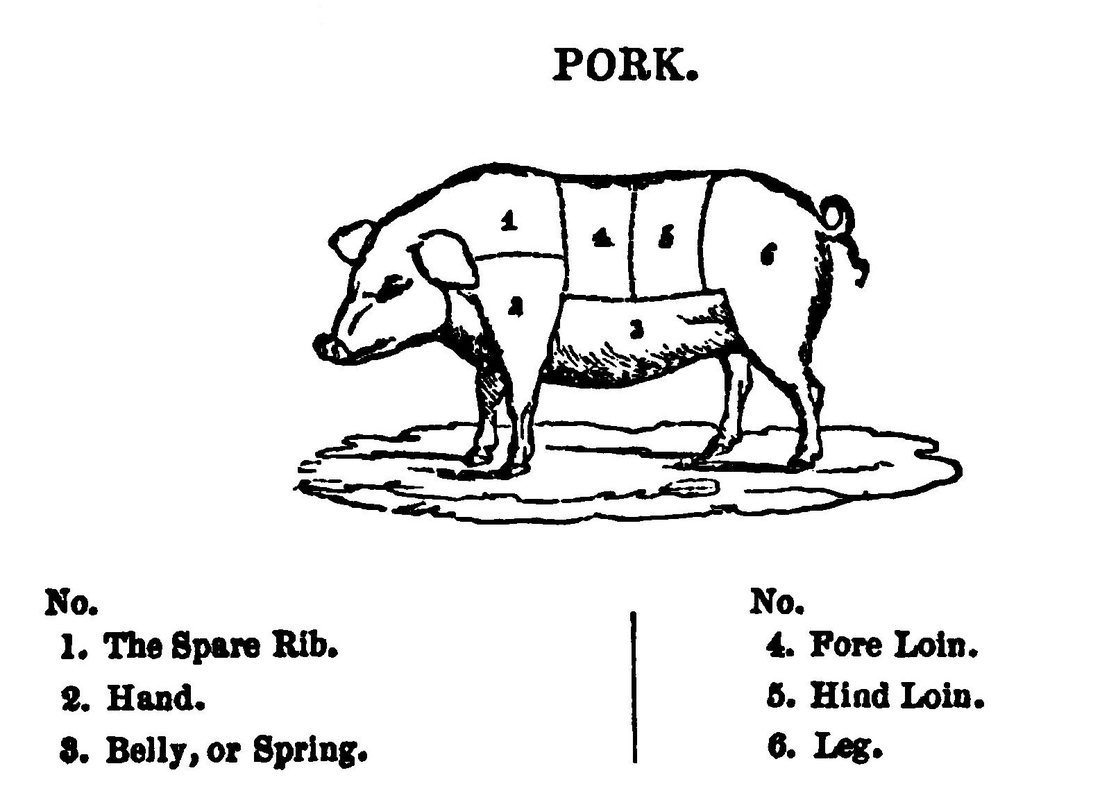
The pig by numbers, from Eliza Acton’s Modern Cookery. Butchers’ charts show the cuts; the list on this page is everything else.
This page answers one question for each of thirty-nine parts: is it eaten, and if so, how? Some are among the world’s great foods. A few are eaten only in one region, and a few are not eaten at all. Those are marked not eaten here, rather than dressed up with a dish that does not exist.
Arteries. Eaten as one named ingredient only: the aorta. In Chinese hot pot it is huang hou (黄喉, “yellow throat”) — the aortic arch of a pig or cow, often mistaken for the throat. It is prized for its crunch, and is swished in the broth for about ten seconds because it toughens if overcooked. Smaller arteries are trimmed away as gristle.
Bladder. Used as a cooking vessel, not eaten. Lyon’s poularde en vessie poaches a truffled Bresse chicken sealed inside a pig’s bladder, which keeps the juices in, like an early sous-vide. The dish was made famous by Paul Bocuse; who invented it is disputed. (The fish swim bladder is a different organ, and is eaten — see below.)
Blood. Eaten worldwide — see blood.
Bone marrow. See heads, feet and tails.
Brain. See kidneys, sweetbreads and brains.
Bronchus. Not a separate food. The bronchi are the airways inside the lungs and are eaten as part of the lung (below). The trachea is occasionally eaten on its own in Colombia; haggis recipes cut the windpipe away.
Capillaries. Not eaten, and cannot be. Capillaries are 5–10 micrometres across, with walls one cell thick, and run through nearly every tissue. Every piece of meat already contains them. A “capillary dish” found online is almost certainly a mistranslation — usually of huang hou or blood curd.
Cheeks. See heads, feet and tails.
Chitterlings. See tripe and intestines — and boil them five minutes before cleaning.
Ears. See heads, feet and tails.
Eyes. Eaten as part of a whole head, mostly of fish, goats and cattle. See heads, feet and tails.
Gallbladder. Usually discarded, carefully: a burst gallbladder makes the liver around it bitter. The bile is used on purpose in a few dishes, as a bittering agent: Lao and northern Thai laab made with bile, and the Ilocano pinapaitan (from paít, “bitter”) of goat or beef offal. Popular modern pinapaitan recipes substitute bitter melon.
Gizzard. See gizzards.
Head cheese. See heads, feet and tails.
Heart. See heart and tongue.
Hide. Eaten widely, as skin rather than leather:
- chicharrón — fried pork rind, in Spain, Latin America and the Philippines;
- crackling and pork scratchings — British;
- pork rinds — American;
- gribenes — the crisp chicken or goose skin of Jewish cooking;
- ponmo — cow skin, singed, boiled and cooked into Nigerian soups and stews.
Pati Jinich simmers chicharrón in a green salsa until it turns soft and chewy — the point of the dish: Chicharrón in Three Chiles Salsa. Ponmo carries real health cautions: Nigeria advised against it after an anthrax outbreak, and fire-singeing leaves combustion compounds on the skin.
Hooves. The hoof itself is not eaten — it is keratin, like a fingernail. The foot inside and above it is: cow heel and pig’s trotters. See heads, feet and tails.
Horns. Not eaten. A horn is a sheath of keratin over a core of bone. Its only “consumption” is medicinal: antelope horn in traditional Chinese medicine, and deer antler velvet as a supplement — antlers are shed bone, not horn, and one double-blind study found no evidence that the velvet works. Rhino horn is a poaching trade, not a food.
Intestines. See tripe and intestines.
Kidney. See kidneys, sweetbreads and brains.
Lips. Not “meat” in US law but a byproduct, which goes into processed meats and whole-head dishes. No stand-alone beef-lip dish could be verified. See heads, feet and tails.
Liver. See liver.
Lung. Traditionally called “lights”, for its airy lightness. It cannot be sold as food in the United States; see safety and the law. Elsewhere it is eaten boiled, then cut up:
- haggis — sheep’s heart, liver and lung with oatmeal and suet. The earliest written recipe, “hagese”, is English, from a Lancashire verse cookbook of about 1430;
- Hungarian savanyú tüdő — “sour lung,” a pork lung and heart ragout with a sour cream sauce and pickles;
- Rome’s coratella — lamb heart, lung and oesophagus with artichokes;
- Palermo’s spleen sandwich (below), which also contains veal lung.
Omentum. The lacy fat membrane of the abdomen, called caul fat. It is a wrapper, not a dish: it holds loose forcemeat together and bastes it as it melts. French crépinettes, British and Welsh faggots (pig’s heart and liver meatballs, still eaten by the tens of millions a year in the UK), Cypriot sheftalia, and Italian fegatelli (liver in caul) all use it, and so do many pâtés.
Oxtail. See heads, feet and tails.
Pancreas. Sold and eaten as sweetbread — the round “heart” or “stomach” sweetbread, and the only kind harvested from beef and pork. No dish knowingly made of pancreas as such was found. See kidneys, sweetbreads and brains.
Penis. Eaten mainly as a reputed tonic or aphrodisiac:
- China — biān (鞭, “whip”);
- Philippines — Soup Number Five;
- Jamaica — cow cod soup;
- Bolivia — caldo de cardán;
- Malaysia — sup torpedo.
The texture is mostly collagen, and gelatinous when cooked. Its commonest modern use is dried bull pizzle as dog chews (“bully sticks”). No recipe from an authoritative cook was found.
Scrotum. Not a recognised dish. It appears on general lists of edible offal, but no dish, preparation or region that serves it could be found. Testicle recipes (below) skin the testicle’s own membrane.
Snout. See heads, feet and tails for the snoot sandwich. In China, the snout is braised as part of a pig’s head.
Spleen. The old English word is milt (also the word for fish soft roe). Palermo’s pani câ meusa is a sesame roll of boiled, lard-fried veal spleen and lung, served maritatu (“married”) with cheese or schettu (“single”) without. The Ashkenazi miltz is stuffed spleen, and Bavaria makes Milzwurst.
Sweetbread. See kidneys, sweetbreads and brains.
Swim bladder. Eaten as fish maw, one of China’s four sea delicacies, and once in England as cod “sounds.” See fish offal.
Testicle. Eaten widely, usually skinned, floured and fried:
- Rocky Mountain oysters or calf fries — the American West and Oklahoma;
- prairie oysters — Canada;
- criadillas — Spain and Argentina;
- animelles — France, grilled with butter and lemon;
- donbalān — Iran, skewered.
Serbia holds a World Testicle Cooking Championship every September. They are a meat byproduct under US law, and cooked like other organ meats, to 160 °F.
Throat. Several different things. The thymus, or “throat sweetbread” (see sweetbreads); the oesophagus, which is part of Rome’s coratella and is legally meat in the US; and the misnamed huang hou, which is an artery. No stand-alone larynx dish was found.
Tongue. See heart and tongue.
Tripe. See tripe and intestines.
Trotters. See heads, feet and tails.
Udder. A niche and declining food wherever it is found:
- teteun from Italy’s Valle d’Aosta — cow udder cured with herbs and juniper, cooked, pressed and sliced as an antipasto;
- grilled ubre at the Argentine and Chilean asado;
- historically “elder” in Lancashire and Scotland, “rarely seen today.”
Veins. Not eaten. They are thin, low-mass tubes of connective tissue, and cooks trim them out of hearts and livers rather than cook them. The one named “vessel” dish, huang hou, is an artery.
In this dive: What offal is · The history · Safety and the law · Liver · Heart and tongue · Kidneys, sweetbreads and brains · Tripe and intestines · Blood · Heads, feet and tails · Gizzards · Game offal · Fish offal · Every part on the list · Corrections
Comments (0)