Fish Offal: Roe, Milt, Livers, Heads and Collars
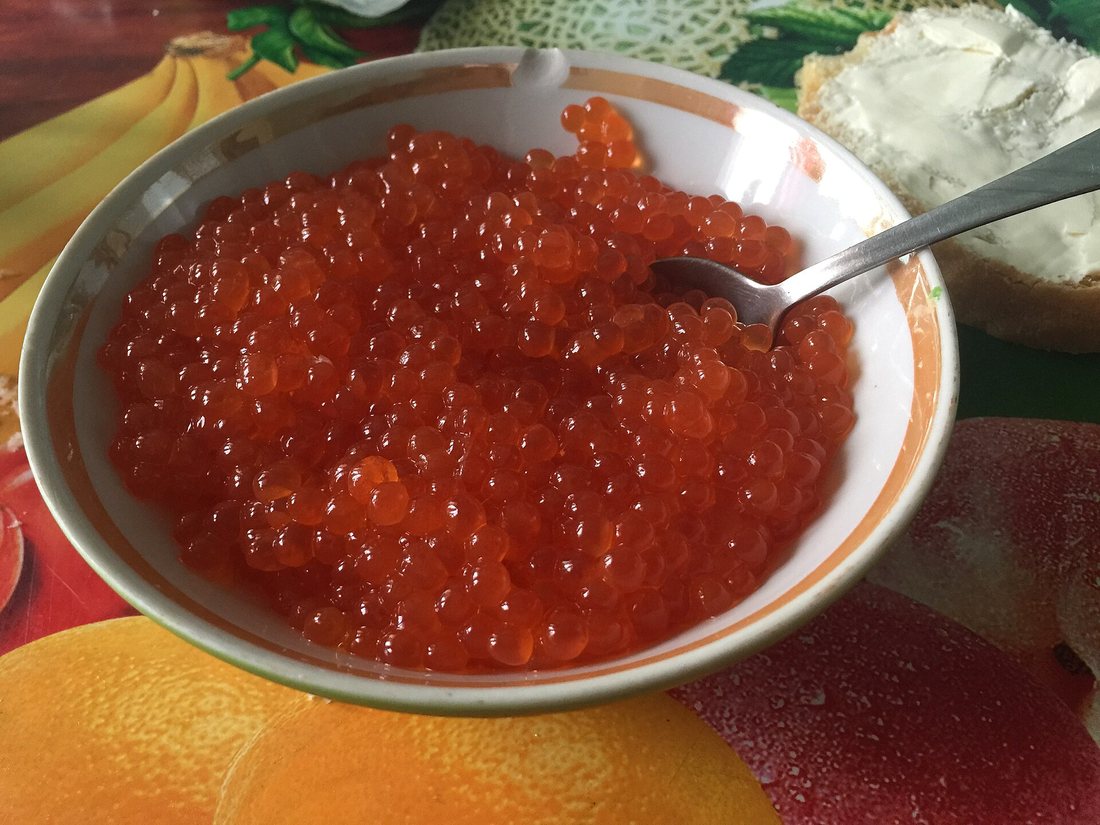
Salmon roe — sold in the US as “salmon caviar,” because unqualified “caviar” means sturgeon.
Fish have offal too, and some of it is the most expensive food in the world. Caviar is roe; bottarga is roe; the Japanese call monkfish liver “the foie gras of the sea”; and one fish’s dried swim bladder has sold to poachers for up to $20,000 a kilogram. Other parts — cheeks, collars, heads — are the bits a fishmonger throws away and a cook fights over.
Roe: hard and soft
Roe is the egg mass of a female fish — “hard roe.” The male’s reproductive gland is the milt, or “soft roe.” The skein is the membrane that holds the eggs together.
Ripeness matters. Hank Shaw’s rule: underripe roe is small and dryish, best cooked whole; ripe roe “just looks right”; overripe roe is bloated and watery, and “best salted down to make bottarga.”
Most roe is edible. The Encyclopedia of Fish Cookery (A. J. McClane) lists herring, salmon, trout, flounder, mullet, sturgeon, cod, haddock, flying fish, smelt, tuna, mackerel, paddlefish, lumpfish, carp, whitefish and cisco among the good ones; Shaw adds yellow and white perch.
The one to never eat: gar
Gar roe is poisonous, and cooking does not make it safe. Gar eggs carry a toxin that breaks down only at about 120 °C (248 °F) — a temperature the inside of cooked roe does not reach — so “even cooked roe causes severe symptoms.” Longnose gar live in Michigan waters. Shaw names gar (and the Pacific cabezon) as the exceptions to the rule that fish roe is edible.
“Caviar” is a legal word
In the United States, “caviar” on its own means salted sturgeon roe — FDA Compliance Policy Guide 540.150: “The term ‘caviar’ unqualified should be applied only to the article prepared by the special method (salting) of sturgeon roe.” Any other roe must be sold as “[fish] caviar” — salmon caviar, whitefish caviar — with the fish’s name in type as large as the word “caviar.” Added colour is allowed if it is declared. For international trade (CITES), paddlefish roe counts as caviar too.
The roe vocabulary
| Name | Fish | What it is |
|---|---|---|
| Ikura | Salmon, trout | Loose large eggs, cured in soy and dashi. The word is borrowed from Russian ikra, “roe.” |
| Sujiko | Salmon | Roe cured still in its skein |
| Tobiko | Flying fish | Small, crunchy, naturally bright |
| Masago | Capelin | Dull yellow and often dyed — and sometimes sold as “flying fish roe” |
| Tarako / mentaiko | Alaska pollock | Salt-cured roe sacs; mentaiko is marinated in red chili |
| Kazunoko | Herring | Firm, brined; a New Year dish in Japan |
| Karasumi / bottarga | Mullet, tuna | Pressed, salted, dried roe |
| Tarama | Cod, carp, grey mullet | The base of taramasalata |
| Löjrom | Vendace | Small orange roe, Sweden’s delicacy |
| Shad roe | American and hickory shad | The spring roe of the US East Coast |
| “Cajun caviar” | Bowfin | Louisiana’s roe industry |
Mentaiko is Korean food made Japanese. It descends from Korean myeongnan-jeot, spicy salted pollock roe. Toshio Kawahara, born in Busan during the Japanese occupation, adapted it for Japanese tastes. He opened his shop, Fukuya, in Hakata (Fukuoka) on 5 October 1948, and first made and sold karashi mentaiko on 10 January 1949 (the dates are from the company’s own history). The Korean dishes in this collection are Fermented Pollock Roe and Spicy Pollock Roe Stew.
Bottarga is grey-mullet (or tuna) roe, massaged free of air, salted and dried for weeks, and often sealed in beeswax. The word runs from Byzantine Greek “egg-pickle” through Arabic into Italian, and the Greek version, avgotaracho of Messolonghi, is a protected designation of origin. It is grated over pasta: Spaghetti with Bottarga.
Taramasalata is cured roe beaten with olive oil and lemon onto a base of bread or potato (almonds in northern Greece) — “essentially an emulsion, like mayonnaise,” in Diane Kochilas’s phrase. It is a dish of Clean Monday and Lent. The bright pink supermarket version is dyed; natural tarama is beige, and undyed tarama is, Kochilas says, “difficult, if not impossible, to find in the United States”: Taramasalata.
Kalix löjrom, from vendace caught in the Bothnian Bay, became Sweden’s first protected designation of origin in 2010.
Shad roe: the East Coast spring
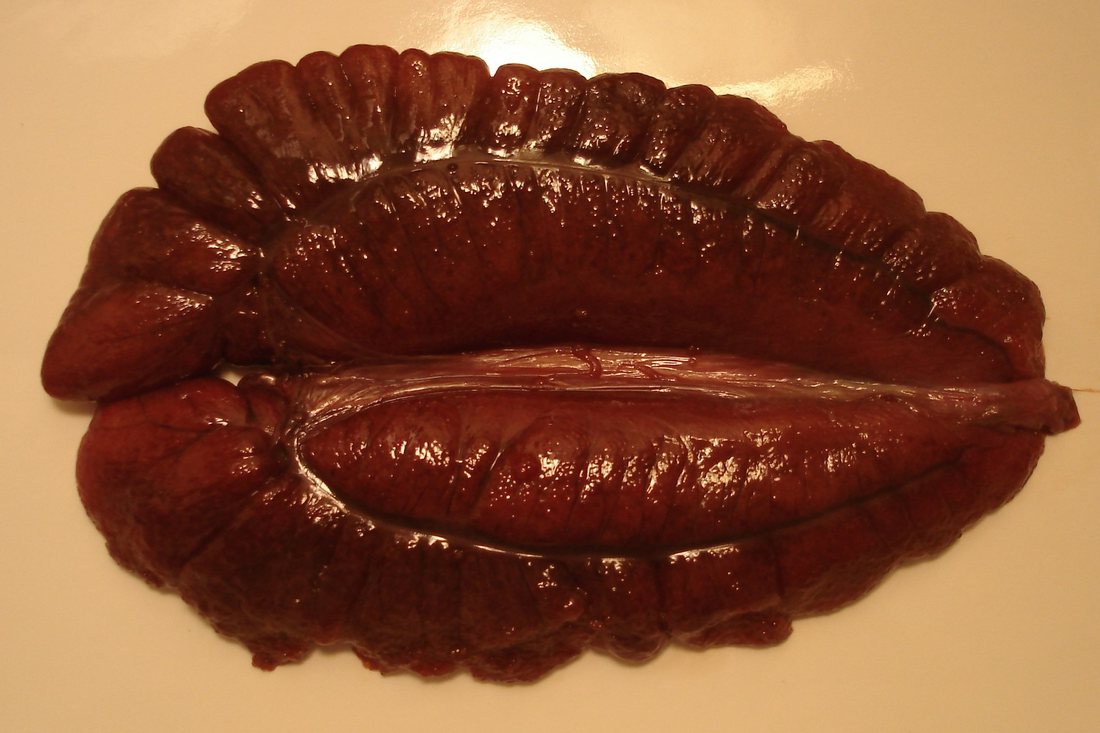
A raw shad roe set: the paired sacs of the East Coast’s spring roe.
The American shad runs up East Coast rivers every spring — Georgia in January, the Carolinas in March, the Potomac in April, and New England and Canada in May and June — and its roe is the one American fish roe prized above the fish. William Penn wrote that Schuylkill shad were “excellent Pickled or Smoked.” Each fish carries two or three sacs. The classic way is Shaw’s Virginia breakfast: shad roe with bacon and grits. He brines the sacs briefly (2 tablespoons of kosher salt to a pint of water, about two hours for shad), dusts them in flour, and fries them “like bacon: slowly, at a nice, calm sizzle,” because the eggs spit. He warns that roe that has been frozen “loses its texture and gets fishy”: Shad Roe with Bacon and Grits.
A field note: shipped north, cooked low and slow
East Coast shad roe is a favourite in this collection’s kitchen too. It is shipped to Michigan in season and cooked at home, and in spring in South Carolina it is both cooked and ordered in restaurants. The home method is simpler than Shaw’s: butter, salt and pepper in the pan, and low, slow heat. High heat bursts the eggs inside the sac, and the mess that follows is the lesson — learned, in this kitchen, the hard way. The recipe is Pan-Fried Shad Roe. Shaw’s floured roe with bacon is rated just as good here, and stays in the collection beside it.
A field note: panfish roe in butter
The fish roe cooked most often here comes from Michigan panfish — bluegill, sunfish and their kind. The skeins are rolled in a little flour and fried in butter with salt and pepper. It is the same method as the shad roe above, on a smaller scale, and a favourite: Fried Panfish Roe.
What Michigan’s fish advisory says about eggs
Michigan’s Eat Safe Fish guides test only fillets, and they are direct about the rest of the fish:
“The organs and head are not tested for the ESF Guide. Internal organs (liver, fish eggs, etc.) typically have higher levels of chemicals than the filet and shouldn’t be eaten.” — Michigan Department of Health and Human Services, Eat Safe Fish Guide (2026)
The reason is where contaminants sit: PCBs and dioxins are stored “in the fat and organs,” while mercury and PFOS sit in the fillet. The guide does not publish measurements for roe, so the size of the risk is not quantified; it is a precaution, not a finding about any particular lake. The advice is general, covering panfish roe as much as salmon or steelhead roe; the guide for each region lists the waters it covers.
Curing your own roe
Steelhead and salmon roe can be cured at home as salmon caviar or ikura. Shaw’s method frees the eggs from the skein by rubbing it over a cooling rack, or under water at 105–115 °F (warmer water starts to cook them), then salts them briefly: Home-Cured Steelhead Roe.
- Keeping. Shaw says two weeks refrigerated but “fishy after about a week”; Just One Cookbook says eat home-cured ikura “within a few days.” Go with the shorter figure — “although ikura is processed, it’s still raw seafood.”
- Parasites. The FDA Food Code requires most fish served raw to be frozen first, but it exempts “fish eggs that have been removed from the skein and rinsed.” Roe eaten raw in the skein is not covered by that exemption.
- Michigan law. It is unlawful to “buy or sell fish or parts of fish … taken under a sport fishing license” — so home-cured roe from a sport-caught steelhead can be eaten or given away, but not sold — and it is unlawful to “take fish for the sole purpose of removing the eggs.”
- Lake sturgeon have been a threatened species in Michigan since 1994. Harvest is allowed in only four waters, one fish per angler per year, registered within 24 hours. Home sturgeon caviar is not a realistic Michigan project.
Milt
Milt, or soft roe, is creamy and mild — in Japan it is shirako, “white children,” and cod and pufferfish milt are the prized ones. It is Korean iri, Sicilian lattume (tuna milt over pasta), and carp milt in the Czech Christmas Eve soup. In Britain, soft herring or cod roes fried in butter on toast were a standard savoury. (That dish is often credited to Mrs Beeton; it is not in her 1861 book.) Wikipedia notes that “many North Americans find the consumption of milt taboo.”
Fish livers
- Ankimo — monkfish liver, salted, rinsed with sake, rolled and steamed, served with ponzu; “the foie gras of the sea.”
- Cod liver — the source of cod liver oil, given to children by the teaspoon from the nineteenth century into the 1950s to prevent rickets. One tablespoon of cod liver oil carries 4,080 µg of vitamin A, more than the adult daily upper limit of 3,000 µg.
- Burbot liver — the Great Lakes’ own. The burbot (lawyer, eelpout) has a liver about a tenth of its body weight, far richer in vitamins A and D than cod liver oil. Finland prizes it. Shaw sears clean, unspotted livers and serves them on toast, and eats them “only occasionally” because of the vitamins. The Eat Safe Fish advice on organs applies to burbot livers too.
Heads, cheeks and collars
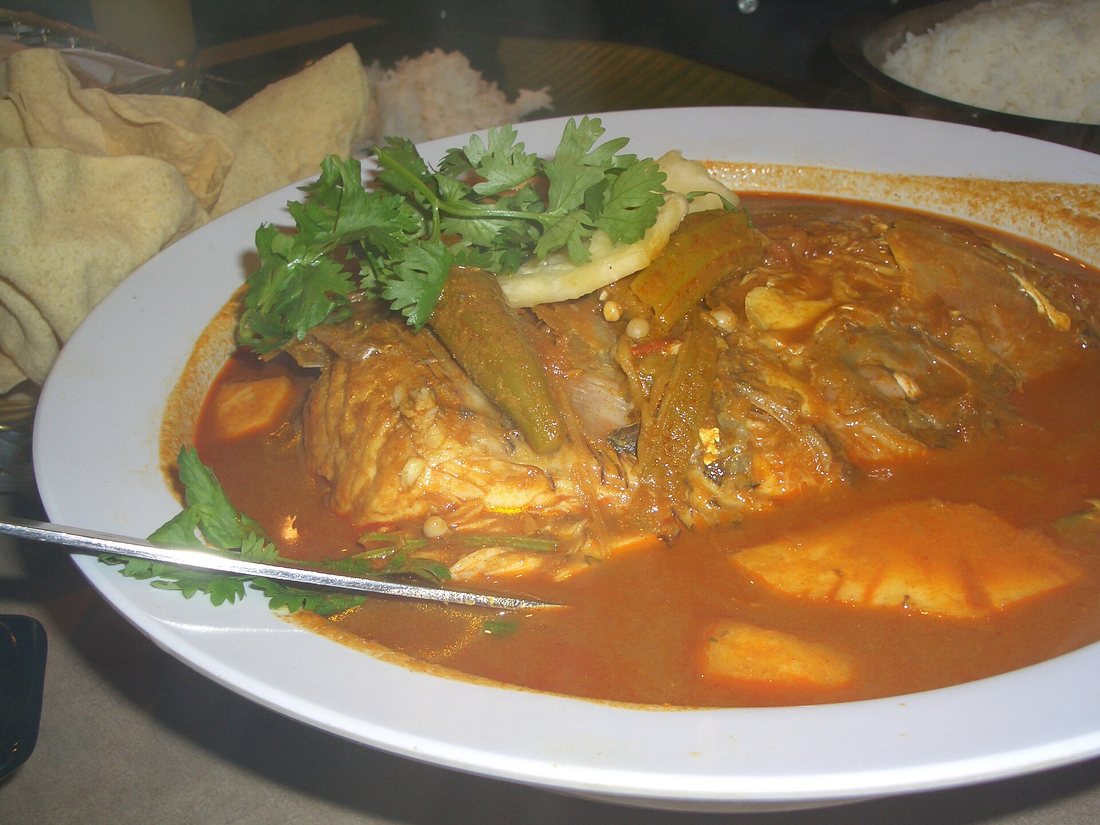
Fish head curry, Singapore’s own dish, credited to a cook from Kerala in 1949.
- Fish head curry (Singapore). Credited by Singapore’s National Heritage Board to Marian Jacob Gomez, an immigrant from Kerala, who began selling it on Sophia Road in 1949 — as a stall or a restaurant, depending on the source. The heritage board notes that fish head “is not served in traditional Malayalee cuisine” — the dish is Singaporean, not Indian: Fish Head Curry.
- At a Chinese table, the fish head goes to the most senior guest.
- Cod “tongues” (Newfoundland) are not tongues; they are the boneless flesh under the lower jaw, fried in pork fat with scrunchions. Cod cheeks are the jaw muscles. Both were dockside scraps before the 1992 cod collapse made them a tourist dish.
- Collars (kama) are the fattiest part of the fish, just behind the gills — yellowtail collar is a Japanese izakaya staple. Shaw grills salmon collars and says they are worth taking from any fish of about 5 pounds or more, which includes Great Lakes kings and steelhead: Grilled Salmon Collar with Ponzu.
- Burbot cheeks are “big, giant” for the size of the fish.
Swim bladder: fish maw
A fish’s swim bladder, dried or puffed in oil, is fish maw — one of the Chinese “four sea delicacies,” prized for its collagen texture, not its flavour. In Victorian England the same organ was eaten as cod sounds, which Mrs Beeton called “a great delicacy.” The trade has a dark side: the bladder of the totoaba, a Gulf of California fish, sells for up to thousands of dollars a kilogram, and the gillnets set to poach it have driven the vaquita porpoise to about ten survivors. Swim bladder is also the source of isinglass, the fining agent used to clear cask ale.
In this dive: What offal is · The history · Safety and the law · Liver · Heart and tongue · Kidneys, sweetbreads and brains · Tripe and intestines · Blood · Heads, feet and tails · Gizzards · Game offal · Fish offal · Every part on the list · Corrections
Comments (0)