Heads, Feet and Tails
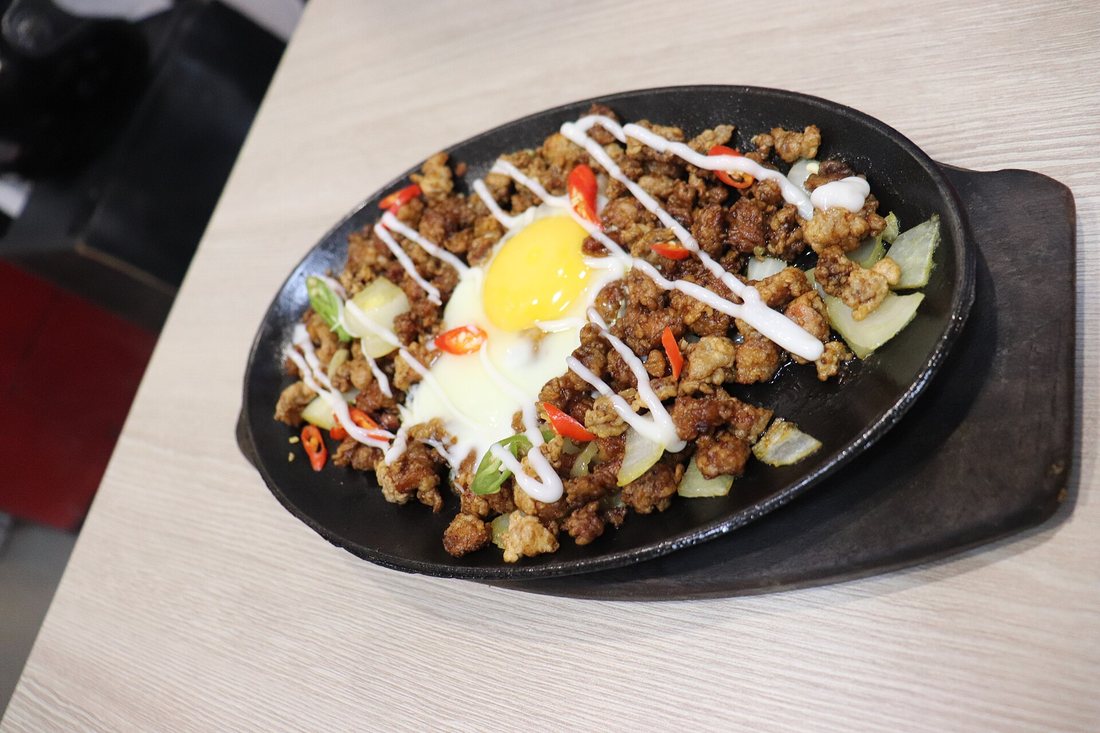
Sisig on its sizzling plate: chopped pig’s head and ears, vinegar, calamansi and chili.
The extremities are the most gelatinous parts of an animal: skin, cartilage, tendon and small bones wrapped around modest amounts of meat. Cooked long, they give up collagen that sets a broth into jelly. That is why a pig’s head becomes a head cheese, a calf’s foot became the dessert jelly of Victorian England, and an oxtail stew has a body no stock cube can imitate.
Cheeks
The cheek is the chewing muscle (the masseter), with the fat around it — beef and veal cheek (joue), pork jowl, and fish cheeks. It works all day, so it is full of connective tissue, and braised slowly it melts into one of the silkiest meats there is.
- Joues de bœuf — beef cheeks braised in red wine. Mrs Beeton (1861) soaked an ox cheek overnight in salt water and stewed it about four hours with onions, cloves and root vegetables; Pierre Koffmann braises floured, seared cheeks in 1.1 litres of red wine for about 2½ hours.
- Guanciale (Lazio and Umbria; from guancia, “cheek”) — salt-cured pork jowl aged at least three months, and the traditional fat of carbonara and amatriciana.
- Barbacoa de cabeza and tacos de cachete (Mexico and South Texas) — cheek from a whole cow’s head, cooked in an earth oven.
The collection has several: Beef Cheeks in Red Wine, Braised Beef Cheeks, Slow-Cooked Beef Cheeks, Smoked BBQ Beef Cheeks and Beef Cheek Ravioli with Crushed Squab Liver.
Ears, snouts and lips
Pig ears are skin over cartilage: crunchy if cooked briefly, soft if cooked long.
- Chinese pig-ear salad — boiled about 20 minutes (longer loses the crunch), cut into strips along the gristle and dressed with chili oil, black vinegar and soy.
- Oreja a la plancha (Spain) — griddled ear, served with garlic and parsley or a spicy sauce, with a small beer.
- Sisig (Angeles, Pampanga, Philippines) — chopped grilled pig ears and cheeks with vinegar, calamansi, onion and chicken liver on a sizzling plate, credited to Lucia Cunanan in 1974. Pig heads were cheap there because personnel at the nearby Clark Air Base did not eat them. The word itself is much older: in a 1732 dictionary, sisig meant a sour salad of green papaya or guava.
Snouts — the snoot sandwich is a Black barbecue tradition. Street vendors sold snoot sandwiches in Atlanta in the late 1920s, and in Harlem and on Memphis’s Beale Street by the 1930s (Adrian Miller, citing Real Barbecue). It survives today in two cities: St. Louis, where the snout is fried crisp and sauced, and Kansas City, where it is stewed tender and served whole on a bun. St. Louis is a survival of the tradition, not its origin.
Lips are, in US law, not meat at all: “Meat does not include the muscle found in the lips, snout, or ears” (9 CFR 301.2). They are a byproduct, and a hot dog that contains them must say “with byproducts” or “with variety meats.” No dish of beef lips in its own right could be verified. Lips disappear into processed meats and whole-head dishes such as sisig and souse.
Eyes
Eyes are almost always eaten as part of a whole head: tuna eyes braised with ginger in Japan, the taco de ojo from a Mexican barbacoa de cabeza, goat head in Nigerian isi ewu. These are lightly sourced, and the often-repeated story of sheep’s eyes offered to honoured guests at Arab feasts could not be sourced at all and is not repeated here. Cattle eyes from animals 30 months and older are banned as food in the US under the BSE rules.
Head cheese, brawn and souse
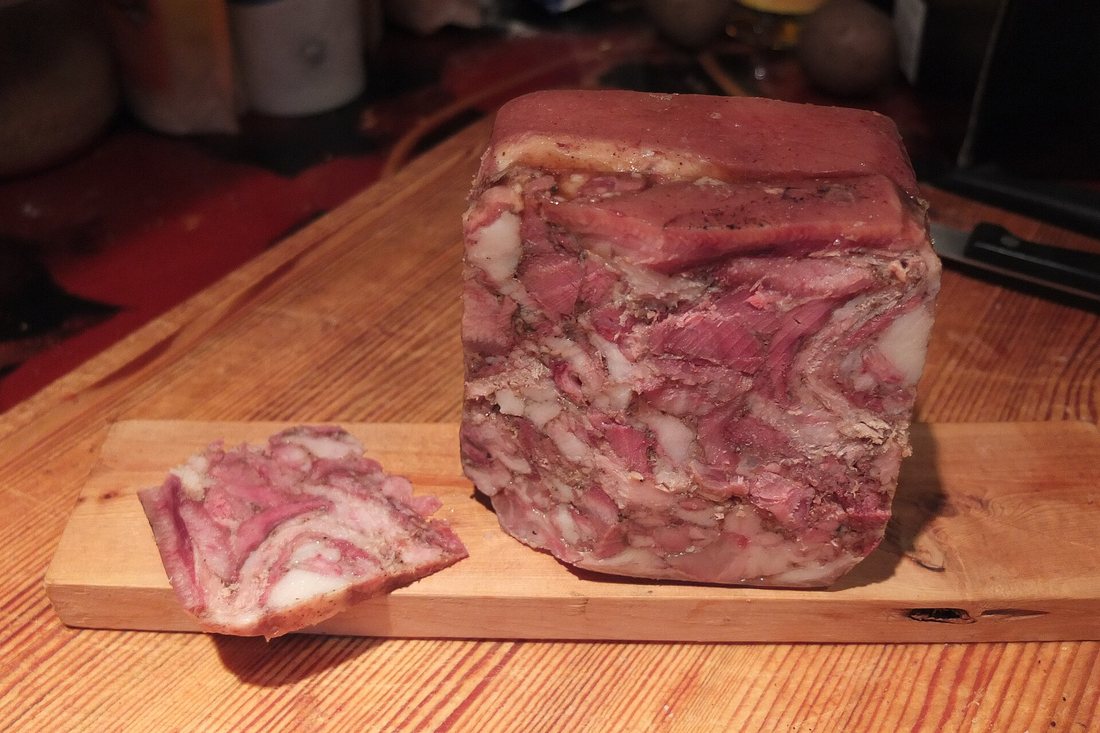
Norwegian hodesylte — head cheese. No cheese and no dairy: meat from the head, set in its own jelly.
Head cheese is not cheese and contains no dairy. It is a meat jelly: a pig’s or calf’s head (with feet and ears for extra gelatin) simmered until the bones pull free, the meat picked, seasoned, packed into a mould with some of the reduced broth, weighted and chilled. It has many names:
- brawn in Britain;
- potted heid in Scotland;
- fromage de tête in France and Sülze in Germany;
- souse for the vinegar-pickled version in North America and the Caribbean.
Mary Randolph’s souse (The Virginia House-Wife, 1824) soaks the pieces twelve hours, boils them “until you can run a straw into the skin with ease,” bones, seasons and rolls them in a cloth, and keeps them in a liquor of meal, water, salt and one-fourth vinegar. She insists on pale vinegar and no singed hair: “good souse will always be white.” Mrs Beeton’s collared pig’s face (1861) brines a boned head ten days before rolling and simmering it. Its saltpetre belongs to 1861; any modern version uses a measured cure.
The collection has Hog Head Cheese (Souse) Sandwich and Souse (Pickled Pork) and Onion Sandwich. The full story of pressed meats is in the planned Pâtés and Terrines section.
Feet: trotters and cow heel
The hoof itself is never eaten — it is a horny keratin capsule. What is eaten is the foot beneath and above it: skin, tendons and cartilage around small bones. Recipes call for “de-hoofed” cow feet.
Pig’s trotters:
- Pied de porc à la Sainte-Menehould (France) — simmered so long that the bones become edible, then breaded and grilled.
- Pickled pig’s feet (the American South) — sold from gallon jars on bar counters, often in a red-dyed brine, and eaten at New Year.
- Cantonese trotters in sweet vinegar and ginger — the dish Guangzhou serves new mothers during the month of confinement: Cantonese Pork Trotters with Ginger and Vinegar.
- Zampone (Modena) — a boned trotter stuffed with a cotechino filling and eaten with lentils at New Year.
- Jokbal (Korea) — trotters braised in soy, ginger and garlic, in its modern form from Jangchung-dong, Seoul, in the 1960s, developed by women from North Korea.
Cow heel:
- Mrs Beeton fried cow heel in egg and breadcrumbs, and boiled it for stock that set “sweet or relishing jellies.” Before powdered gelatin, the dessert jellies of the eighteenth and nineteenth centuries were set with calf’s or cow’s feet.
- Cow foot soup is eaten in Jamaica and across the Caribbean.
- Nkwobi (southeast Nigeria) is cow foot tossed in palm oil emulsified with potash until yellow and thick.
- Caldo de mocotó (Brazil) and kawareh (Egypt and Lebanon, with chickpeas) are other versions.
Oxtail
“Oxtail” once meant the tail of a working ox; today it is simply the tail of any beef animal. A whole tail weighs about 3.5 kg and is sold cut at the joints, and it is always cooked slowly for its gelatin.
- Coda alla vaccinara (Rome) — named for the vaccinari, the slaughterhouse butchers, whose neighbourhood was nicknamed magnacode, “tail-eaters.” It is braised with tomato, wine and a startling amount of celery — 1.5 kg of celery for every kilogram of tail — and it belongs to Rome’s quinto quarto, the “fifth quarter” once paid to slaughterhouse workers in kind.
- Jamaican oxtail — stewed with butter beans, served with rice.
- Kkori-gomtang (Korea) — a milky oxtail bone soup.
- Oxtail soup accompanies gyūtan in Sendai.
The collection has French Braised Oxtail (Queue de Bœuf Braisée) and Potato Gnocchi with Oxtail Ragu.
Bone marrow
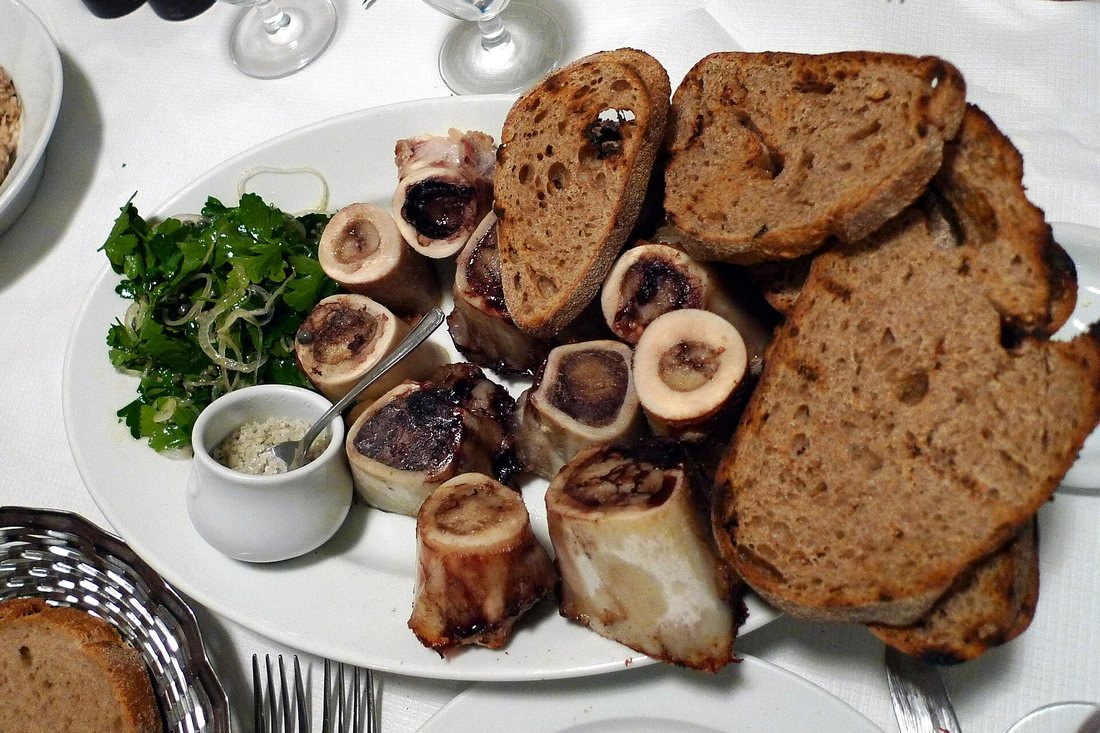
Roast bone marrow with toast, parsley salad and salt at St John, London.
Marrow may be the oldest offal of all. Stone tools for cracking bones go back almost two million years, Neanderthals were processing marrow about 125,000 years ago, and at Qesem Cave in Israel, people stored marrow bones to eat later between 420,000 and 200,000 years ago.
Mrs Beeton sealed sawn bones with a flour paste, boiled them upright for two hours and served the marrow “very expeditiously,” because it cools fast; eighteenth-century diners used dedicated marrow scoops for the job. Marrow is also the heart of ossobuco, of marrow toast from a pot-au-feu, of South Asian nalli nihari, of the Filipino beef soup bulalo and of a good phở stock.
The modern classic is Fergus Henderson’s roast bone marrow and parsley salad, the dish most associated with St. John, the London restaurant that opened in 1994; the recipe was published in Nose to Tail Eating (1999). (That it has “never left the menu” is a recipe-site headnote, not a documented fact.) The bones are roasted about twenty minutes until the marrow is “loose and giving, but not melted” (Andrew Zimmern’s version gives 450 °F for 15–20 minutes), and served with toast, coarse salt and a sharp salad of parsley, shallot and capers — the parsley chopped “just enough to discipline it”: Roast Bone Marrow with Parsley Salad.
In this dive: What offal is · The history · Safety and the law · Liver · Heart and tongue · Kidneys, sweetbreads and brains · Tripe and intestines · Blood · Heads, feet and tails · Gizzards · Game offal · Fish offal · Every part on the list · Corrections
Comments (0)