Safety and the Law
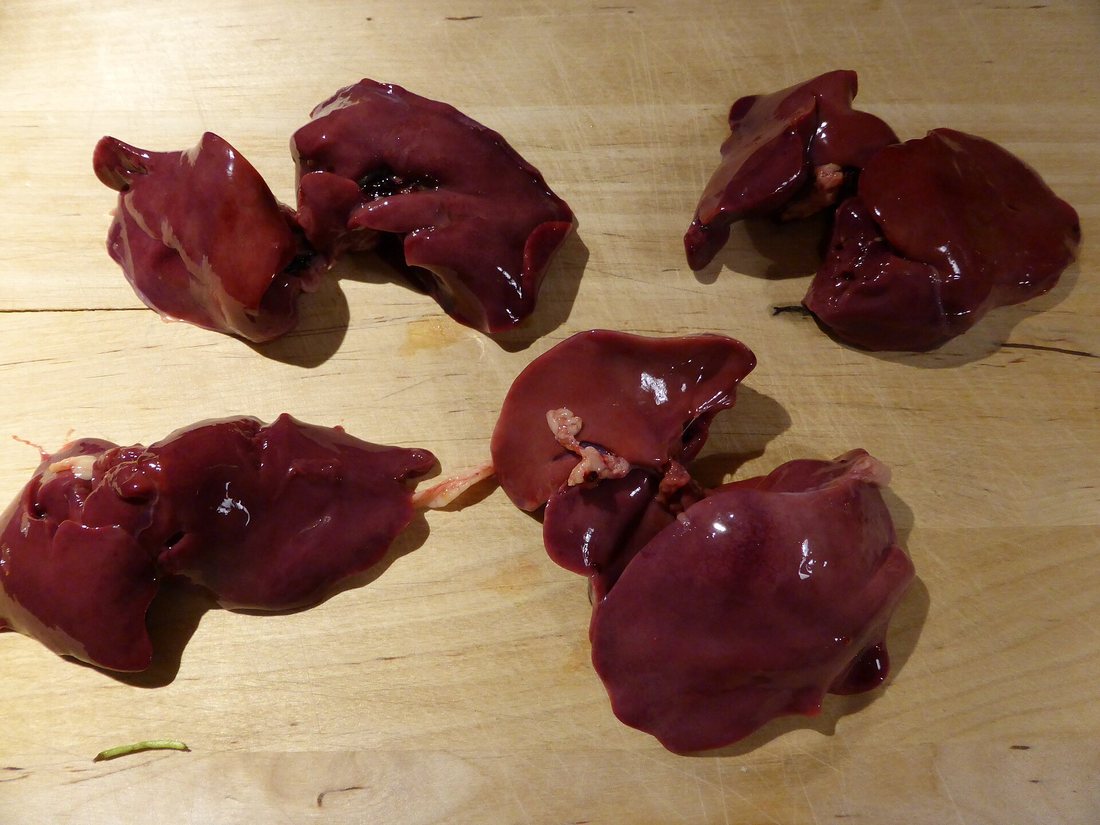
Raw chicken livers. The Campylobacter that makes pink chicken-liver pâté the offal most often behind outbreaks is inside the liver, not only on it.
Offal is not more dangerous than muscle meat as a rule, but a few organs carry specific, well-documented hazards, and the law treats a few parts differently from all the rest. This page sets out what is actually known, with the sources, and without the scare stories that tend to gather around organ meats.
What US law forbids — three things, three reasons
It is false that “offal is banned in America.” Almost every part is legal. Exactly three kinds of offal may not be sold as human food, each for a documented reason.
1. Lungs (since 1971)
9 CFR 310.16(a): “Livestock lungs shall not be saved for use as human food.” The rule was proposed on 31 December 1969 and made final on 17 June 1971 — which is why sources give both dates. The USDA’s basis was a study finding that 93.5% of beef lungs passed as fit for food had “various abnormal conditions,” mostly contamination with “dust, molds, rumen ingesta, nasal exudate, etc.,” and that the lung’s structure makes those impossible to detect in routine inspection. A 2015 study for the pork industry later found Salmonella in 54% of pork lungs, and pigs inhale scald-tank water at slaughter.
A physician, Dr Jonathan Reisman, petitioned the Food Safety and Inspection Service to lift the ban in 2023. FSIS denied the petition on 8 May 2026, saying it lacked data showing lungs are safe, and naming haggis explicitly in its letter. It also rejected the comparison with tripe: stomach linings “can be washed,” but “there is no effective way for contamination to be removed from livestock lungs by washing them.” This is why real haggis — which is 10–15% sheep’s lung — cannot be made or imported in the United States. American “haggis” is made without it.
2. Thyroid and larynx
9 CFR 310.15: “Livestock thyroid glands and laryngeal muscle tissue shall not be used for human food.” The reason is on record: in 1984–85, 121 people in Minnesota, South Dakota and Iowa developed thyrotoxicosis from hamburger made with neck trimmings that had picked up bovine thyroid during “gullet trimming” (New England Journal of Medicine, 1987). Whether that outbreak prompted the rule was not confirmed for this page.
3. BSE “specified risk materials” (cattle only, since 2004)
After a BSE-infected cow was found in Washington State on 23 December 2003, the USDA issued an interim rule on 12 January 2004, affirmed in 2007 and still in force (9 CFR 310.22):
- From cattle 30 months and older: the brain, skull, eyes, trigeminal ganglia, spinal cord, vertebral column and dorsal root ganglia.
- From all cattle: the tonsils and the distal ileum (the last part of the small intestine). The rest of the small intestine may be sold once at least 80 inches have been removed.
Brain from cattle under 30 months is legal. The rules apply to cattle only — there is no equivalent section for sheep or goats. This is why the Ohio Valley’s fried brain sandwiches mostly switched to pork brains. On the prion diseases themselves: 233 people worldwide have been reported with variant CJD, the human disease linked to eating BSE-infected beef, almost all in Britain; the four US cases were all believed to have been infected abroad (CDC).
The organ with the worst outbreak record: chicken liver
The organ most often behind outbreaks is not an exotic one. It is chicken liver, cooked pink, in a pâté.
- In the US, 2000–2016, there were 28 outbreaks linked to chicken liver — most of them Campylobacter. 86% involved blended dishes such as pâté, 93% involved inadequate cooking, and 89% were in restaurants (Lanier et al., Foodborne Pathogens and Disease, 2018).
- The bacteria are inside the liver, not just on its surface. A study of retail chicken livers found Campylobacter in every package tested, and inside the tissue in 14 of 45 livers (Berrang et al., Journal of Food Protection, 2018). Searing the outside is not enough.
- In England and Wales, pâté-linked outbreaks rose from 12% to 74% of Campylobacter outbreaks from 2007, with a marked December peak — Christmas menus.
- The fix is simple. FSIS says to cook chicken liver to 165 °F; its campaign slogan is “Cook Chicken Liver Like It’s Chicken (It Is).” Laboratory work shows that at 158–165 °F the bacteria die within seconds.
A pâté can be smooth and still safe: cook the livers through to 165 °F before they go into the blender, and the texture comes from the butter and the blending, not from pink liver.
Chitterlings: the victims are babies who never ate them
Raw pig intestines can carry Yersinia enterocolitica and Salmonella, and the documented victims of holiday chitterling preparation are infants — infected through the hands of whoever cleaned the chitterlings.
- Tennessee, 2001–02: 12 infants under a year old (Emerging Infectious Diseases, 2003). Chicago, 2002–03: 9 infants, 6 hospitalised; “all eight infants who were exposed to chitterlings had a history of contact with caretakers who prepared chitterlings” (CDC, MMWR). An earlier Atlanta outbreak was reported in 1990.
- The USDA fix: buy pre-cooked chitterlings, or boil raw ones for 5 minutes before cleaning them — Georgia public-health studies found this kills the bacteria “without changing the flavor.” Keep children out of the kitchen, have someone else hold the baby, wash hands for 20 seconds, sanitise surfaces with a tablespoon of unscented bleach per gallon of water, and cook to 160 °F.
Cooking temperatures (USDA)
| Temperature | |
|---|---|
| Organ and variety meats — heart, kidney, liver, tongue (beef, pork, lamb) | 160 °F |
| Poultry, including giblets and livers | 165 °F |
| Wild game | 160 °F |
| Whole cuts of beef, pork, lamb | 145 °F and a 3-minute rest |
Note the gap: many cooks serve calf’s liver pink, which is below the USDA’s 160 °F advice for organ meats. That is a choice against the guidance, not a practice it endorses.
Liver, vitamin A and pregnancy
A 100 g serving of pan-fried beef liver carries about 2.6 times the adult upper limit for preformed vitamin A, and about 1.5 times the upper limit for copper (USDA; NIH). An occasional serving is not poisoning — the limit is a daily, long-term benchmark — but the arithmetic is why liver is best as a weekly food rather than a daily one. Britain’s NHS advises pregnant women to avoid liver and liver products because of the vitamin A; the US guidance is framed around supplements.
The famous poisonings are Arctic. Gerrit de Veer, wintering with Barents on Novaya Zemlya in 1597, wrote the first European account: “we drest her liuer and eate it… it made vs all sicke… all their skins came of from the foote to the head.” Polar bear, Arctic fox and bearded seal livers hold 10–20 times the vitamin A of other Arctic animals’ livers. (The death of Xavier Mertz on Mawson’s Antarctic expedition in 1913 is often blamed on vitamin A from sled-dog liver; that explanation is contested, with a 2005 paper arguing for starvation instead.)
Pork, game and trichinella
Trichinella is now mainly a wild game disease in the United States. Around 400 cases a year were recorded in 1947–51; 90 in 2008–12, and bear meat accounted for 91% of the cases not caused by pork. Cook wild game to 160 °F — and freezing does not reliably kill the species found in game (CDC).
Game: CWD, flukes and tularemia
Michigan deer and rabbits carry their own specific warnings — chronic wasting disease, liver flukes and tularemia. They are on game offal.
Fish organs in Michigan
Michigan’s Eat Safe Fish guide tests only fillets, and advises that “internal organs (liver, fish eggs, etc.) typically have higher levels of chemicals than the filet and shouldn’t be eaten.” And gar roe is poisonous even cooked. Both are on fish offal.
What was looked for and not confirmed
For honesty: no evidence was found that soaking kidneys in milk or salt water removes anything in particular (it is a cooks’ practice, not established science); the legality of selling unwashed “green” tripe for human food was not confirmed either way; and the widely repeated list of deer tissues not to eat (brain, spinal cord, eyes, spleen, tonsils, lymph nodes) could not be found on any CDC or Michigan DNR page, so it is not printed here as agency advice.
In this dive: What offal is · The history · Safety and the law · Liver · Heart and tongue · Kidneys, sweetbreads and brains · Tripe and intestines · Blood · Heads, feet and tails · Gizzards · Game offal · Fish offal · Every part on the list · Corrections
Comments (0)