Game Offal
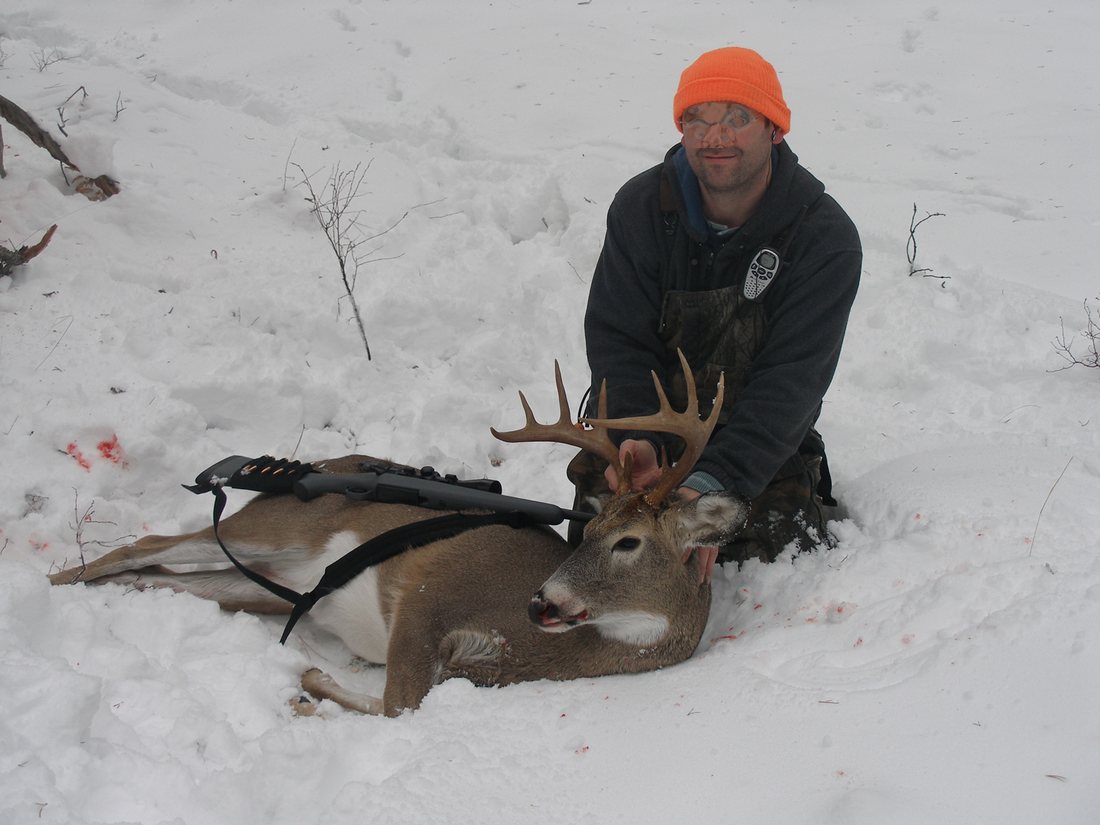
A white-tailed buck in the snow of the Hiawatha National Forest, in Michigan’s Upper Peninsula.
For a hunter, offal is the first meal of the season. The heart, liver and kidneys come out of the animal at field dressing, before the carcass is hung, and they are the freshest meat the hunter will ever have. Cooking them that night is a common practice among deer hunters, though no agency or historical source describing it as a custom was found.
Game offal also comes with questions that farm offal does not: disease in wild herds, parasites the animal carried, and lead from the shot that killed it. In Michigan, the Department of Natural Resources answers most of them directly, and its answers are quoted here.
Gloves first
Before any of the rest: wear gloves when field dressing. The CDC advises latex or rubber gloves for dressing deer, and gloves for handling “animals, especially rabbits, muskrats, prairie dogs, and other rodents.” Tularemia, below, is caught through the skin as well as by eating.
A field note: rabbit, deer and beef
The game offal behind this collection is rabbit heart, liver and kidneys, and deer heart. The hearts go the same way as a beef heart — pressure-cooked, slow-cooked, or sliced and braised with bacon (see heart and tongue).
Deer
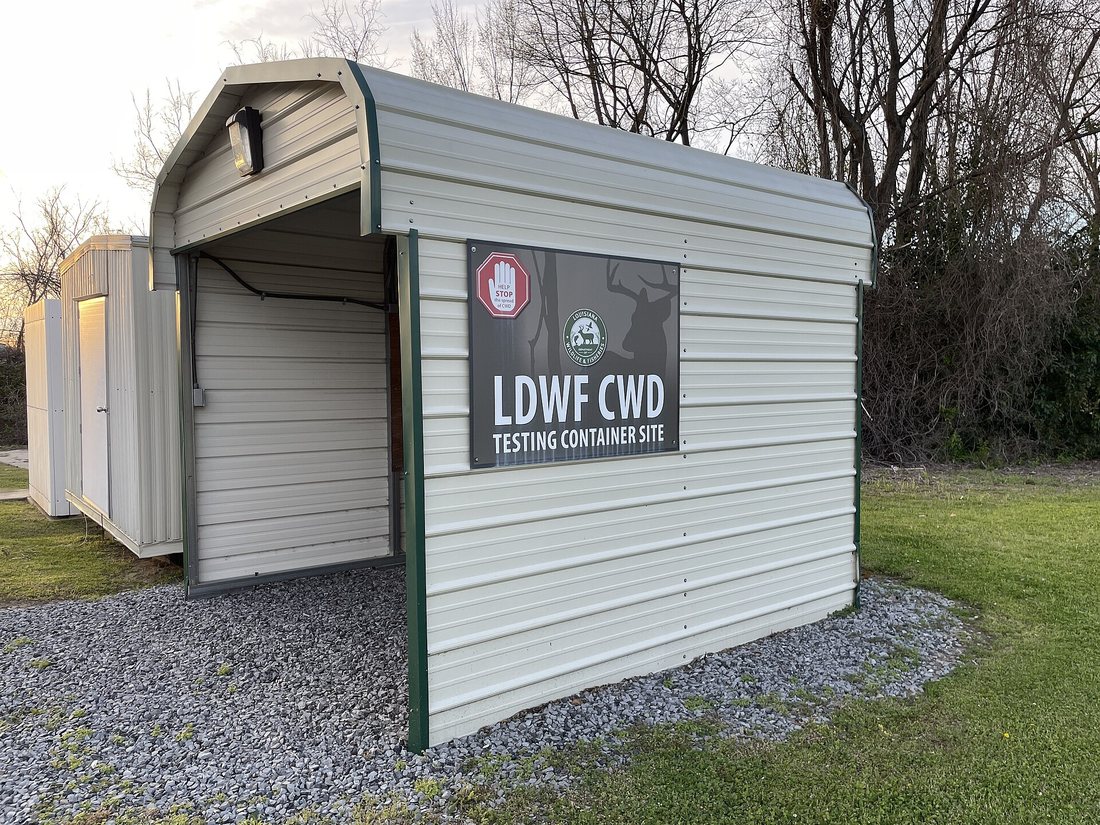
A chronic wasting disease drop-off site — this one in Louisiana. Michigan runs its own drop boxes and staffed sites, and the test is free.
Chronic wasting disease
CWD is a contagious prion disease of deer and elk that makes the brain deteriorate “in a distinctive spongy manner.” It spreads “through saliva, urine, feces, and nervous tissue.” Michigan’s first wild positive was in May 2015, in Ingham County. By the DNR’s count, 378 free-ranging white-tailed deer have tested positive across eighteen counties, most of them in the central and west-central Lower Peninsula; Montcalm County alone accounts for 196.
On human risk, the agencies say the same thing:
- Michigan DNR: “There is no evidence the disease can be transmitted to humans.”
- CDC: CWD “hasn’t been shown to infect people,” but “if CWD could spread to people, it would most likely be by eating meat from an infected animal.”
The CDC’s advice to hunters:
- wear gloves;
- “Minimize how much you handle the organs of the animal, particularly the brain or spinal cord tissues”;
- “Strongly consider having the deer or elk tested for CWD before you eat the meat”;
- “If your animal tests positive for CWD, do not eat meat from that animal.”
What this means for the heart and liver. No agency declares deer heart or liver CWD-safe. A 2006 study (Jewell et al., Journal of General Virology) found the disease prion in the heart muscle of 7 of 16 infected white-tailed deer and 12 of 17 infected elk — at lower levels than in the brain, and none in the tongue, diaphragm or leg muscle studied. Liver was not studied there. So the answer is testing, not picking the “safe” organ. In Michigan, testing is free: through DNR drop boxes and staffed sites in the focus counties (in 2026, Ionia, Kent, Mecosta, Montcalm and Newaygo), and elsewhere by a free lymph-node kit mailed to the MSU Veterinary Diagnostic Laboratory. In the bovine-TB counties of the northeast Lower Peninsula, hunters should submit the head rather than cut out lymph nodes themselves.
The list of “high-risk tissues” often quoted online — brain, spinal cord, eyes, spleen, tonsils, lymph nodes — could not be found on any current CDC or Michigan DNR page and is not presented as agency guidance here.
The liver: black lines mean no
Michigan deer livers are often infected with the giant liver fluke, Fascioloides magna — “White-tailed deer are the normal definitive (final) host.” The fluke “leaves black lines (fluke tracts) in the liver as it migrates to the bile ducts,” and can sit in hard-walled cavities “full of dark brown liquid with one to several flukes.”
The DNR’s verdict: “The flukes and the migration tracts in the liver tissue render it inedible.” A liver with black tracks or fluid-filled pockets is discarded. A clean one is a fine dinner: Deer Liver and Onions. (Whether this fluke can infect people is not stated by the DNR, and is not claimed either way here.)
A different finding is not a reason to discard the liver. Small clear cysts of a canine tapeworm (Taenia hydatigena) can be trimmed out: “the remainder of the liver is edible.”
Lungs and chest
Livestock lungs cannot be sold as food in the US (see safety and the law), and for deer the DNR describes two more reasons to leave the lungs alone:
- hydatid cysts (“clusters of grapes”) of Echinococcus granulosus in deer from the Upper Peninsula and northern Lower Peninsula;
- bovine tuberculosis in the northeast Lower Peninsula — “tan pea-size nodules (tubercles) that occur in lungs and on the lining of the thoracic cavity.” A deer showing these should be submitted to the DNR.
Rabbits: spots on the liver

An eastern cottontail. White spots on a rabbit’s liver mean tularemia: the rabbit is not eaten, and the DNR wants it.
Tularemia (Francisella tularensis) has been diagnosed in Michigan rabbits and snowshoe hares. The DNR’s description of the sign to look for is exact: “Small white necrotic foci (pimple-like in appearance) are observed on and in the liver and the spleen.” Infected rabbits often act sick or sluggish, and “humans can contract the disease via contamination with blood or by ingesting insufficiently-cooked infected carcasses.” A rabbit with white spots on its liver is not eaten, and the DNR asks that it be submitted to its lab.
The same DNR page lists findings that look alarming and are harmless: Taenia pisiformis cysts on the liver surface (“Humans can’t be infected … the meat is edible”), Shope fibromas, and Multiceps serialis cysts. The one exception is Sarcocystis cuniculi — white strands in the leg muscle — for which the DNR recommends that “the carcass be disposed of and not consumed.”
Cook all rabbit thoroughly: the CDC’s advice is to “cook game meat thoroughly before eating.”
Squirrel and bear
- Squirrel. The DNR describes pox and fibromas, mange, and tapeworm cysts in the organs of squirrels as not infectious to people, with the carcass edible.
- Bear. From 2008 to 2012, bear meat caused 41 of the 45 non-pork trichinellosis cases reported in the United States. Bear — and wild boar — must be cooked to 160 °F, and freezing is not a reliable fix, because the Trichinella species in wild game resist freezing. Whether bear organs carry the same risk as bear muscle was not established for this page; the larvae encyst in striated muscle, which includes the heart and tongue.
Temperatures
The USDA’s figure for organ meats is 160 °F, and the CDC’s figure for wild game is 160 °F. A pink deer heart is a choice against both, and a CWD test result is the precondition for making it.
In this dive: What offal is · The history · Safety and the law · Liver · Heart and tongue · Kidneys, sweetbreads and brains · Tripe and intestines · Blood · Heads, feet and tails · Gizzards · Game offal · Fish offal · Every part on the list · Corrections
Comments (0)