At the Hearth
What was actually on it. This is the closest I can get to a meal in one of those houses, and I want to be exact about which parts I know and which parts I am still guessing at forty years later.
There are three things on this page I cannot identify, and they stay unidentified.
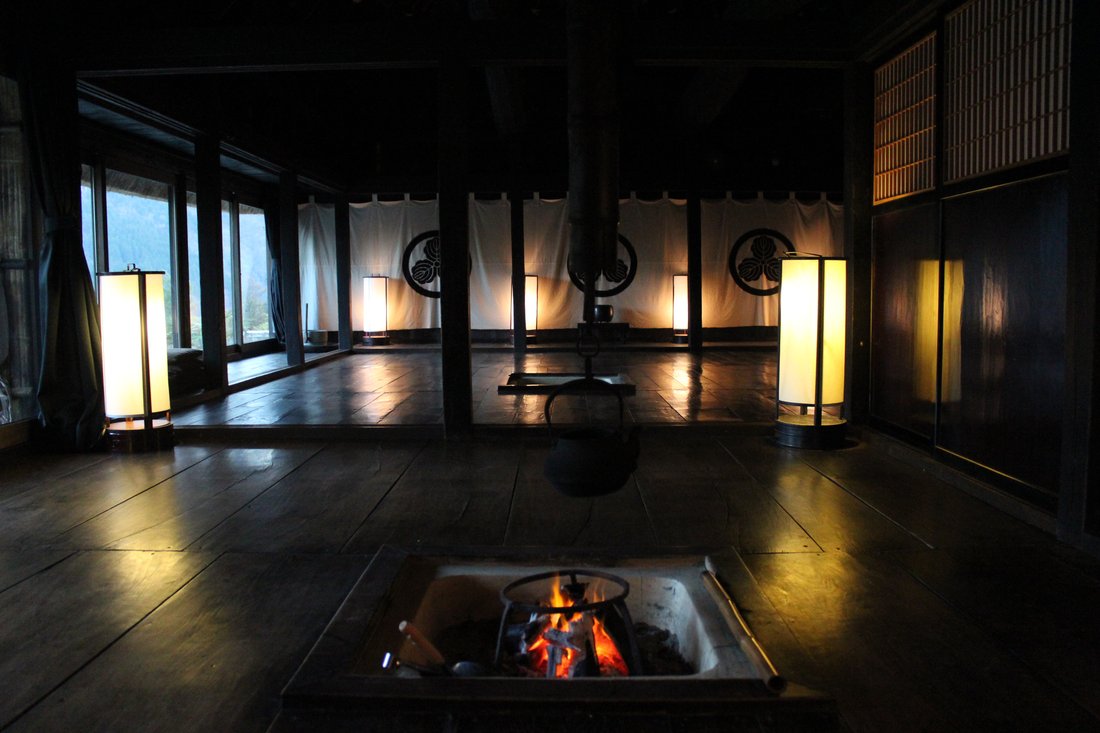
Fish, hanging above
Usually there were fish. And this matters more than I realised: they were hanging above the fire, in the smoke — not skewered in the ash.
Every photograph you see of an irori shows fish on sticks planted in the ash ring, leaning in toward the coals. That is real, and it is the grilling use. It is not what I saw.
What I saw was fish up on the rack — the hidana — in the smoke. And that is the older and more important function: preserving. The household was not cooking those fish for that evening. It was drying and smoking them, slowly, using smoke it had no way of getting rid of anyway.
So the fish above my head were not dinner. They were next month.
A stew, over rice
There was usually a stew on, and it was eaten over rice.
Here is what I remember about it, with my uncertainty intact:
- Fish in it, certainly.
- Maybe squid or octopus. I am not sure.
- No miso — I don’t believe anyway.
- Not too spicy, but a bit.
- Very fragrant. That is the thing I remember most clearly about it.
What that adds up to is a seafood nabe built on dashi and soy rather than on miso. And that is as far as I am prepared to take it. I am not going to name a dish. Coastal southern Japan has dozens of them, they vary by town and by household, and I was a guest at somebody’s table, not a cook in their kitchen.
If you want a guess at where the fragrance came from — in a non-miso coastal nabe it typically comes from ginger, sake, and the dashi itself, and sometimes citrus. I offer that as an explanation of what I was smelling, not as a recipe I am claiming to have eaten.
The rice, and the thing I got right by accident
There was rice balled up with seaweed over it, to hold it by.
That is onigiri, and I did not know the word for it. But look at how I described it — seaweed over it, to hold it by — because that turns out to be exactly what the nori is for.
⭐ Almost every English description of onigiri treats the seaweed as a flavouring or a garnish, and much of the time as a decorative wrapper. Its actual job is to be a handle. Rice is hot and sticky and falls apart; nori is dry, strong and doesn’t stick to your fingers. You hold the rice by the seaweed, and the seaweed also keeps the ball from drying out and from gluing itself to whatever it is carried in.
I had no idea what it was called. I described its function correctly the first time, because when you are handed something and told nothing, function is all you have got. I have come to think that is not the worst way to learn about food.
Pickled vegetables, every time
Tsukemono, at every meal, in small dishes, in colours and textures I had no framework for.
This is where this section and the Pickled one run into each other, so I will keep it short here: Japan does not sort pickles by acid the way English does. It sorts them by what they are buried in — salt, soy, vinegar, rice bran, miso, rice malt, sake lees — and only one of those seven is vinegar.
Which is why, when I said there were so many vegetables that at the time I had no idea what they were, that was not ignorance. The categories genuinely do not line up. The full version is over here.
Umeboshi — always
Always pickled plums. I believe umeboshi.
I hedged there, and I was right to, and it turns out I was also correct — and the hedge earned a correction I would never have gone looking for otherwise.
🔴 Umeboshi is not a plum. The fruit is Prunus mume, and it is classified in the Armeniaca section of the genus Prunus — the apricot group. “Pickled plum” is a translation habit that stuck; Japanese apricot is the accurate name.
And it is not a vinegar pickle either. It is a salt cure — the fruit packed in salt at around 20%, coloured and preserved with red shiso, then sun-dried for a few days in the doyo period after the rainy season. It comes out around pH 2.5–3.2 and extremely salty.
⭐ The detail that makes the naming completely backwards: “plum vinegar” — umezu — is a product of umeboshi, not an ingredient in it. It is the brine the fruit drew out of itself. Nobody poured anything on.
It was on the table every single time. I have never stopped eating it.
Tofu — and here is the one I cannot solve
Lots of tofu. Some spicy, some not.
And the spicy ones had some type of pepper or chili in it. Not sure what.
I have wanted to know what that was for forty years and I still cannot tell you. What I can do is say what fits.
⚠ This is a hypothesis and nothing more. My best candidate is yuzu kosho — a paste of yuzu peel, chili and salt. It fits three things at once: it is intensely fragrant as well as hot, which matches the register I keep describing; it is mildly spicy rather than aggressive; and it is a Kyushu and southern-Japan speciality, which is exactly where I was.
Other real possibilities: shichimi togarashi (the seven-spice blend), ichimi togarashi (straight ground chili), or rayu (chili oil).
I do not know. Yuzu kosho fits everything I remember, but I never saw the jar and I never asked, and a confident answer here would be a worse page than an honest gap.
What the meal actually was
Put together: fish smoking on the rack overhead. A fragrant seafood stew on the hook below it. Rice. Onigiri held by its nori handle. Pickled vegetables in small dishes. Umeboshi, every time. And tofu, some of it carrying a chili I have never been able to name.
In a room with an open fire and no chimney, in a house where people had very little, somewhere down the southern coast, in 1985 or 1986.
Nothing on that list is invented, and the three things I do not know are still marked as things I do not know.
Comments (0)