Okonomiyaki
This is where I first tasted it, and first learned anything about it: the alley shops of the Iwakuni ginza, behind the rice-paper doors, in 1985.
It is also the page where I have to be most careful, because the obvious thing to write — “I learned Hiroshima-style okonomiyaki” — is not true, and the reason it isn’t is more interesting than the claim would have been.
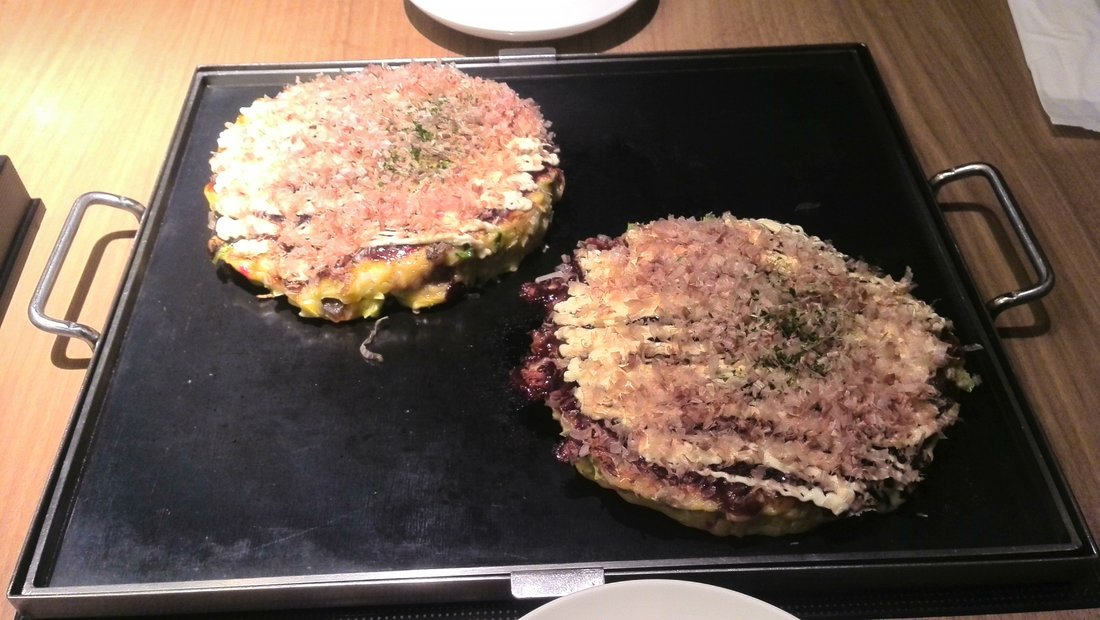
The observation I made at the time
Here is what struck me then, and it has stayed with me:
They go out for okonomiyaki and a beer, or unfiltered sake, on a Friday night. We go out for pizza and a beer. So alike.
I thought that was a nice coincidence. It turns out to be more than that.
⭐ The payoff is in the word
Okonomiyaki is two pieces:
- okonomi — “as you like it”, “to your preference”
- yaki — “grilled”
The name literally means grilled how you like it.
So the thing I noticed from the outside — that it is casual, customisable, communal, shared, and what you eat with friends and a drink at the end of a working week — is not a coincidence of culture at all. It is the definition of the food, stated in its own name. The pizza analogy is built into the noun.
I made that comparison because it felt right. The comparison holds because both foods are answering the same question: what do you eat with other people when nobody wants to decide anything?
The unfiltered sake
The cloudy sake I was drinking with it is nigorizake (濁り酒) — literally “cloudy sake”, unfiltered or only roughly filtered, so the rice solids stay suspended. Sweeter, thicker and softer than clear sake. There is also doburoku, which is the unrefined farmhouse version.
That was the Friday drink, and it went with the food the way beer goes with pizza — which is to say it cut through it.
🔴 What style was it? Not the one you would assume
I asked myself this and the honest answer took some work.
What I remember: some had noodles, but most had bean sprouts.
Here is what that means, and it does not resolve the way the textbooks want it to.
The bean sprouts point to Hiroshima. Moyashi are a standard layered ingredient in Hiroshima-style okonomiyaki — laid onto the cabbage along with tenkasu and scallion. The Osaka and wider Kansai style does not feature them. So the sprouts genuinely do place what I ate in the Hiroshima lineage rather than the Kansai one.
But the noodles don’t fit. In by-the-book Hiroshima-yaki, noodles are close to standard — the canonical order is niku-tama soba: pork, egg, soba. If most of what I ate had sprouts and no noodles, then I was not eating textbook Hiroshima-yaki either.
So what was I eating?
I was eating Iwakuni. Not a category.
Two things make that the right answer rather than a dodge:
One — geography. Iwakuni is in Yamaguchi prefecture, not Hiroshima. It is about 40 km down the coast. It sits between the traditions, and would naturally pick up the Hiroshima layered-and-sprouted approach without adopting its noodle default. That is exactly what somebody 40 km away would do.
Two — and this is the part that matters most — the date. This was 1985 and 1986. The rigid “Hiroshima-style versus Osaka-style” taxonomy that dominates every English article about okonomiyaki is substantially a later product of food tourism and regional branding. Forty years ago, in small alley shops in a mid-sized Yamaguchi city, it was far less codified than the internet now suggests it always was.
I ate what an Iwakuni cook made in 1985. That is not required to match a category that got tidied up afterwards, and I would rather say so than file myself under a style I never ordered.
What I actually learned was local practice — one town’s way of doing it, from the people doing it, before anybody had written the rules down for tourists.
What it is, mechanically
For anyone who has not had it: a batter of flour, dashi, egg and grated nagaimo (mountain yam, which is what makes it light rather than dense), mixed through a large quantity of shredded cabbage, cooked on a flat griddle — a teppan — usually with pork belly laid over the top and flipped once.
Then the finish, which is most of the personality: okonomiyaki sauce (thick, sweet-savoury, in the Worcestershire family), Japanese mayonnaise, aonori seaweed powder, and katsuobushi — bonito flakes so thin they move in the heat coming off the pancake. That movement is half the theatre of the dish.
The Hiroshima approach differs structurally rather than in ingredients: instead of mixing everything into the batter, it is layered — a thin crêpe of batter, then a mound of cabbage and sprouts, then pork, then (usually) noodles, then egg, assembled and compressed on the griddle. It is built, not stirred.
What I would say about it now
That it is the most sociable food I have ever eaten, that the name says so, and that the version I learned belongs to a specific town at a specific time rather than to a style guide.
And that I have never had one as good since, which is at least partly the same problem as the irori — although in this case I suspect it really is just that I was twenty-something and in Japan on a Friday night.
Comments (0)