Sampuru: How I Ate for Two Years Without the Language
I did not speak Japanese. I ate extremely well for two years anyway, and a large part of the reason was that they most always had plastic replica food in the window — and I could point at it.
I assumed at the time it was a convenience. It is actually a craft industry with an inventor, a founding accident, and a company that still dominates the market.
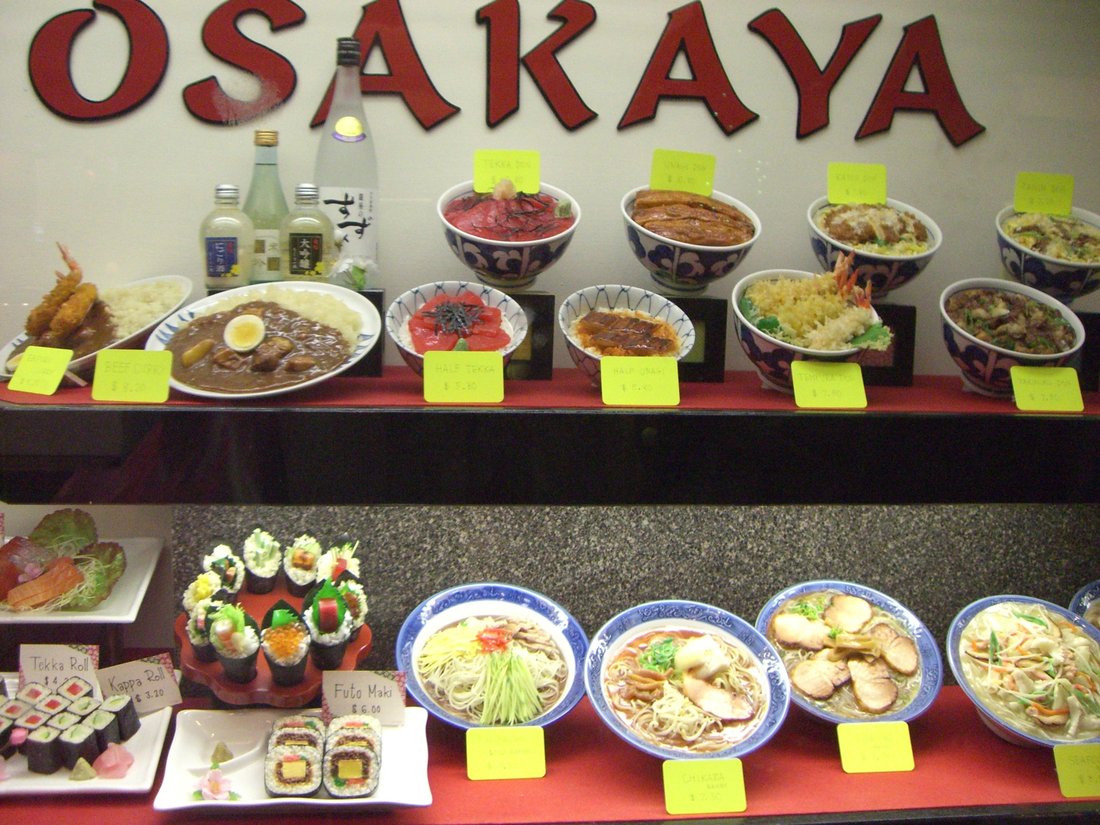
What they are
Sampuru (サンプル) — from the English word sample. Full name shokuhin sampuru, “food sample.” The replicas of menu items in the window of nearly every restaurant in Japan.
They are not mass-moulded tat. They are hand-made, individually, to match a specific dish at a specific restaurant, and good ones are startlingly convincing — right down to the sauce mid-pour and the steam.
Where they came from
The modern industry begins with one man: Takizo Iwasaki (1895–1965), generally called the father of sampuru.
⭐ The origin story is a candle. He is said to have been struck by the shapes formed by drops of candle wax falling on the tatami mat of his apartment — the way molten wax set into forms that looked organic and specific. After a long run of failures, his first genuine success came in 1932: a replica of an omelette, based on his wife’s cooking.
It drew crowds at an Osaka department store restaurant, and that was that.
He built the business from a workshop in Gujō Hachiman, a mountain town in Gifu prefecture, and the company he founded — Iwasaki Mokei — still holds around 70% of the Japanese market.
Why they exist at all
This is the part I find genuinely interesting, because it is not the reason you would guess.
Sampuru are not primarily a solution for foreigners. They came out of Japan’s own rapid modernisation after the Meiji Restoration: Western-style restaurants were appearing, serving dishes that ordinary Japanese diners had never seen and could not picture from a name on a menu.
So the display case was invented to explain unfamiliar Western food to Japanese customers.
Which means that when I stood in an alley in Iwakuni in 1985 pointing at a bowl I could not name, I was using a system built fifty years earlier to solve the reverse problem. It worked in both directions, and nobody had to design it twice.
A detail that dates my memory correctly
The originals were wax. Durable plastic only took over in the late 1970s.
I was there in 1985 and 1986 — so what I was pointing at really was plastic, not wax, and my description is accurate for the period rather than the older thing people picture. A decade earlier and I would have been pointing at wax.
That is a small thing, but it is the sort of small thing that tells you a memory is a real one rather than a reconstruction.
What it actually did for me
It removed the entire risk of ordering.
Not the language barrier — the risk. In a country whose menus I could not read, in shops whose signage I could not read, the display case meant that walking into a place I knew nothing about was never a gamble. I could see the food. I could point. I could stop at many stalls just to see what they had, which is exactly how I spent two years, and how most of the food on the at-the-hearth page and the ginza page got in front of me.
⭐ And there is a nice irony in it that I only see now: the sampuru let me eat confidently without ever learning what anything was called. I could recognise every dish by sight and name almost none of them — which is precisely the state I describe throughout this section, and precisely why so much of this writing has been me going back forty years later to look things up.
The display case solved ordering. It did not solve knowing. I have been catching up ever since.
Comments (0)