Iwakuni
The town I was actually stationed in, which I mostly used as a starting point for driving somewhere else — and which, it turns out, had rather more going on than I appreciated at the time.
Marine Corps Air Station Iwakuni, Yamaguchi prefecture, 1985 and 1986.
Where it is, and why that mattered
Iwakuni is in Yamaguchi prefecture — not Hiroshima. About 40 km down the coast.
That sounds like trivia and it is not: it is the reason the okonomiyaki question does not resolve cleanly into a named style. Iwakuni sits between the Hiroshima and Kansai traditions, close enough to Hiroshima to take its layered-and-sprouted approach, far enough to keep its own habits. A town 40 km away is its own place, and the food said so.
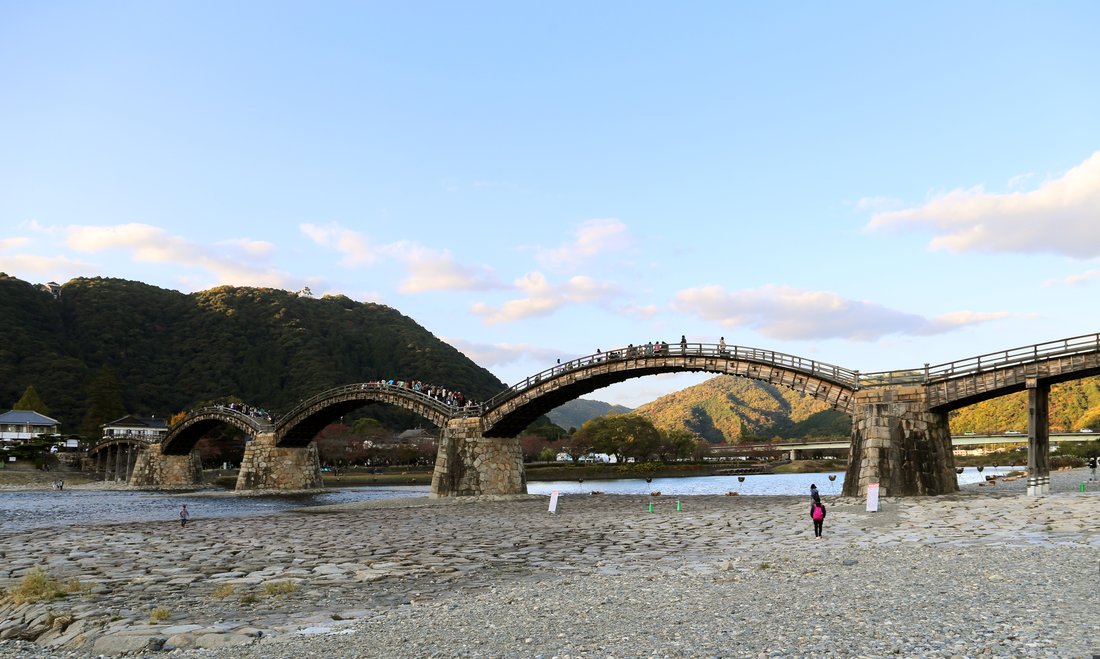
The Kintai Bridge
The thing everybody knows about Iwakuni, and rightly.
Kintai-kyō is a wooden arch bridge over the Nishiki River — five arches, 193.3 metres, built in 1673, using wood joinery rather than nails.
The history is worth the paragraph:
- A castle town was founded here in 1603 by the Kikkawa family, the local daimyō.
- The bridge went up in 1673 and was declared a National Treasure in 1922.
- In 1950 the Kijiya Typhoon destroyed it. The citizens petitioned to rebuild it to the original design rather than replace it with something modern, and it was reconstructed three years later.
- It has stood since 1953 — which means the bridge I walked over was, strictly, thirty-odd years old and six hundred years old at the same time.
It is about ten minutes from the air station gate, along with Iwakuni Castle, Kikkō Park and the Shirohebi Shrine — the white snake shrine, which is exactly what it sounds like.
⭐ The lotus root, and the detail I love most
Iwakuni is one of Japan’s leading producers of renkon — lotus root — and Iwakuni renkon is a named local speciality, prized for a dense, sticky, moist texture that pulls into fine threads when you cut it.
But here is the thing.
Lotus root, nearly everywhere, has seven holes. Iwakuni’s has nine or eleven.
And the reason that is celebrated rather than merely noted: the nine holes resemble the crest of the Kikkawa family — the lords who founded the castle town — which is said to have delighted the local ruler.
So the town’s most famous vegetable is famous partly for accidentally resembling its ruler’s coat of arms. I have been reading about food for a long time and that is one of the better reasons for a regional speciality I have come across.
Iwakuni-zushi
And the two threads tie together, because Iwakuni has its own sushi and the lotus root is in it.
Iwakuni-zushi — also called tonosama-zushi, “the lord’s sushi” — is a pressed sushi, said to have been devised at Iwakuni Castle as a provision for battle, which explains the construction entirely.
It is not made piece by piece. It is built in layers inside a large wooden mould: vinegared rice alternating with toppings — thin egg strips, simmered shiitake, pickled lotus root, chisha leaf, sakura denbu — then the whole block is pressed under weight and cut into squares.
Two details I like:
- Someone stands on the frame to press it. That is the actual method.
- Five layers is the maximum. Beyond that the block will not hold its shape when you slice it. A structural limit, discovered by people making it.
⭐ And note what is in the layers: pickled lotus root. Iwakuni’s nine-holed renkon, pickled, in Iwakuni’s own sushi. The town’s vegetable, the town’s preserving method and the town’s dish, in one square. That is the kind of tight local logic that made the food in Japan feel different from anywhere I had eaten before.
What I actually did with the town
Honestly? I left it most weekends. I bought a car specifically so that I could drive south and stop at the docks, and that is where the food I remember best came from.
But the ginza was five minutes away and I was in it constantly — and that is where okonomiyaki came from, and most of the pickles, and the fish, and the soba.
I did not know about the lotus root’s nine holes or the lord’s sushi until I sat down to write this. That is a fair summary of my two years there: I ate the place thoroughly and understood it afterwards.
Comments (0)