The Irori
This is the centrepiece of the whole section, and it is the thing I have been telling people about for forty years.
An irori (囲炉裏) is a sunken hearth in the floor of a Japanese farmhouse — a square, stone-lined pit, an ash bed, an open wood or charcoal fire, and a pot hanging over it. In the houses I stayed in down the southern coast, that was the kitchen, the heater, the light, and the middle of the room where everybody sat.
I ate some of the best food of my life at one, in houses where people had very little.
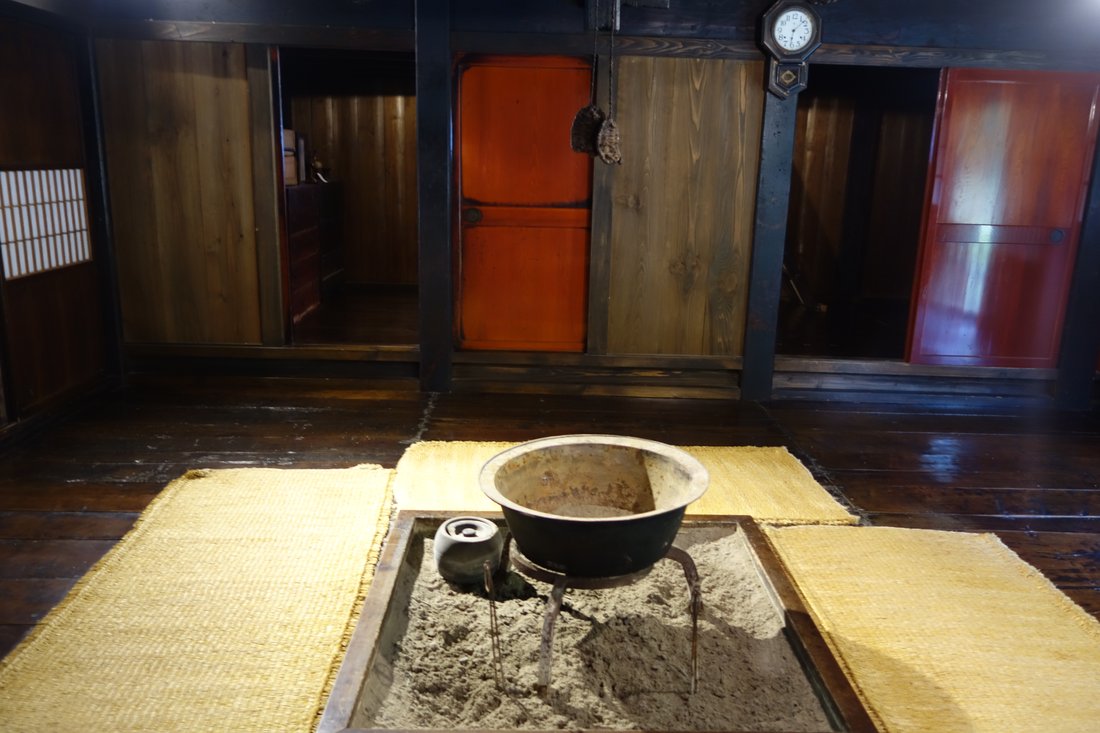
“I doubt I could ever replicate the taste”
I have said that for four decades and assumed it was sentiment. It is not. When I finally went and read about how these things actually work, it turned out there is a real, specific mechanism, and it is not one you can buy your way around.
An irori is not a technique. It is an environment.
Here is what is actually happening:
- The fire is open, in a sunken ash bed, burning wood or charcoal, in the middle of the room.
- The pot hangs above it on an adjustable hook for hours, not minutes.
- And critically: the room has no chimney.
That last one is the whole answer. The smoke does not leave through a flue. It rises into the room, spreads across the ceiling, filters up through the thatch and out over hours and days. So everything in that house is being smoked, continuously, all the time. The food. The beams. The walls. The pots. The people.
You cannot reproduce that on a range at any setting, with any pan, at any temperature. It is not a heat level you are missing. It is a room.
I find that a much more satisfying answer than “it was a long time ago and I was twenty,” which is what I would otherwise be saying. The food genuinely was different, and the reason it was different is that it was cooked inside a slow smoker the size of a house.
The jizai-kagi, which is cleverer than it looks
The pot hangs from a jizai-kagi (自在鉤) — the name means roughly “free hook”, and free is exactly what it is: fully adjustable, raise or lower the pot to any height above the fire, with no notches or fixed settings.
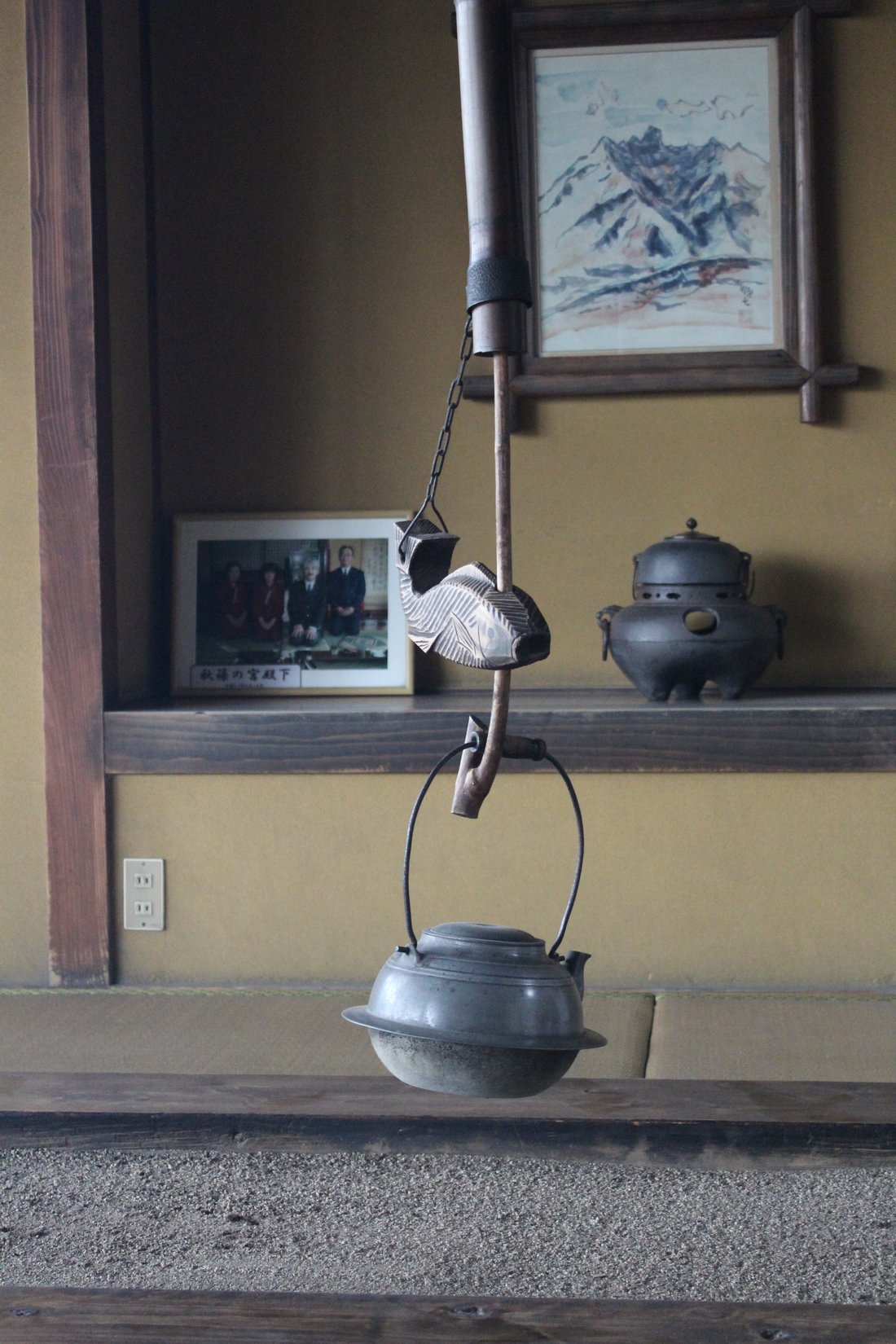
The mechanism is a length of rope run through a piece of bamboo, and it is worth describing because it is genuinely elegant: the principle is identical to a guy-rope tensioner on a tent. Friction and geometry hold the pot wherever you leave it, and a light pull releases it. No ratchet, no notches, nothing to wear out or seize in a smoky room.
⭐ And the lovely part. The little lever that grips the rope is called a kozaru — “little monkey” — because it climbs up and down. And it is very often carved as a fish, usually a carp.
The reason given for the fish is one of my favourite details in this entire section: hanging in the air above the hearth, on a rope, in a dim smoky room, a carved carp convincingly appears to be swimming through the room. Somebody worked that out, and then everybody kept doing it.
That is the difference between a tool and a piece of furniture somebody lived with.
The hidana — the rack that made a house into a smokehouse
Above the hearth there is very often a hidana (火棚): a lattice rack of timber or bamboo, hung from the crossbeams, sitting over the fire.
I remember it because that is where the fish were. More on that on the next page — I saw fish hanging in the smoke above the fire, not skewered in the ash the way the grilling photographs always show.
The hidana does three jobs at once, and this is the part I did not know at the time:
- It catches sparks before they reach the thatch, which in a wooden house with an open fire is not a minor consideration.
- It stops the heat going straight up through the roof and spreads it back into the room. It is a heat baffle as much as a rack.
- It dries and preserves food by hanging it in the smoke — fish, and also herbs, and also wet clothes and rain gear.
Which means the answer to “how does a house with no chimney handle its smoke” is: it doesn’t handle it. It uses it. The thing that would be a design flaw in any other building is the household’s food-preservation system. The hearth is a year-round smokehouse that happens to also cook dinner.
I did not understand any of that when I was sitting next to one. I just noticed there were fish up there.
What it was actually like
Low. Warm. Dark. Everybody around one square of fire, at floor level. The pot in the middle where anybody could reach it. Smoke you stopped noticing after a while and then carried in your clothes for a week.
The honest caveat
I stayed in these houses in 1985 and 1986, and even then an irori in daily use was not the ordinary way a Japanese household cooked. It was already a rural and an older thing, in places that had not changed over. Most of Japan had gas.
So I am not describing “how Japan cooks.” I am describing how the specific households that took me in cooked, in small coastal towns in the south, forty years ago — people who, as I said, had very little. That is a narrower claim and it is the true one.
Today most irori you can see are in preserved farmhouses, museums and a few inns. They are worth going to. But a preserved one has been cleaned, and the thing I am describing is what happens to food in a room where the fire has been going for decades.
Next: At the Hearth — what was actually cooking on it.
Comments (0)