What the Boil Actually Does
I went into this expecting the science section to be short — you boil a legume, it gets soft, salt gets in. Instead this turned out to be the page with the biggest surprise in the whole dive, and one genuinely serious warning.
The short version:
Boiling doesn’t just cook the peanut. It empties it into the water.
And since the Southern way to eat a boiled peanut is to crack the shell and drink the brine first, that matters more than it sounds.
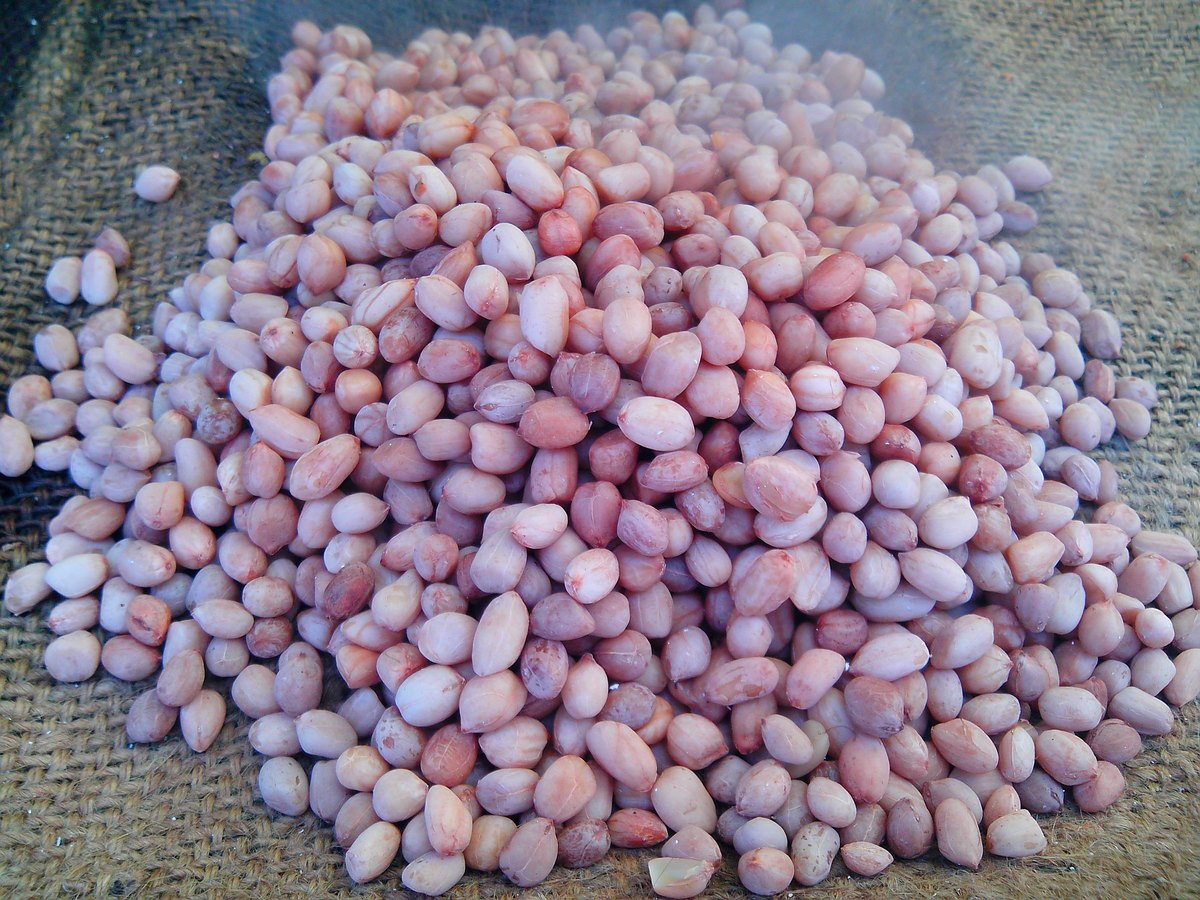
Why it goes creamy instead of crunchy
A peanut is a legume that we happen to eat like a nut. Almost every other use — roasting, peanut butter, salted in a bar — starts by driving moisture out. Boiling does the opposite.
Long wet heat rehydrates the kernel, gelatinizes its starch and breaks down the pectin holding the cell walls together. The result is the texture of a cooked bean, because that is essentially what you have made. This is why the first bag tastes wrong to nearly everybody: your mouth ordered a peanut and received a butter bean.
⚠ Being honest about the limits of that explanation — I could not find a food-science paper working out starch gelatinization specifically in Arachis hypogaea under boiling. The mechanism above is the general legume one, applied. It fits everything observable, but I’m not going to dress it up as a peanut-specific finding when it isn’t one.
The salt is the slow half
Salt has to cross three barriers: shell → skin → kernel. The shell is porous and quick, the red skin is slower, and the kernel itself is the bottleneck.
Which is why most of the seasoning happens after you turn off the heat. Diffusion doesn’t need the boil; it needs time. A peanut lifted out at the moment it goes creamy is a cooked peanut that has not been seasoned yet.
Every tradition that boils peanuts worked this out independently and says the same thing:
| The instruction | |
|---|---|
| Lady’s Island, SC, ~1991 | ”Turn off the heat and let them sit — they’ll pick up more of the salty flavor.” |
| A Chinese factory, today | 低温泡卤 — low-temperature steeping in the brine |
| Chinese home recipes | Let sit 30 minutes to overnight in the cooking liquid |
| My slow cooker | Twelve hours, and the last four are the good ones |
Three continents, one instruction, no contact.
⭐ The boil is an extraction — and the brine is part of the food
Here is the finding I did not expect.
Chukwumah Y, Walker L, Vogler B, Verghese M, “Changes in the phytochemical composition and profile of raw, boiled, and roasted peanuts,” Journal of Agricultural and Food Chemistry 2007;55(22):9266–73. They compared raw, boiled, oil-roasted and dry-roasted peanuts. What they found:
- Boiled peanuts had the highest total flavonoid and polyphenol content of any preparation.
- Biochanin A — twofold higher. Genistein — fourfold higher.
- ⭐ trans-resveratrol was detected ONLY in the boiled peanuts. Not reduced in the others — absent.
Boiling is doing something roasting cannot: it is a hot aqueous extraction, pulling compounds out of the shell and the red skin and moving them into the kernel and the liquid. The shell is not inert packaging during a six-hour boil. It is a tea bag.
⭐ Which reframes the brine entirely. Sucking the liquid out of the shell is not a folk flourish or a way of not wasting salt. The liquid is where a lot of the extracted material ends up. The stand on Lady’s Island was selling me the peanuts and the tea they were brewed in, in the same shell, and treating the second part as obvious.
🔴 A correction to a claim you will see everywhere
You will constantly read that “boiled peanuts have four times the antioxidants of raw or roasted peanuts.” It is on Wikipedia and it is repeated in a hundred articles.
That is a garbling of this paper. The fourfold figure is genistein specifically — one isoflavone. Biochanin A was twofold. Total polyphenols and flavonoids were “highest,” which the abstract does not quantify as a multiple at all.
The real finding is more interesting than the slogan, because trans-resveratrol showing up only in the boiled samples is a bigger deal than any multiplier. Say what the paper says.
🔴 Peanut allergy — read this part carefully
This is the one section here that isn’t just interesting, and I want to be extremely clear because the honest finding is easy to misread into something dangerous.
The research is real. Boiling causes peanut’s major allergenic proteins to leave the peanut and dissolve into the cooking water. Work in this area has identified polypeptides in the cooking water corresponding to Ara h 2, Ara h 3, Ara h 6 and Ara h 7, with the loss most extensive in peanuts boiled for four to six hours. A 2014 case report in the Journal of Allergy and Clinical Immunology (Turner et al., 134(3):751–3) described four patients and used boiled peanut to begin supervised desensitization; that line of work continues in clinical trials.
⭐ Note the timing. Four to six hours is not a laboratory abstraction — that is exactly the Southern boil. The traditional method sits precisely in the window where the effect is largest.
🔴 And now the part that matters
Boiled peanuts are NOT safe for people with peanut allergy. Do not treat anything above as permission.
Three reasons, all of them load-bearing:
- The proteins are not destroyed — they are relocated. They move out of the kernel and into the water. ⭐ Which means the brine is the allergen-rich part — and the brine is the thing Southerners deliberately drink straight out of the shell. The traditional way of eating them targets exactly the fraction the research says the protein went into.
- Reduced is not zero. The published work is explicit that boiling and frying decrease soluble Ara h 1 and Ara h 2 but do not generate hypoallergenic peanuts. Enough allergen remains to cause reactions.
- The clinical work is supervised, and that is the whole point. Desensitization protocols happen in hospitals with adrenaline in the room, using measured doses. A bag from a roadside kettle is not a dose, and a car is not a clinic.
If you have a peanut allergy, boiled peanuts are peanuts. Nothing on this page changes that, and nobody should test it at home.
Nutrition, briefly
From the back of one of my Chinese bags, per 100 g of the spicy brine-braised product: 352 kcal, fat 27.4 g, sodium 654 mg, carbohydrate 11.2 g, protein 15.7 g.
Two things stand out. The sodium is the headline — 654 mg per 100 g is a third of a day’s allowance, and a hot bag at a stand is more than 100 g. Boiled peanuts are a salt delivery system and there is no version of them that isn’t. And the fat and protein are intact; boiling doesn’t remove them, it just puts water back alongside, so a boiled peanut is less calorie-dense per bite than a roasted one purely because it is wetter.
⚠ Aflatoxin is a genuine concern with peanuts generally, and it is a storage and handling problem, not a cooking one. Boiling does not destroy aflatoxin. Buy from sources with turnover and discard anything musty, discolored or shriveled — advice that applies equally to raw peanuts you are going to roast.
Next: Keeping Them — the perishability problem that every one of these traditions had to solve.
Comments (0)