China: 卤汁花生
CHINESE boiled peanuts. What?!?!?
That was my genuine reaction, and it is the reason this section exists. I had spent thirty years thinking of boiled peanuts as an intensely local Southern thing — a Lowcountry thing, a roadside thing, something you had to explain to people from Michigan. Then I found them vacuum-packed in a Chinese grocery, and it turned out that the world’s largest producer and consumer of peanuts has been boiling them the whole time, in enormous quantity, with an entirely developed tradition behind it.
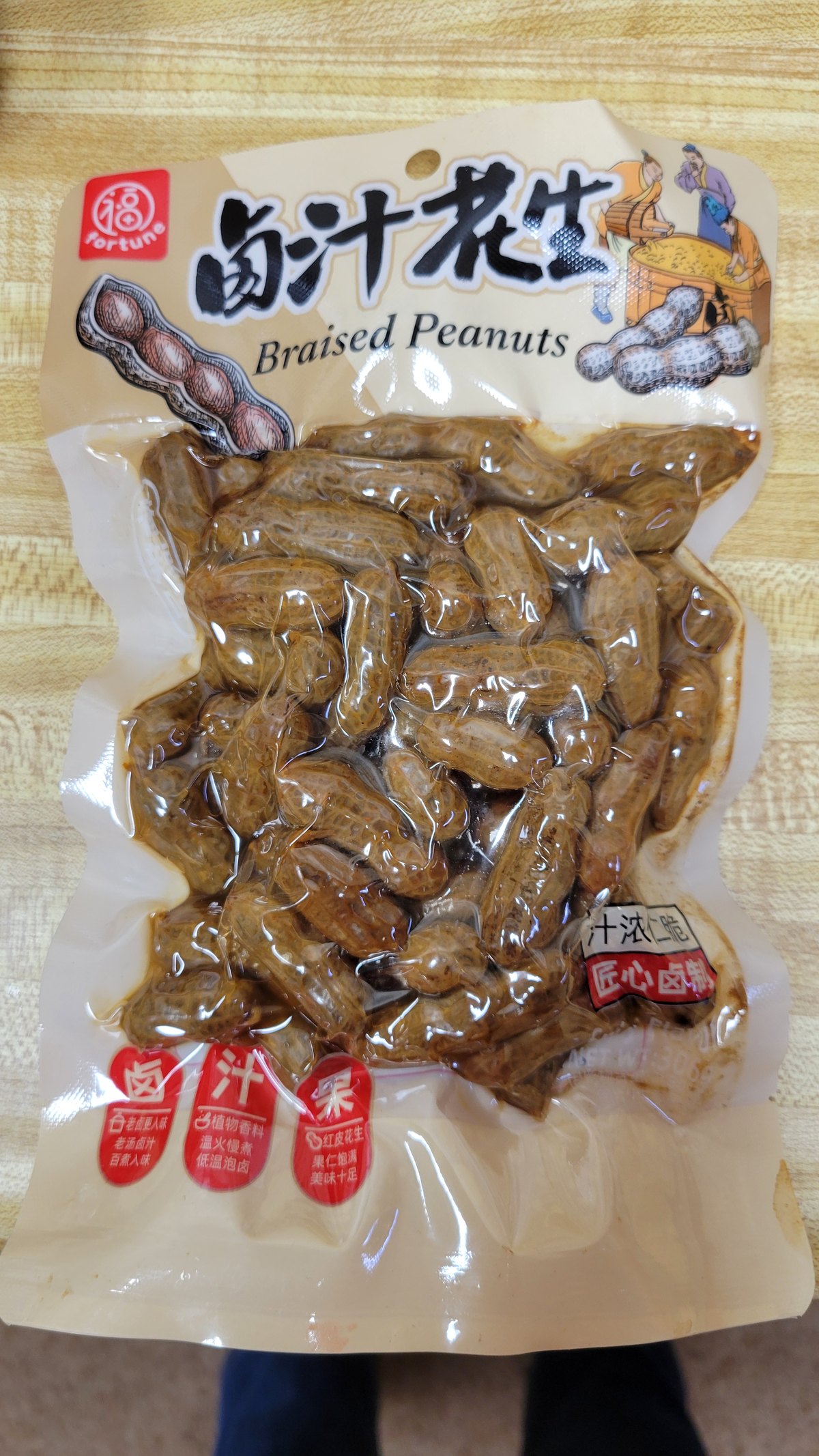
The two bags on my counter
They are the same product in two flavors, and reading them properly took some doing.
卤汁花生 — lǔzhī huāshēng. The English on the front says “Braised Peanuts”; the back is more precise: “Fortune Shell-On Braised Peanuts.” Brand 福牌 (fú pái, “Fortune brand”), Product of PRC, imported by Two Bros Food Inc.
| 卤汁花生(五香) | 卤汁花生(香辣味) | |
|---|---|---|
| Five-Spice | Spicy | |
| Colorway | Yellow | Red |
| Chili in the ingredients? | No | Yes |
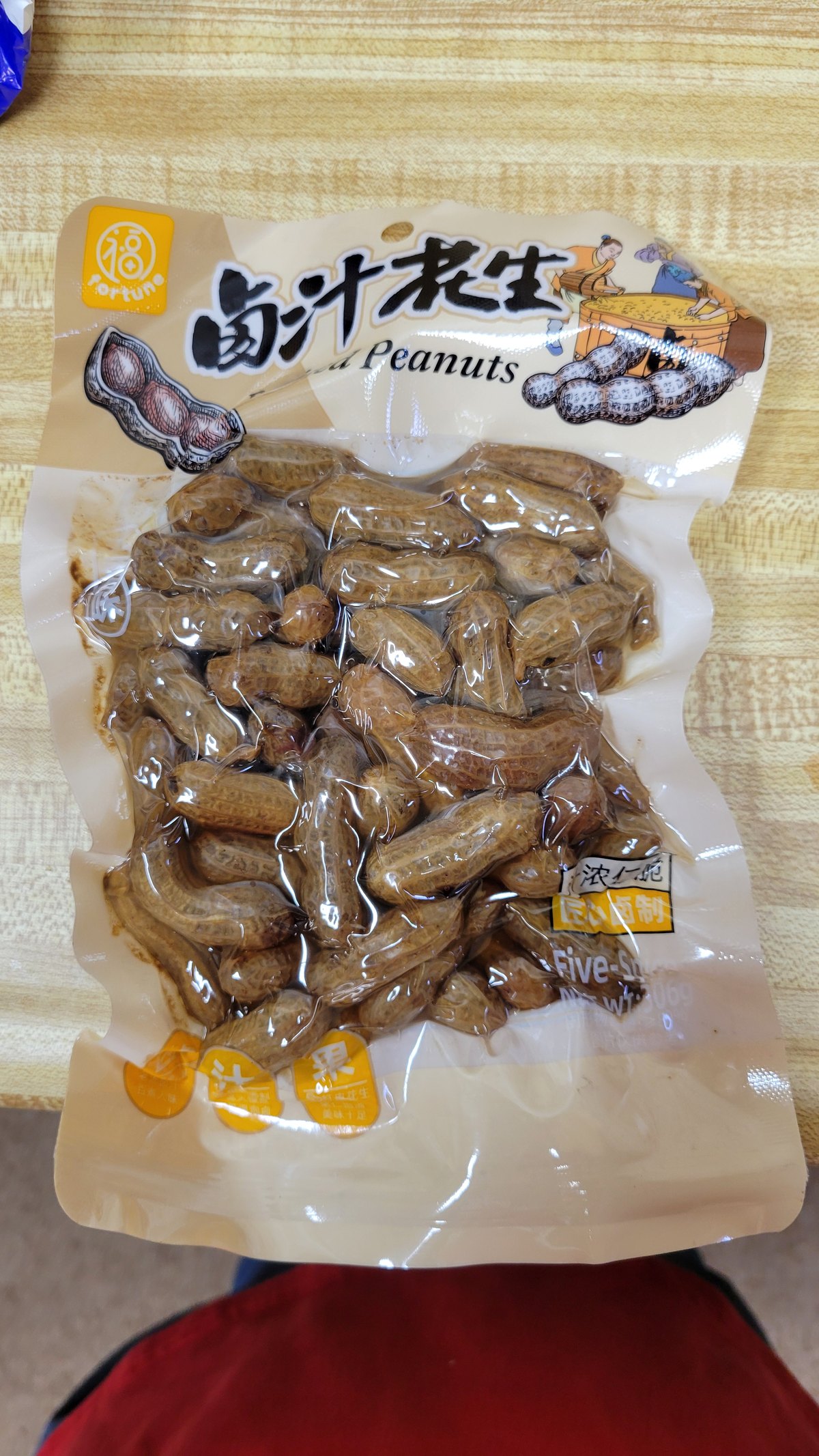
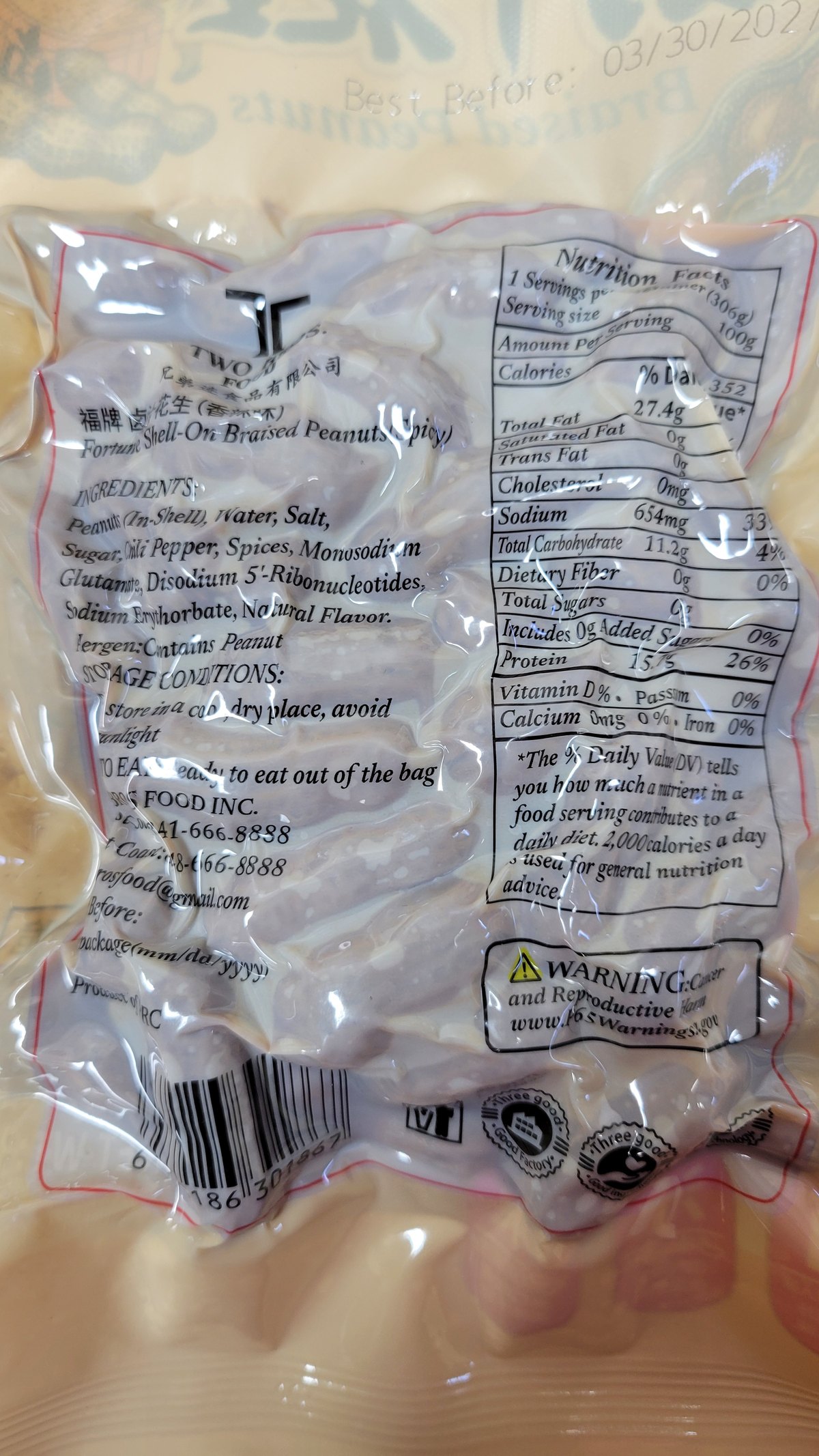
⚠ I got this wrong at first, reading only the front panels, and decided the color was a flavor variant rather than a heat marker. The back settled it: 香辣味 — xiānglà wèi, “fragrant-spicy” — with chili pepper listed in the ingredients. The characters are on the front too; they were just sitting under the glare on the plastic. Read the back before you rule on a package.
The 卤 character is the whole story
The name is not “boiled peanuts.” It is 卤汁 — lǔzhī, “brine-sauce” — and that word carries a complete Chinese cooking technology with it.
卤 (lǔ) is the master brine. A dark, aromatic, deeply savory liquid built on soy sauce, rock sugar and a spice load — star anise, cassia or cinnamon, Sichuan peppercorn, bay, clove, fennel — that a kitchen keeps and reuses, replenishing rather than replacing. Things get simmered in it: eggs, tofu, beef shin, chicken feet, duck wings, and peanuts. The technique is called 卤味 (lǔwèi) and the products are a whole category of cold appetizer and drinking snack.
⭐ So the Chinese boiled peanut is not a parallel invention of the Southern one. It is a peanut that got dropped into a braising tradition that was already several centuries old — exactly the way the peanut in Louisiana got dropped into an existing crawfish-boil tradition. Same mechanism, different host cuisine. That parallel is, to me, the single most satisfying thing in this entire dive.
Readers of the marinated eggs section will recognize the master stock immediately — it is the same liquid, and in a Chinese kitchen the same pot really might do the eggs and the peanuts on the same afternoon.
⭐ The badge that stopped me
The front of both bags carries three marketing badges. Translated:
| Badge | Text | Meaning |
|---|---|---|
| 卤 | 老汤卤汁 · 百煮入味 | Old-stock master brine — a hundred boilings to take the flavor in |
| 汁 | 植物香料 · 温火慢煮 · 低温泡卤 | Botanical spices · gentle-heat slow cooking · low-temperature steeping in the brine |
| 果 | 红皮花生 · 果仁饱满 · 美味十足 | Red-skin peanuts · plump kernels · full of flavor |
And a corner tag: 汁浓仁脆 / 匠心卤制 — rich sauce, crisp kernel / artisan brine-braised.
⭐⭐ 低温泡卤. Low-temperature steeping in the brine.
That is, word for word, what the man at the roadside stand on Lady’s Island told me in about 1991: turn off the heat and let them sit and they’ll pick up more of the salty flavor. A stand in the South Carolina Sea Islands and a factory in China arrived at the same instruction and both consider it important enough to lead with — he told me first, they print it on the front of the bag.
Nobody taught anybody. The salt just moves slowly, and if you pay attention you find that out.
⭐ 红皮花生 — red-skin peanuts — is the other one. The bag specifies a peanut type, by skin color, as a quality claim. The American South’s preferred boiling peanut, Valencia, is the small red-skinned multi-seeded type. Two traditions, same physical preference.
What’s actually in the bag
From the back of the spicy one, verbatim:
INGREDIENTS: Peanuts (In-Shell), Water, Salt, Sugar, Chili Pepper, Spices, Monosodium Glutamate, Disodium 5’-Ribonucleotides, Sodium Erythorbate, Natural Flavor.
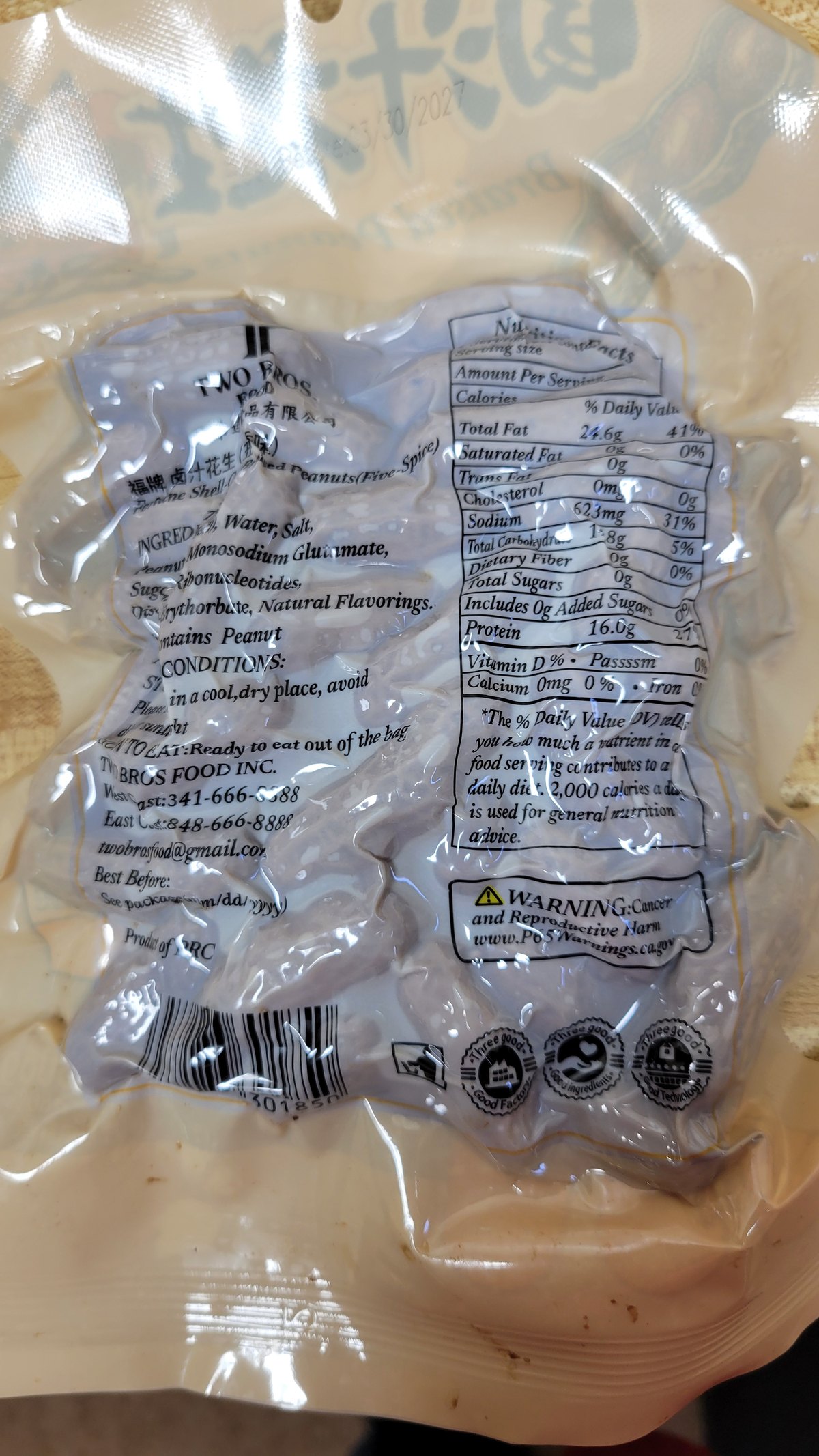
The five-spice bag is the same list without the chili pepper.
Three observations:
1. There is sugar in it. Not much, but it’s there, and no Southern boiled peanut has ever had sugar in it. That is the 卤 tradition showing — a master brine is built on soy, sugar and spice, and a trace of sweetness underneath the salt is characteristic of the whole category.
2. MSG and disodium 5’-ribonucleotides. That pairing is deliberate: glutamate plus the I+G nucleotides is a well-known synergy that multiplies perceived savoriness far beyond what either does alone. This is a product engineered for umami. The Lowcountry version gets its depth from six hours and a shell full of extracted brine; this one gets a good deal of it from the seasoning package. Neither is cheating. They are different routes to the same destination.
3. Sodium erythorbate is an antioxidant — it keeps the kernels from browning and going stale in a bag with a two-year shelf life.
⚠ Note also what is not there: for a product called five-spice, the ingredient list says only “Spices” and “Natural Flavor.” The named spice load lives in the marketing copy on the front, not in the declaration on the back. A homemade version will taste considerably more of star anise and cassia than the bag does.
Nutrition, per 100 g: 352 kcal · fat 27.4 g · sodium 654 mg · carbohydrate 11.2 g · protein 15.7 g. The bag is 306 g and cheerfully declares itself one serving, which is either honest or alarming depending on your afternoon.
⭐ And it doesn’t need a refrigerator
READY TO EAT: Ready to eat out of the bag. STORAGE CONDITIONS: Store in a cool, dry place, avoid sunlight.
A wet, cooked, low-acid peanut product, shelf-stable, sitting on a shelf in a grocery store.
That is a retort pouch — the sealed bag goes into a pressurized steam vessel and is held well above boiling long enough to reach commercial sterility. It is the same physics as the pressure canner I’m about to buy, done industrially in a laminate that bends.
So the answer to my canning question was sitting on my counter the whole time. The bar in Beaufort used a fridge. The Piggly Wiggly uses a can. A factory in China uses a pouch. Same food, same problem, three answers, and the Chinese one is the most technologically advanced version of a thing a Lowcountry farmer was doing in a washtub.
The Chinese versions worth knowing
Beyond the commercial bag, there are two distinct home traditions:
水煮花生 — plain boiled. Peanuts, water, salt, often star anise and a cinnamon stick and nothing else. Slightly salted, semi-soft, still with a bite. A classic of the Yangtze delta and the Huaiyang repertoire, and much closer to a South Carolina peanut than to the bag — the goal is firm-tender, not creamy, which is the one real difference in intent between the two continents.
五香花生 / 卤水花生 — the brine-braised. The full 卤 treatment: soy sauce, star anise, cassia, Sichuan peppercorn, bay leaf, clove, sometimes dried chili, simmered 40 minutes to 3 hours and then — always — left to steep off the heat.
Both are served as 凉菜 (liángcài), cold appetizers, at the start of a meal or alongside beer. ⭐ And this is the detail I like best: in China, boiled peanuts are the snack you eat at the movies, in the role popcorn plays in America.
⚠ One thing they are not: 麻辣花生, the fried numbing-spicy peanuts with dried chilies you get in Sichuan restaurants, is a different dish — fried, not boiled, and crunchy. Easy to conflate from the name.
How the peanut got to China in the first place
Portuguese traders brought it to Fujian in the 1500s, along the same route that took it to Africa. China took to it comprehensively and is now the world’s largest producer and consumer.
⭐ Which produces a genuinely strange piece of symmetry. The peanut left South America in European ships and went two ways: west to Africa, where it was boiled and then carried to South Carolina by enslaved people; and east to Fujian, where it was dropped into a master brine. Two branches of one dispersal, roughly contemporaneous, arriving independently at salted water and time.
They met again on a kitchen counter in Michigan, thirty-odd years after a bar in Beaufort, which seems like a reasonable place for this section to have started.
Recipes: Chinese Five-Spice Braised Peanuts · Chinese Spicy Brine-Braised Peanuts
Next: Around Asia — Japan’s roadside stands, Vietnam’s beer snack, India’s monsoon food.
Comments (0)