How to Actually Boil Them
The method fits in four lines. Everything else on this page is detail, and the detail is where the difference between adequate and very good actually lives.
Peanuts. Water to cover. Lots of salt. Boil until soft inside, then turn off the heat and let them sit.
That is what the man at the Lady’s Island stand told me in about five minutes, and thirty years of making them has not improved on it.
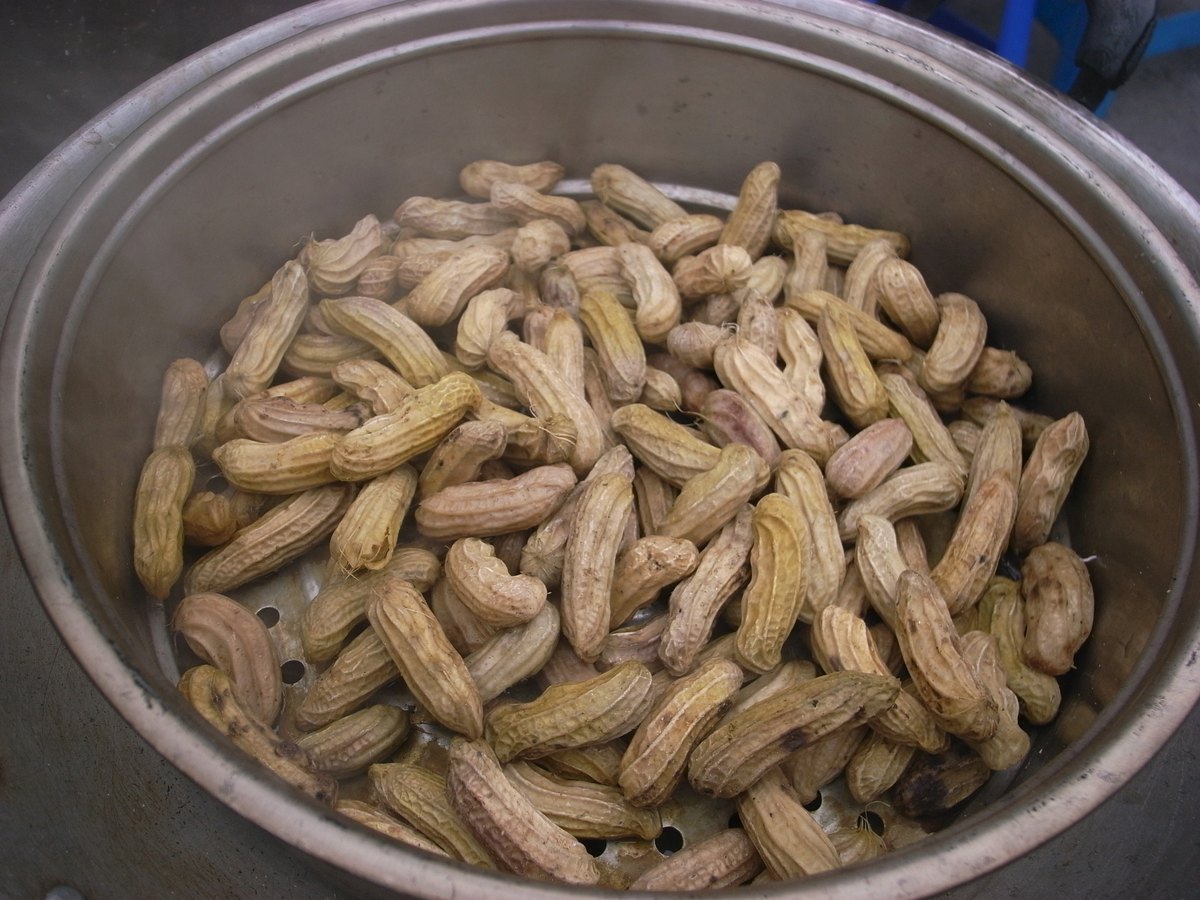
Salt: how much is “lots”
This is the one number people want and the one number everybody states differently, because there are two ways to measure it and they don’t agree.
By weight of water — the useful way. The reference points:
| Source | Salt concentration |
|---|---|
| NCHFP canning brine (US) | 1 cup salt per gallon ≈ 7–8% |
| Japan, Chiba (MAFF) | 3% of the water |
| My own practice | ½ cup kosher per gallon ≈ 3.5–4% |
| A stand aiming for salty | up to 10% |
My working figure is ½ cup of kosher salt per gallon of water, which lands around 3.5–4%. That makes a peanut that tastes seasoned rather than aggressive. If you like them the way the bar in Beaufort sold them — properly, unapologetically salty — go to ¾ cup a gallon and let them steep longer.
⚠ Kosher and table salt are not interchangeable by volume. A cup of Morton kosher weighs noticeably less than a cup of table salt, and Diamond Crystal less again. If you are using fine table salt, cut the volume by about a third or you will overshoot badly.
🔴 Do not salt to taste during the boil. The kernel is nowhere near equilibrium with the brine while it is cooking. Water tasted at hour two says almost nothing about what the peanut will taste like at hour six. Set your salt at the start, leave it alone, and judge after the steep.
Keeping them under the water
Peanuts float. All of them, the whole time, and the ones on top do not cook.
Use a plate, a heavy lid, or a steamer basket pressed down on top of the peanuts to hold them under. This is not fussiness — an unweighted pot gives you a batch where a third of the peanuts are done, a third are close, and a third are raw, and there is no fixing it afterwards.
Top up with boiling water as the level drops, not cold, or you stall the pot every time.
Four vessels
1. The turkey fryer — the real thing. A 20–30 gallon pot on a propane burner stand, outdoors. This is what was running at the stand on Lady’s Island and it is what every commercial operation uses. You can do a 50-pound bag this way. It is also the only method that scales to a party, which is the historically correct use: a peanut boil is a social event, not a cooking technique.
🔴 Outdoors only, and stay with it. A propane burner under a pot that size is a serious piece of fire. Level ground, nothing overhead, and never inside a garage.
2. The stockpot on the stove — 4 to 5 hours. Two pounds of raw peanuts, water to cover by three inches, half a cup of kosher salt, weighted down, hard boil. Start checking at four hours, every fifteen minutes. Green peanuts will be done in 2 to 4.
3. The slow cooker — my favorite for a normal week. ⭐ This is the method I worked out for myself and it is the one I actually use. A large crock pot holds about 2 lb of peanuts. Everything in, high, about 12 hours — overnight is perfect. Check every hour or two and top up the water, which is the only real chore.
It takes longer than the stove and it needs almost nothing from you, and the long gentle cook produces a slightly better texture than a hard boil: fewer blown shells, more even kernels.
4. The pressure cooker / Instant Pot — when you forgot. Peanuts, water to cover (up to about 10 cups depending on the pot), salt and seasonings. Stir. Pressure cook 75–80 minutes, then natural release for at least 5 minutes before venting the rest manually.
⚠ Pressure cooking gets you there fast but skips the steep, which is where the salt arrives. Let them sit in the liquid afterwards — an hour minimum — or they will taste flat compared with a long batch. ⚠ Also: the Instant Pot is a pressure cooker, not a pressure canner. It cannot be used to can them. See Canning Them.
The steep, one more time, because it is the whole thing
When the kernels go creamy, turn off the heat and walk away.
An hour is the minimum. Until the pot reaches room temperature is better. Overnight in the brine is best of all, and if that means they sit in the refrigerator in their liquid until tomorrow, so much the better.
Every tradition that boils peanuts arrived at this independently:
- The stand on Lady’s Island: “turn off the heat and let them sit and they’ll pick up more of the salty flavor.”
- A Chinese factory prints 低温泡卤 — low-temperature steeping in the brine — on the front of the bag as a selling point.
- Chinese home recipes almost universally end with let sit 30 minutes to overnight in the cooking liquid.
Three unrelated sources, one instruction. The science page explains why: salt diffusion through shell, skin and kernel is slow, and it does not stop when the heat does.
Eating them
Crack the soft pod with your fingers or your teeth. Drink the brine out of the shell first — this is not an optional flourish, it is a substantial part of the food, and it turns out there is a real reason the liquid tastes like that. Then eat the kernels.
Have somewhere for the shells. This is a food that generates as much waste as product, which is half of why it belongs outdoors, in a paper bag, at a stand.
Scaling
| Peanuts | Water | Kosher salt | Vessel |
|---|---|---|---|
| 2 lb | ~1 gal | ½ cup | Stockpot or slow cooker |
| 5 lb | ~2½ gal | 1¼ cup | Large stockpot |
| 10 lb | ~5 gal | 2½ cup | Turkey fryer |
| 50 lb | 20–25 gal | ~3 cup/gal of water used | Turkey fryer, all day, invite people |
Next: The Drift — what changes in that pot as you drive west.
My recipes: Boiled Peanuts · Boiled Peanuts — Several Recipes
Comments (0)