Yakamein · 4 of 9
The Name
The dish has no standard spelling. The Southern Foodways Alliance (SFA) opened its oral-history project with a list — “Ya-ka-mein. Yakimi. Yet-ca-mein. Yak e mein. Yacamein. Ya-ka-meat. Yaka mein” — and explained that “there is no standard spelling because little has been recorded about the dish and its place at the New Orleans table until quite recently.”
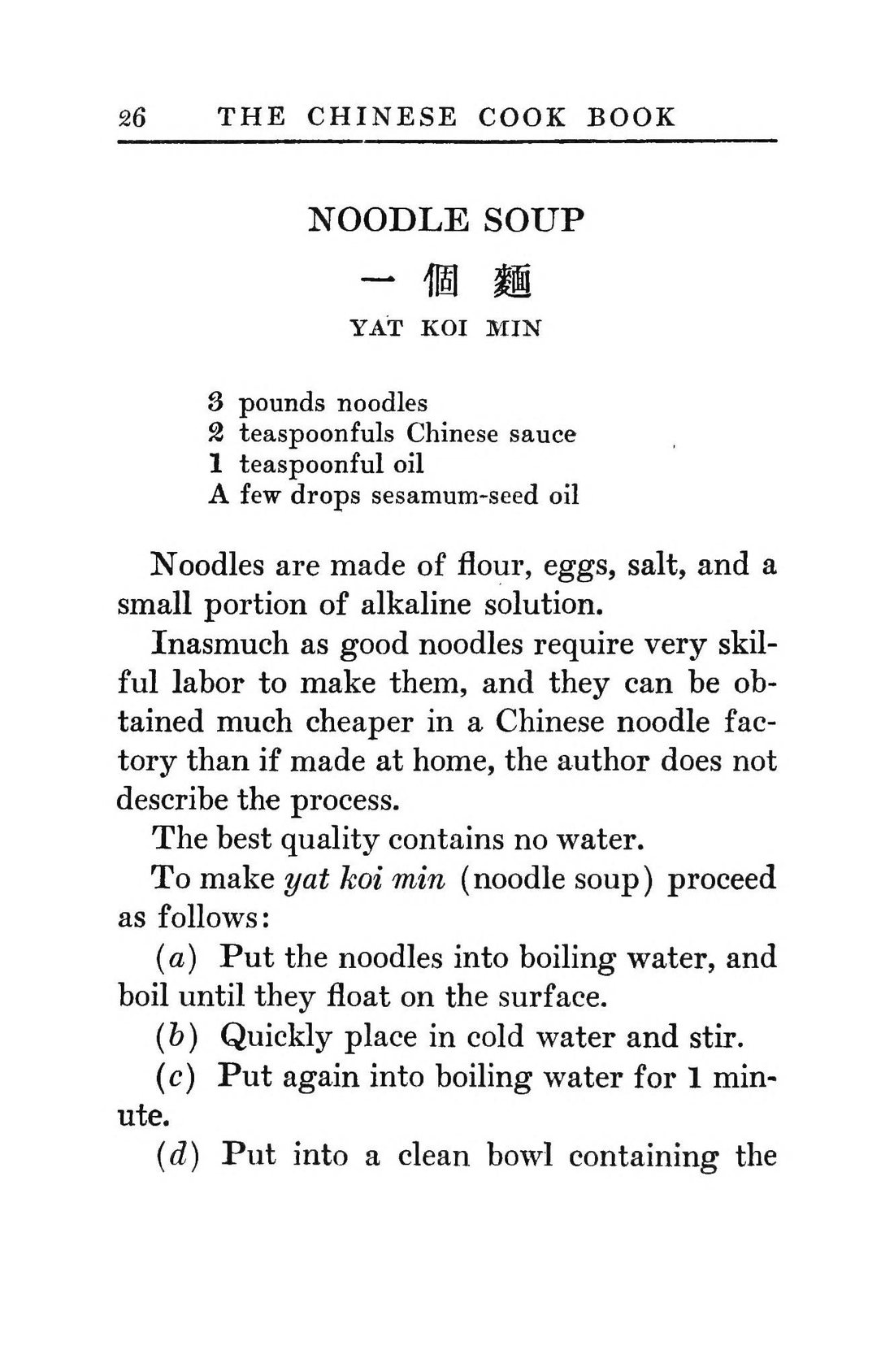
The scatter of spellings is itself the best clue to the name’s origin, and a Cantonese cookbook author supplied the strongest evidence on the name more than a century ago. In 1917 Shiu Wong Chan wrote the dish’s name in Chinese characters as 一個麵 — roughly “one [measure word] noodles.” That makes the long-repeated explanation, “one order of noodles,” the best-supported reading of the name. What remains unproven is the story usually told about why a soup would be called that.
The spellings on record
| Year | Spelling | Where |
|---|---|---|
| 1904 | Yet quo mein | Oriental Restaurant menu, New York |
| 1905 | yock mein | Milk River Valley News, Montana |
| 1907 | Yet Ca Mein | The Chinese Cook Book in Plain English, Illinois (title only seen) |
| 1911 | Yet Gai Mein | Nolton, Chinese Cookery in the Home Kitchen, Detroit |
| 1914 | YAT KO MAIN | Bosse & Watanna, Chinese-Japanese Cook Book, Chicago |
| 1916, 1918 | yock a mein | Five Mile Beach Weekly Journal, Wildwood, N.J. |
| 1917 | 一 個 麵 / YAT KOI MIN | Chan, The Chinese Cook Book, New York |
| 1918 | yet yok min | Ben Hong Low Restaurant menu board, New Orleans |
| 1921 | Yet ca Mein | Montgomery Advertiser, Alabama |
| 1926 | yok-a-mein | Ransdell’s Oriental Tea Room advertisement, Portsmouth, Va., as reported by the Virginian-Pilot |
| 1927, 1932 | Yet-Ca-Mein | Maclean’s; La Choy cookbook, Detroit |
| 1929 | Yaka Mein | The Milwaukee Leader |
| 1938 | Yock-A-Mein | Suffolk, Va., telephone directory |
| 1955 | Yat-mein | Walter’s Place sign, New Orleans |
| 1963 | Yaka Mein | The Key West Citizen, Florida |
| 1967 | Yat ca mein | House of Lee, Metairie |
| c. 1970s | Yat ka mien | Chinese Kitchen, New Orleans |
| 2013 | Yatka mein | Fong’s, Kenner |
Present-day New Orleans adds yakamein, ya-ka-mein, yaka mein, Red Rooster’s “YET-CA-MEIN” and John & Mary’s “yatkamein.” Chef Chip Flanagan, first hearing it around 2000, met “ya-ka-mein,” “yaka meat” and “yaka mo”: “It was like 20 different pronunciations.” Baltimore uses “yak,” “yat gaw mein,” “yakame” and “dirty yak”; Virginia uses “yock.”
Winston Ho, historian at the University of New Orleans, gives the reason. Because Chinese is not written alphabetically, “there is no standard way to transliterate Cantonese names into the English alphabet, so Chinese people have to use their best guess.” Many restaurant owners, each romanising the same Cantonese words by ear over decades, produce exactly this kind of spread.
一個麵: the 1917 printing
Ho reports the standard etymology carefully: “Multiple sources report that yakamein is actually ‘an order of noodles’ 一個麵 in Cantonese.” The Chinese-restaurant historian who writes as Chandavkl says the same. Neither cites a primary source.
The primary source is Chan’s The Chinese Cook Book (New York: Frederick A. Stokes, 1917), pp. 26–27. The recipe heading is printed in three lines:
NOODLE SOUP 一 個 麵 YAT KOI MIN
Here a Cantonese-literate author writes the characters himself: 一 “one,” 個 a measure word (Cantonese go3), 麵 “noodles.” This moves the etymology from “multiple sources report” to “printed by a Cantonese cook in 1917.” It is the strongest evidence on the name found anywhere.
It is also usage, not grammar. The same book, two pages later, has Mor Gue Guy Yat Koi Min, noodle soup with chicken and mushrooms: in 1917 yat koi min was a base noun that could take toppings, the way “yakamein with shrimp” does now. The 1927 Maclean’s writer understood it the same way, as a format: any combination of noodles, broth and garnish “would be quite in keeping with the name Yet-Ca-Mein.” A name that describes an amount rather than an ingredient suits a dish that has never had fixed ingredients.
What the printing does not prove
The popular account says the name was kitchen shorthand: a waiter calling “one order of noodles” to the kitchen, which customers overheard and took for the dish’s name. Chan’s heading shows how the name was written; it does not show how it arose. No linguist, dictionary or Cantonese-language source analysing the phrase has been found. Nor has any source addressed whether 一個麵 was idiomatic restaurant Cantonese — the everyday measure word for a bowl would be 碗, and whether 個 was kitchen usage is a question none of the sources consulted answers. The waiter story is an explanation, not evidence.
The “Yet Gai Mein” problem
Jessie Louise Nolton’s Chinese Cookery in the Home Kitchen (1911) prints the name as “Yet Gai Mein.” Gai could be another romanisation of 個 go3, like Chan’s koi and Bosse’s ko. But the same book spells 雞 gai, “chicken,” the same way: the very next recipe is “Gai Mein Gang,” chicken noodle soup. Read that way, “Yet Gai Mein” would mean something like “one chicken noodle.” The book’s own menu page argues against it, glossing the dish as “Yet Gai Mein (Noodle Soup, Plain)”, and the recipe allows chicken, beef or mutton broth. The 個 reading is the better fit, but the spelling cannot be called settled.
The 牛肉麵 alternative
A rival derivation appears in tourism and food writing: that “yaka mein” comes from Cantonese “ngau yoke mein” (牛肉麵), “beef noodle soup.” No scholar has been found proposing it. An anonymous editor on the Wikipedia talk page has also suggested 肉麵 yuk min, “meat noodles,” with the “beef” dropped.
The reading is attractive because New Orleans yakamein is in fact a beef noodle soup. It fits the record poorly:
- The syllables. 牛肉麵 (ngau4 juk6 min6) has the meat syllable in the middle. The early spellings — quo (1904), gai (1911), ko (1914), koi (1917, with 個 printed above it), ca (1927, 1932) — consistently carry a hard k/g middle syllable.
- The meat. None of the four earliest recipes is a beef dish. Nolton offers beef broth as one option of three; Chan uses chicken and pork stock; Bosse uses ham; Maclean’s uses chicken or pork. The beef emphasis is a later, New Orleans development.
- The exception. The 1918 New Orleans menu board’s “yet yok min” is the one spelling that looks like 肉 juk, and it arguably contains elements of both readings. It complicates the picture without overturning it.
The balance of evidence is lopsided toward 一個麵, though no published linguistic study exists on either side.
The Japanese question
To an English-speaking ear “yakamein” can sound Japanese: yaki (焼き, grilled) is familiar from yakisoba and yakitori, and 麺 is read men in Japanese. No scholar, linguist or Chinese-food historian has been found arguing for a Japanese origin, and no document links the dish to Japanese cuisine. The resemblance is an accident of one modern spelling. The 1904 and 1918 forms, “Yet quo mein” and “yet yok min,” do not read as Japanese at all.
One Virginia record shows how a Japanese connection could be imagined. The Suffolk-Nansemond Historical Society reports that the 1938 Suffolk telephone directory lists the Horseshoe Cafe — run by Tsuruju (Tsuruyu) Miyazaki, a Japanese citizen later interned at Rohwer, Arkansas — as serving “Choice Oriental and American Dishes Including Chop Suey and Yock-A-Mein.” That is a Japanese immigrant running a chop suey house. It shows that the trade, not the owner’s ethnicity, carried the dish; it says nothing about the name, which was on Chinese American menus by 1904.
What New Orleans calls it
Linda Green, the dish’s best-known vendor, told SFA interviewer Sara Roahen in 2013 that the household name was different again: “That’s what the people in the black community—they call it ya-ka-meat. … But it’s ya-ka-mein.” Growing up in Central City, “It was ya-ka-meat,” and her family “all called it” that. Flanagan heard “yaka meat” too, and the SFA list includes “Ya-ka-meat.”
On the origin of the name, Ms. Green made no claim: “I don’t know anything about the Chinese Americans, if they had it. They probably did.” Her view of the dish was that “it always have been a New Orleans dish … with a twist to it.”
The dish’s other name, “Old Sober,” is a separate question with a much shorter paper trail, taken up on “Old Sober” and the Hangover Question.
Recipes in the collection
- Yat Ko Main (1914 Chinese American Noodle Soup) — the name as Bosse & Watanna printed it
- Ms. Linda’s Original Ya-Ka-Mein (Louisiana Cookin’)
- Yakamein (New Orleans Beef Noodle Soup)
- Taiwanese Beef Noodle Soup — an actual 牛肉麵, for comparison; not an ancestor
Comments (0)