Yakamein · 8 of 9
Making It
Yakamein has not yet been made or eaten in the kitchen these pages are written for; this page is a briefing for a first bowl.
The dish is simple to assemble and easy to get wrong in two places: the beef, which needs far longer than one widely reprinted recipe says, and the salt, which arrives from soy sauce, seasoning blends and bouillon at once. Everything else — spaghetti, half an egg, green onion, hot sauce — is settled by the published recipes and by the people who sell it. What follows compares those recipes and draws out what they agree on.
The parts
Every street-style source builds the bowl the same way, from the bottom up:
- Spaghetti, cooked soft.
- Chopped stewed beef, usually chuck.
- Half a hard-boiled egg.
- Sliced green onion.
- Hot beef broth, dark and salty, ladled over the top.
- At the table: hot sauce, soy sauce and ketchup.
Philipe LaMancusa’s summary of the target is the most useful single sentence on the dish: “There’s no set taste for ya-ka-mein except brown. It’s got to taste brown and salty, and it’s got to have a handful of green onions” (SFA oral history, 2012). The full construction is on What Yakamein Is.
The beef: cut and time
Chuck roast is the cut most often published. Garden & Gun allows eye of round as an alternative; America’s Test Kitchen specifies chuck-eye roast. Chuck is a collagen-heavy cut, and tenderness is the whole point here — Linda Green: “That’s the longest part of anything is your meat because you want to get the meat a little tender” (SFA oral history, 2013, p. 16).
The published times agree with each other, except for one.
| Recipe | Beef | Simmer |
|---|---|---|
| Louisiana Cookin’, “Adapted from Chef Linda Green” (2017) | 1 lb (450 g) chuck | ”about 15 minutes” |
| Garden & Gun, after Linda Green | 2½–3 lb (1.1–1.4 kg) chuck or eye of round | 3–4 hours |
| America’s Test Kitchen (Fairman, 2021) | 2 lb (900 g) chuck-eye, browned first | 1½–2 hours |
| Food & Wine (Brian Jupiter, 2023) | 2 lb (900 g) chuck, seared | about 2 hours, in a 4-hour bone stock |
| Allrecipes (John Mitzewich, 2024) | 1½ lb (680 g), 1-inch cubes | 60–90 minutes |
Every recipe that cooks chuck in a whole roast or large pieces simmers it at least 1½ hours. The Louisiana Cookin’ card’s 15 minutes stands alone. A check of the live page on October 1, 2026 found it unchanged. The card is labeled “Adapted from” Linda Green, so the time may be the magazine’s, not hers. A pound of chuck simmered for 15 minutes will be cooked but tough. Use the longer times.
Practical points the tested recipes share:
- Cool before chopping. Garden & Gun rests the beef 20–30 minutes; ATK at least 20.
- Chop, don’t slice. ATK cuts ¾-inch (2 cm) pieces; Garden & Gun shreds or chops and discards chunks of fat.
- Skim the broth. Both skim the fat from the cooking liquid, which becomes the broth.
Where the soy goes
This is the largest real difference between versions.
- In the broth, in quantity. Garden & Gun adds ½–⅔ cup (120–160 ml) of soy sauce to the beef stock, with ketchup, Worcestershire and hot sauce. That is what produces the dark, salty broth every description mentions.
- In the broth, moderately, and at the table. ATK uses ¼ cup (60 ml) for six servings, plus extra soy for the table.
- At the table only. The Louisiana Cookin’ card puts “a dash of soy sauce” on each finished bowl; its broth gets its salt from the seasoning packet.
Linda Green’s own account covers both: her mother “would put soy on top” once the broth was made (p. 12), and of her own broth she says, “You got to cook that soy sauce” (p. 13). Soy, in her words, is “the twist” (p. 13).
Taste before adding more salt. Soy sauce is itself very salty, and so are bouillon, beef base and most commercial Creole and Cajun blends. A reader review of one widely circulated online recipe, which claims soy adds umami “without any additional salt”, calls the result “too salty”. Add soy in stages, after the beef is out and the broth has been skimmed, and leave room for the soy and hot sauce the eater will add.
MSG
ATK’s recipe lists ½ teaspoon Ac’cent (MSG), marked optional. It is the only tested recipe here to name it. Philipe LaMancusa recalled the first yakamein he found, at a St. Claude corner market, being darkened with a seasoning he “found out later on was Maggi” (SFA oral history, 2012).
The noodles
- Plain spaghetti. “I use number four spaghettis, the regular spaghettis” (Green, p. 77). Spaghetti is the noodle in every street-style recipe reviewed. Maurice Haynes held that linguine was the original, and Philipe LaMancusa recalled shoppers at Circle Food Store arguing angel hair against spaghetti (SFA oral histories, 2012).
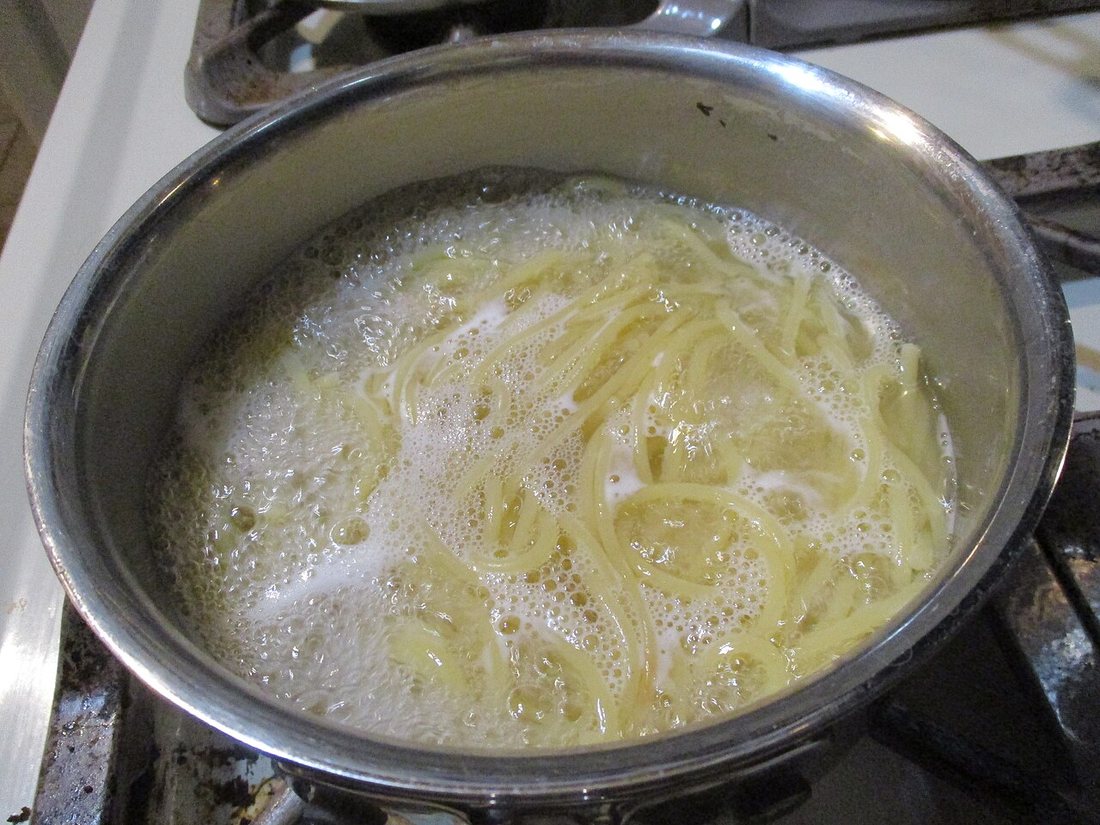
- Cook it fully tender, not al dente. ATK specifies spaghetti boiled in 3 quarts (2.8 L) of water until “fully tender”, which matches the soft texture of the street dish.
- Cook it separately. The modern recipes all boil the pasta on its own and add the broth in the bowl.
- Kenneth Temple’s recipe breaks the spaghetti in half before cooking.
The egg
Half a hard-boiled egg per bowl appears in five independent modern recipes — Louisiana Cookin’ (two quarters), Garden & Gun, TODAY, ATK and Food & Wine — and in Jessie Louise Nolton’s Chinese Cookery in the Home Kitchen (Detroit, 1911), which garnishes “Yet Gai Mein” with “one-half a hard boiled egg for each bowl.” It is one of the oldest fixed points in the dish.
Kenneth Temple’s method for the eggs: lower the eggs into boiling water, boil 2 minutes, take the pan off the heat and leave covered 10 minutes, then rinse in cold water.
The table
- Hot sauce. Linda Green puts Tabasco in every cup; ATK passes Crystal.
- Soy sauce, for those who want more.
- Ketchup. Green keeps it on the counter for customers who ask (pp. 76–77). Garden & Gun uses it both in the broth and at the table.
Green serves her cups with a fork and expects the broth to be drunk: “It’s all about the juice” (p. 30).
Holding and serving
For a crowd, keep the components separate and assemble to order, as Green did at Jazz Fest in 2013: noodles, beef, eggs and onion held cold at about 34 °F (1 °C) and put together in a lidded cup when ordered (p. 50). Hot broth goes in last.
The five recipes in the collection
| Yakamein (G&G, after Linda Green) | Ms. Linda’s Original (Louisiana Cookin’) | Beef Yakamein (ATK) | Seafood Yakamein (John Folse) | Yat Ko Main (1914) | |
|---|---|---|---|---|---|
| Date | — | 2017 | 2021 | 2025 | 1914 |
| Protein | 2½–3 lb (1.1–1.4 kg) chuck or eye of round | 1 lb (450 g) chuck | 2 lb (900 g) chuck-eye | cooked fish | ¼ lb (115 g) minced ham |
| Beef time | 3–4 h | ”about 15 minutes” (see above) | 1½–2 h | — | — |
| Broth | beef cooking liquid, Creole seasoning | 8 cups (1.9 L) cooking liquid + 5-oz seasoning packet | 8 cups (1.9 L) beef broth, trinity strained out | 1 gallon (3.8 L) seafood or beef stock, star anise, clove, fennel | 1 quart (950 ml) soup stock, onion, celery |
| Soy | ½–⅔ cup in broth | dash at the table | ¼ cup in broth, more at table | none | 1 Tbsp “syou” in broth |
| Noodle | spaghetti | spaghetti | spaghetti, fully tender | not specified | noodles |
| Egg | ½ per bowl | 2 quarters per bowl | ½ per bowl | not specified | none |
| Serves | 10 | 8 | 6 | 8 | not stated |
Notes on the less usual two:
- John Folse’s seafood version (Louisiana Cookin’, July 2025) is a restaurant consommé, not the street dish. Folse writes that he had never heard of yakamein until his chef de cuisine, Christopher Anderson, served it at Restaurant R’evolution. The stock simmers with onion, garlic, star anise, clove and fennel for 20–30 minutes, is strained, and is finished with fish, chili oil and green onion. There is no soy at all.
- Sara Bosse and Onoto Watanna’s “Yat Ko Main” (Chinese-Japanese Cook Book, Rand McNally, 1914) is a Chinese American restaurant soup from before the New Orleans record begins: noodles boiled about ten minutes and refreshed in cold water, a quart of stock simmered ten minutes with onion, celery and “syou” (glossed in the book as “Chinese sauce”), then the noodles returned for five minutes and shredded ham scattered on top. It is a way to taste the ancestor described on Where It Came From.
Seasoning blends
Linda Green’s own 5-ounce (about 140 g) seasoning packet carries the broth in the Louisiana Cookin’ recipe, and its formula has never been published. The magazine’s substitute is 1 teaspoon Creole seasoning plus 3 tablespoons beef base (“We used Better Than Bouillon Organic Beef Base”). That is an approximation, not an equivalent by weight; taste and adjust.
ATK and Garden & Gun both name Tony Chachere’s Creole seasoning. A homemade blend lets the salt be controlled separately: Emeril Lagasse’s Essence, for example, is paprika, salt, garlic powder, black pepper, onion powder, cayenne, dried oregano and dried thyme. The collection’s blends are linked below.
Where to eat it now
Listings decay quickly; these are the best-dated as of October 2026 and should be checked before a visit.
- Yakamein House, 2800 Tulane Avenue — listed open, with customer reviews dated September 2026; its listed menu offers beef, beef and shrimp, and chicken yakamein.
- Ms. Linda’s Catering — on the 2026 Jazz Fest food list, selling yakamein. NOLA.com reported in May 2026 that she and her family set up at festivals and frequent pop-ups rather than a fixed restaurant; see Ms. Linda Green, the Ya-Ka-Mein Lady.
- Eat-Well Food Mart, 2700 Canal Street — recommended by Eater in July 2025, “less overwhelmingly salty than some others”, and open early.
- Amanda McCollum (“Yakamanda”), a late-night vendor most regularly at Pal’s Lounge, 949 N. Rendon Street, from about 10 p.m., Thursday to Sunday, as reported by NOLA.com in January 2026.
Comments (0)