Yakamein · 9 of 9
What the Popular Story Gets Wrong
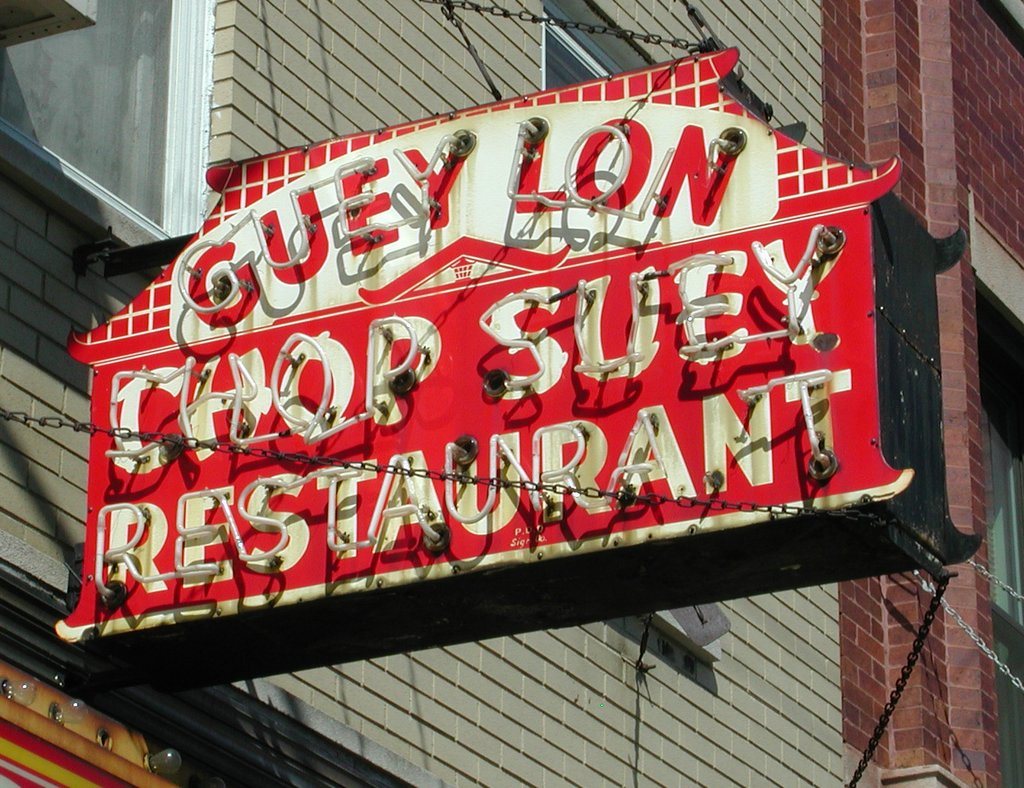
Yakamein has a story that is told the same way in most travel pieces, recipe headnotes and festival guides: invented by Black soldiers back from Korea, unique to New Orleans, a proven hangover cure, called “Old Sober” since anyone can remember, and made famous by a James Beard winner. Almost every part of that telling is wrong, or stronger than the evidence allows.
The corrections below give the popular version first, then the record. Each ends with a note on how firm the correction is.
1. “Black soldiers brought it home from the Korean War”
The claim: African American veterans of the Korean War (1950–53) acquired a taste for Asian noodle soup and recreated it in New Orleans.
What the record shows: the dish is documented decades earlier. A New York menu of 1904 lists “Yet quo mein”; a 1918 photograph of the Ben Hong Low Restaurant at 156 Basin Street in New Orleans shows “yet yok min” painted beside “chicken chop suey” (Winston Ho, University of New Orleans, citing the Historic New Orleans Collection). Four cookbook and magazine recipes from 1911 to 1932 describe the recognizable bowl, and a 1926 advertisement in Portsmouth, Virginia, offered “yok-a-mein for 20 cents” (Virginian-Pilot, 2018). The Southern Foodways Alliance dismisses the Korea story because New Orleanians were eating the dish before that war.
No version of the story names a veteran, a unit or a date, and popular accounts cannot agree on the war: Atlas Obscura hedges with “World War II or Korean War veterans”. Linda Green herself repeats it only as something heard (SFA oral history, 2013, p. 12).
Confidence: high. The chronology rules out invention by veterans. Whether returning soldiers later added to its popularity has not been documented either way.
2. “It was invented in New Orleans”
The claim: yakamein is a New Orleans creation, found nowhere else.
What the record shows: the name and the dish were on Chinese American menus across the country. Library of Congress newspapers find “yock mein” in Montana in 1905, “yock a mein” in New Jersey in 1916, “Yet ca Mein” in Alabama in 1921 and in Black weeklies in Minneapolis and St. Paul in 1946, a pun on “Yaka Mein” in Milwaukee in 1929, and “Yaka Mein .80” on a Key West take-out menu in 1963. Close relatives survive in Hampton Roads and Baltimore, and one has been reported in Washington, D.C. (see The Cousins). Ho’s conclusion is that Cantonese immigrants created the dish in North America, not in New Orleans and not in China.
What New Orleans has is its own branch: the beef, the Creole seasoning, the second-line cup. How and when the Chinese restaurant dish became a Black neighborhood food in the city is genuinely unknown.
Confidence: high for the national spread; the New Orleans crossover is an open question.
3. “The name means ‘one order of noodles’”
The claim: yakamein comes from Cantonese 一個麵, “one order of noodles”, a waiter’s call to the kitchen.
What the record shows: this is the best-supported reading, but not proven. Shiu Wong Chan’s The Chinese Cook Book (New York, 1917, p. 26) prints the characters 一個麵 above “YAT KOI MIN”. Nolton’s 1911 “Yet Gai Mein” is glossed “(Noodle Soup, Plain)” — though gai is also that book’s spelling of “chicken”. None of the four earliest recipes is a beef dish, which counts against the rival reading 牛肉麵, “beef noodles”.
What remains unproven is the waiter’s call-out story. Chan shows how the name was written, not how it arose, and no linguist has published on it.
Confidence: medium-high on 一個麵; low on the kitchen-shorthand explanation. Detail on The Name.
4. “It cures hangovers”
The claim: yakamein, nicknamed “Old Sober”, is a proven hangover cure.
What the record shows: no trial has tested yakamein, or any broth or soup, as a hangover remedy. Systematic reviews in the BMJ (2005), Human Psychopharmacology (2017) and Addiction (2022) find no good evidence for any hangover treatment, food or drug. The usual rationale, that the salty broth replaces water and salt, rests on a premise later research does not support: dehydration markers do not track hangover severity, and blood sodium has been measured rising after binge drinking, not falling.
A hot, salty, filling bowl at the end of a night is a sensible thing to want. It is not a demonstrated treatment.
Confidence: high. The evidence is set out on “Old Sober” and the Hangover Question.
5. “A 2013 chemistry study proved it”
The claim: the American Chemical Society published a study showing yakamein works.
What the record shows: the ACS issued a press release on April 9, 2013, about a talk by Alyson E. Mitchell of UC Davis at a symposium, “Chemistry of the Bar”, at its National Meeting in New Orleans. The release calls the talk “an overview of the chemistry of hangovers”. It describes no measurement of yakamein. Headlines turned it into a “study” (National Post, April 11, 2013), and the word has stuck in later coverage.
Confidence: high. The wording is the society’s own.
6. “‘Old Sober’ is the dish’s old name”
The claim: the dish has been called “Old Sober” for generations.
What the record shows: the earliest print use found is Ian McNulty’s Gambit piece of May 1, 2006. No older food use turned up in the nola.com archive or in Chronicling America. Linda Green, born in 1957 and raised with the dish, told the SFA in 2013: “When I was coming up, no, we didn’t know it” (p. 14). Her family called it “ya-ka-meat”.
Confidence: medium. Older print archives (the Times-Picayune morgue, the Louisiana Weekly) were not searchable, so an earlier use may yet surface. But the name is plainly not universal among the dish’s own makers.
7. “Ms. Linda Green is a James Beard award winner”
The claim: some summaries describe her as a James Beard winner or nominee.
What the record shows: no source could be found for this. No Beard Foundation record, news article or interview read in this research mentions a Beard award, nomination or semifinal. Her confirmed television record is a 2012 Chopped win, No Reservations in 2011 and Netflix’s Street Food: USA in 2022.
Confidence: high that no source was found. The claim should not be repeated.
8. “Ms. Linda’s recipe simmers the beef for 15 minutes”
The claim: the recipe published as “Ms. Linda’s Original New Orleans Ya-Ka-Mein” (Louisiana Cookin’, January/February 2017) cooks a 1-pound (450 g) chuck roast “about 15 minutes”.
What the record shows: the magazine did print that, and still does. But the recipe card says “Adapted from Chef Linda Green”, not that it is her text, so the time may be the magazine’s. Every other published recipe that cooks chuck in a whole roast or large pieces simmers it at least 1½ hours, and Garden & Gun’s version credited to her gives 3–4 hours. Green’s own description of the method stresses that the meat is “the longest part” (SFA oral history, 2013, p. 16).
Confidence: high that 15 minutes will not make chuck tender; unknown whose error it is. See Making It.
9. “She brought yakamein to Jazz Fest after Katrina”
The claim: Green first sold at the New Orleans Jazz & Heritage Festival after the 2005 storm.
What the record shows: she dates her first booth to 2005, after a couple of years of cooking demonstrations (SFA oral history, 2013, p. 51), and The Advocate (2016) agrees. McNulty’s May 2006 preview found her “back this year”. Her start in the trade was earlier still, at the second lines.
Confidence: high.
10. “The Netflix episode was 2023” — and other television dates
The claim: her Street Food: USA appearance aired in 2023; her Bourdain appearance was on The Layover.
What the record shows: Street Food: USA episode 4, “New Orleans, Louisiana”, aired July 26, 2022, confirmed by NOLA.com and Eater coverage that week. The Bourdain appearance was No Reservations, “Cajun Country”, aired August 29, 2011 (NOLA.com, 2018). Her Chopped episode, “Pride of New Orleans”, aired June 26, 2012, and she won.
Confidence: high.
11. “Find her outside the Ogden Museum every Thursday”
The claim: Atlas Obscura’s entry says she “typically serves her yakamein outside the museum every Thursday, 5:30–8:00 pm” at the Ogden Museum After Hours (and spells it “Odgen”).
What the record shows: the listing is undated, Atlas Obscura entries are not systematically updated, and no dated source in this research confirms the Thursday stand. The most recent dated listing is the 2026 Jazz Fest food list, which names Ms. Linda’s Catering.
Confidence: medium. The Thursday stand may once have been accurate; it should not be treated as current.
12. “America’s Test Kitchen’s recipe is paywalled”
The claim: the ATK yakamein (Matthew Fairman, 2021) cannot be read without a subscription.
What the record shows: the full ingredient list and method are published in the page’s public data and can be read without logging in. Among the recipes reviewed, it is the only one that strains out the onion, celery and bell pepper and names MSG outright, and it is in the collection below.
Confidence: high.
Recipes in the collection
- Yakamein (New Orleans Beef Noodle Soup)
- Ms. Linda’s Original Ya-Ka-Mein (Louisiana Cookin’)
- Beef Yakamein (America’s Test Kitchen)
- Yat Ko Main (1914 Chinese American Noodle Soup)
- Chop Suey (Beef, Lamb, Pork, Veal or Smoked Ham) — the chop suey house food that yakamein shared menus with
Comments (0)