Yakamein · 3 of 9
Chinese New Orleans and the Chop Suey Houses
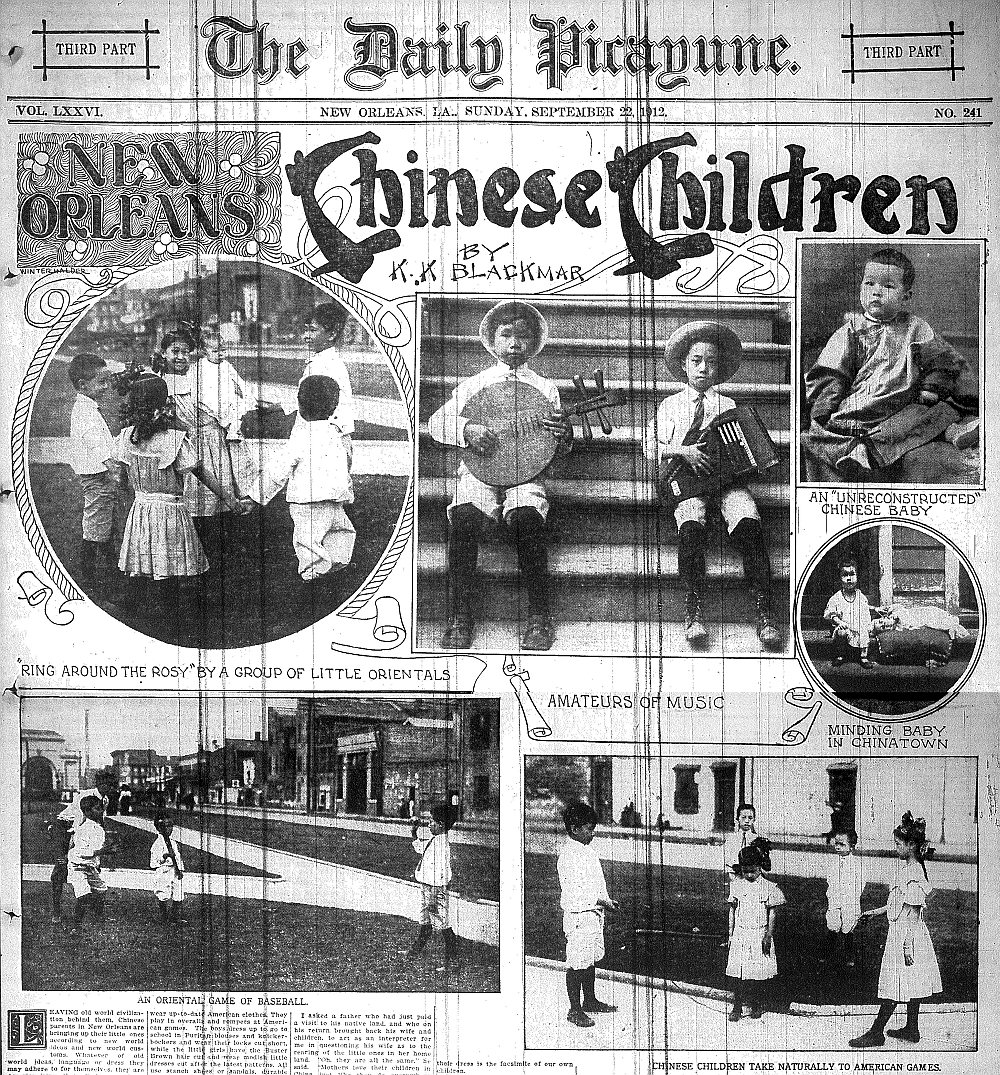
Yakamein reached New Orleans through a small Cantonese community that arrived as plantation labour after the Civil War, settled into the city’s laundry trade, and by the 1890s ran a handful of restaurants on and around one block of Tulane Avenue. Those restaurants sold Americanized Chinese dishes and Creole food on the same menu, and one of them, in 1918, painted “yet yok min” on its wall beside “chicken chop suey.”
The community was small, mostly male, and largely erased from the street plan by 1937. That helps explain why so little was written down about how its noodle soup became a Black New Orleans neighbourhood dish. This page sets out what the record does show, with numbers where they exist. The main sources are Winston Ho, historian at the University of New Orleans, and Richard Campanella, geographer at the Tulane School of Architecture, writing in 64 Parishes.
Arrival: contract labour, 1867–1871
Ho dates “the first major migration of Chinese into Louisiana” to 1867–1871, during Reconstruction: Cantonese speakers from the Siyi, or “Four Counties”, region of central Guangdong, who “originally came to Louisiana as contract laborers on local sugar plantations.”
The arrivals came by several routes:
- From Cuba. Campanella records that in 1867 “fifteen Chinese laborers arrived from Havana and Matanzas, bound for two cotton growers in Natchitoches Parish” (a year after a few labourers from the Philippines were brought in). NPR and Gambit report that Louisiana planters sent agents in 1867 to recruit Chinese workers from Cuba; that effort was disrupted.
- From California and China. The same agents then hired some 1,600 Chinese workers out of California, and later from China, into lower Louisiana. Ho notes that “the vast majority of plantation workers were hired from California or directly from Hong Kong and Guangzhou.”
- One dated contract. On 4 July 1870, 141 Cantonese contract workers from California arrived in New Orleans to work the Millaudon Sugar Plantation, in what is now Gretna on the Westbank (Ho, “The Millaudon Chinese”).
The contracts did not hold. An 1871 account in Every Saturday (Alfred Waud and Ralph Keeler, 29 July 1871) reported that half the Millaudon workers had broken their contracts and left within the year; by 1872 they had dispersed to a Baton Rouge cotton mill, New Orleans cigar factories, levee work and other states. Ho: “By the mid-1870s, nearly all of the laborers had abandoned the slave-like conditions.” Campanella puts the move to the city in the same years: in 1870 Chinese labourers “began to gravitate to larger cities,” and by 1871 they were “a noticeable presence in the streets of New Orleans.”
How many
| Year | Figure | Source |
|---|---|---|
| 1870 | 63,000 Chinese in the United States, 50,000 of them in California | Ho |
| 1880 | 105,000 in the United States, 75,000 in California | Ho |
| 1880 | 95 in New Orleans; 489 in Louisiana | Campanella, census |
| 1890s | ”almost all of the Chinese who lived in Chinatown were men” | Ho |
| 1900 | 150–175 Chinese taking classes at the Chinese Mission, estimated by the Times-Democrat as 25–30 percent of the community | Campanella |
The 1900 estimate implies a community of roughly 500 to 700, but that is arithmetic on a newspaper’s guess, not a census count. Hard New Orleans figures for 1890 through 1930 could not be established; they are likely in Lucy M. Cohen’s Chinese in the Post-Civil War South (1984), which was not consulted directly.
Laundries first
For most of this period the Chinese in New Orleans were laundrymen, not cooks. Ho writes that “most Chinese in New Orleans before the 1930s worked in small family-owned hand-wash laundries,” and that from the 1880s until the 1940s the laundries were “so ubiquitous that they became an indispensable part of the economic and cultural landscape.” Campanella’s counts:
| Year | Chinese laundries | Chinese restaurants |
|---|---|---|
| 1876 | 2 | — |
| 1882 | 13 | — |
| 1886 | 57 | — |
| 1892 | 73 | 3 |
| 1898 | 198 | 8 |
Three restaurants in 1892 and eight in 1898 are the first hard counts of Chinese restaurants in the city. The 1918 Ben Hong Low photograph sits two decades into that trade. The laundries declined after the Second World War, with home washing machines and laundromats, and as second-generation children left for business, medicine, engineering, education and, in one case, politics (Ho).
The Tulane Avenue Chinatown
The first Chinatown was a row of commercial buildings on both sides of the 1100 block of Tulane Avenue, between Elk Place and South Rampart Street. Sources differ on when it began, in a way that is reconcilable: NPR and Gambit say a first Chinatown “developed in the 1870s,” and Ho’s “after six decades” implies the same, while Campanella dates the core to the early 1890s, when “the loose cluster began to develop a core on the 1100 block of Tulane Avenue.” Scattered presence in the 1870s and a consolidated block in the 1890s fits both. By 1900, Campanella writes, “seven Chinese markets, groceries, and shops filled the short block in its entirety.”
The institution at its centre was the Chinese Presbyterian Mission, begun as classes in 1881 by Lena Saunders, a missionary from Maine, and incorporated in 1882 on South Liberty Street. It moved to South Roman Street in 1926, to Mid-City in 1952, and to Kenner in 1997.
The block did not survive the Depression. In 1937, Campanella writes, “the downtown side of 1100 Tulane, the heart of Chinatown, was slated for demolition and the merchants were forced to relocate.” Ho attributes the demolition to the federal government and the WPA and concludes that “the historic Chinatown is completely obliterated today.” A smaller second Chinatown formed on the 500 and 600 blocks of Bourbon Street around St. Louis Street. Its On Leong Chinese Merchant Association building at 530 Bourbon was sold in spring 2019; the name is still visible on the facade.
The chop suey houses
The restaurants of this Chinatown are where the dish is first seen in New Orleans. Ho describes Ben Hong Low, at 156 Basin Street (156 Elk Place), as serving “both Creole favorites and Americanized Chinese American food, such as chop suey,” and writes that Chinatown menus “served soul food on the same menu as their Chinese dishes.” Its painted menu board, photographed in 1918 and held by the Historic New Orleans Collection (1983.159), lists “yet yok min” beside “chicken chop suey.” Ho calls it the earliest photographic evidence of the dish in New Orleans.
The same menus were feeding Black New Orleans. Ho cites Louis Armstrong’s 1969 essay recalling his childhood in the Back o’ Town neighbourhood in the 1910s, eating at Chinatown restaurants and ordering red beans and rice alongside chop suey. That is the contact the dish needed: Black customers, at Chinese American counters, eating Creole food and chop suey from one menu. It is not a record of yakamein itself crossing over, but it is the setting in which it could.
The Chinese American dish also stayed on Chinese menus in the area long after. Ho lists “Yat ca mein” at the House of Lee in Metairie (1967), “Yat ka mien” at the Chinese Kitchen in New Orleans (c. 1970s) and “Yatka mein” at Fong’s in Kenner (2013).
Into Black New Orleans
The sources trace the crossing only in fragments.
- 1955. Ralston Crawford photographed Walter’s Place Restaurant and Bar with “Yat-mein” on the sign (Historic New Orleans Collection, 2013.0021.23). Ho calls it the earliest evidence of the dish prepared by African Americans for African American customers.
- A Chinese-run bar in Tremé. Frank Mitchell told the Southern Foodways Alliance (SFA) in 2012 of a place “on Orleans between Marais and Villere” that “we always called … the Chinamen’s Place,” selling it, mostly with pork or chicken, for fifty cents. He was too young to go in, “he was selling alcohol there, too,” and he assumed it was Chinese because a Chinese man sold it. No date is given beyond his own youth.
- The bars and corner stores. Linda Green’s mother sold it at the Bean Brothers bar at Third and Danneel in Central City; Ms. Green remembered it sold at Sam’s Bar on Rampart, Mr. Byron’s at Danneel and Seventh, and Peck’s on Orleans Avenue (SFA, 2013). Philipe LaMancusa described the corner-store signage formula as “po-boys, plate lunches, Chinese food,” where Chinese food meant ya-ka-mein; the first bowl he found came from an Asian-owned market on St. Claude Avenue, seasoned with what he later learned was Maggi.
- Leah Chase’s view. The chef held that the dish began in the old Chinatown, and, quoted in Louisiana Cookin’ (2017) on the railroad story, summed up the mixing of cultures: “They just mixed those cultures and did whatever they had to do to survive.”
The fragments point the same way — from Chinese-owned restaurants and bars toward Black-run bars, kitchens and parades — but they do not date the turn, and no source has filled the decades between 1918 and the 1950s with documents. What is known about the step after, when the dish became one family’s trade, is on Ms. Linda Green.
Later immigration added a second layer without changing the line of descent. Atlas Obscura lists John & Mary’s Food Store as selling New Orleans, Chinese and Vietnamese takeout together, and McNulty reported in 2019 that Minh Tran of Riteway Soul Food starts his yakamein stock “the same way he begins the pho.” That is coexistence in the same shops, not ancestry; Vietnamese immigration to New Orleans came more than half a century after the 1918 photograph. The cousins page takes up which resemblances are relationships and which are not.
Recipes in the collection
- Chop Suey (Beef, Lamb, Pork, Veal or Smoked Ham) — the menu-board companion, in a 1944 Army version
- Yat Ko Main (1914 Chinese American Noodle Soup)
- Yakamein (New Orleans Beef Noodle Soup)
Comments (0)