Yakamein · 5 of 9
Ms. Linda Green, the Ya-Ka-Mein Lady
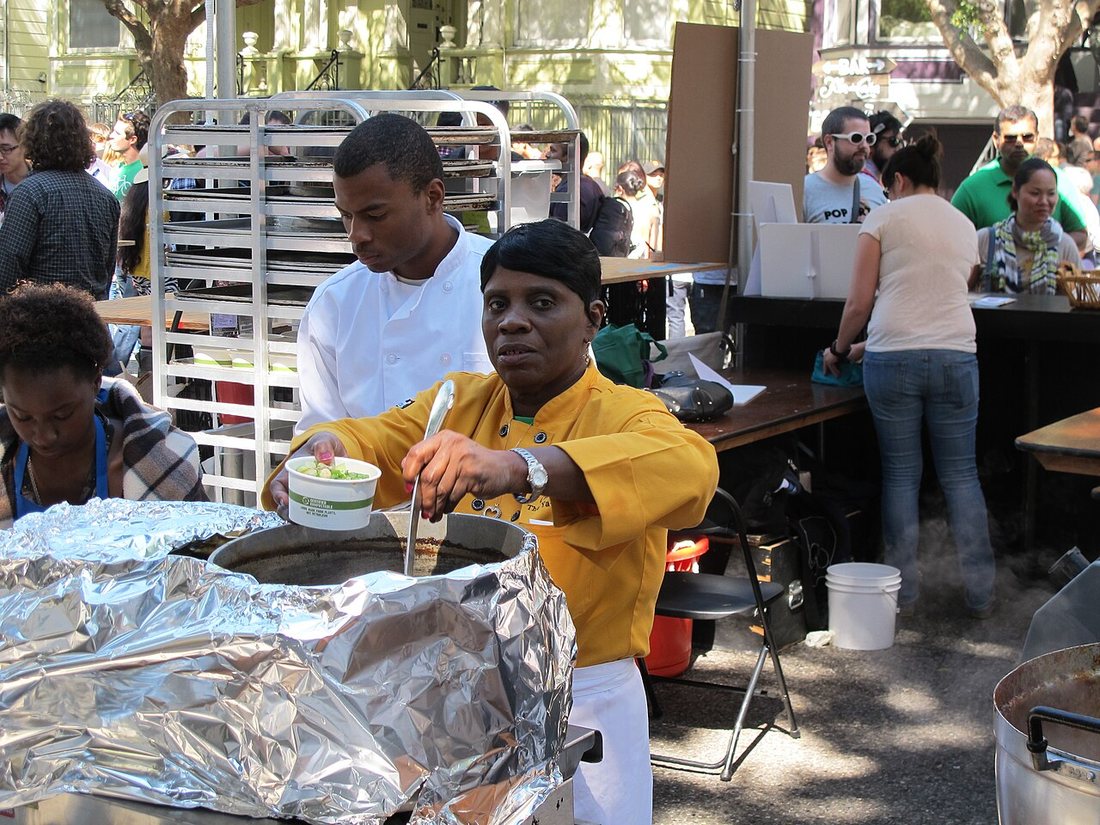
Linda Green is the best-known maker of yakamein in New Orleans, and the person most of the dish’s modern press is written about. She did not invent it, and in her own interview she makes no such claim. What she did was carry a household dish of Central City into the second lines, then onto the Jazz Fest grounds and national television, while keeping the recipe her mother cooked recognizable.
The best source on her is her own account. On March 12, 2013, Sara Roahen recorded a two-hour oral history with her at her catering kitchen in New Orleans East, in the old Ricardo’s Restaurant at Morrison Road and Crowder Boulevard, for the Southern Foodways Alliance project “Ya-Ka-Mein in New Orleans” (published on the SFA site in February 2014). Unless marked otherwise, the facts below come from that transcript, with page numbers from the transcript itself.
Central City and the school board
She was born in New Orleans in 1957 and grew up in Central City, at Third and Danneel, where she still lived in 2013 (Roahen, SFA oral history, 2013, pp. 2–4).
Her mother, Shirley Green, worked in school cafeterias and retired after thirty years with the Orleans Parish School Board. She also cooked church banquets at St. Francis de Sales, at Second and Loyola, and took catering jobs (pp. 5–6, 9). Linda Green followed her onto the payroll: “I have twenty-five years with that school board, but after [Hurricane] Katrina I went out on faith and I never looked back” (p. 6).
Learning the dish: a pork chop, a corner bar, a six-pack
The yakamein she learned was not the one she sells. In her words:
“My mom used to cook ya-ka-mein at home, but when she did it, it was with a pork chop. That’s what black families were doing. … My grandmother used to cook it, my great-grandmother, she cooked it, and they cooked it with the pork chops.” (p. 7)
The pork chop was boiled and “chop[ped] up real good” (p. 15). The switch to beef was her own change, made for vending: “when you’re traveling with it—you know, I don’t want it to spoil or nothing like that, so beef carries more than pork do” (p. 7).
Her mother sold the dish at a corner bar, Bean Brothers, at Third and Danneel, and at the church (pp. 8, 15). She gave up the bar trade because “the school board had benefits and the bar didn’t have no benefits”, but told her daughter “one day I might be able to use that” (p. 8).
The recipe was handed over at her mother’s house, at a price. Her mother told her to come over and sit down, and to bring “six beers” first: “So I had to go get her a six-pack of ponies” (pp. 22–23). Her verdict: “History is repeating itself. I am actually cooking just like that woman” (p. 23).
Where the accounts differ
The family history is told several ways, and the versions should be kept side by side rather than collapsed into one:
- Which ancestor sold it. The 2013 transcript names her mother as the seller at Bean Brothers. NOLA.com (2024) and The Advocate (2016) credit her grandmother, “Mama Georgia”, selling from her Central City porch. Where Y’at (April 2025) quotes her calling her mother “the original YaKa-Mein Lady” and separately recalling her grandmother’s “porch poppers”. The likeliest reading is that more than one generation sold it.
- Which ancestor taught her. The SFA project page says she remembers her great-grandmother making it with pork chops; the transcript makes clear she learned it from her mother.
- The bar’s name. The transcript gives “Bean Brothers”. A childhood friend quoted by NOLA.com in 2012 called it “Bear Brothers”. Both put it at Third and Danneel.
- Whether it was written down. The SFA project page says she never wrote the recipe down. In the transcript she says she did not at first, then later wrote it down for her daughter in Houston (pp. 23–24).
Her bowl, in her words
Her account of the method is short and specific:
- Soy sauce is the defining touch. “The only thing the twist is is soy sauce” (p. 13). It goes into the broth, not only on top: “You got to cook that soy sauce” (p. 13). Her mother boiled the meat with onion and put soy on top once the broth was made (pp. 12, 22).
- Spaghetti, not anything fancier. “I use number four spaghettis, the regular spaghettis”; her mother “always used the spaghettis” (pp. 77–78).
- A fork, and the broth drunk from the cup. She does not carry spoons. “That juice coats the inside of your body” (p. 73), and, elsewhere, “It’s all about the juice” (p. 30).
- Tabasco in every cup: “it’s something that connects it” (p. 75). Ketchup stays on the counter for customers who want it: “I don’t put that in there for them” (pp. 76–77).
- A vegetarian version for Jazz Fest, made with a vegetarian bouillon cube and cauliflower, broccoli, carrots, zucchini and peas (pp. 21–22). Ian McNulty reported in 2019 that she had also made versions with oysters, duck, alligator, or no meat at all (NOLA.com, 2019).
By 2013 she cooked with her own packaged seasoning, “Miss Linda’s Original New Orleans Ya-Ka-Mein Seasoning”, and added nothing else at the stand: “No, no, no, because everything is in there” (pp. 25–27, 36–37). The main ingredient is deliberately kept off the label (pp. 24–25, 33), and no published source gives the formula. The company appears in the SFA title as Miss Linda’s New Orleans Soul Food Seasoning Company.
In 2013 she sold a 16-ounce (about 475 ml) cup at second lines and a 12-ounce (about 355 ml) one at festivals (p. 66).
On the dish itself she is plain: “It was always a poor man’s dish” (p. 12). On its origin she is careful: “I don’t know anything about the Chinese Americans, if they had it. They probably did” (p. 17). The name she grew up with was “ya-ka-meat” (p. 11); that story is on The Name.
Second lines
“I was selling my ya-ka-mein at the second line. That’s where I started” (p. 46). In 2013 she was president of her own social aid and pleasure club, the Lady and Men Rollers, which she said was “going on eighteen years” old. It began as her ex-husband’s Men Rollers, became the Lady Rollers after the divorce, and took its present name when the men came back (pp. 46, 78–79). The club parades on the last Sunday of the year (pp. 86–87). She hired the Hot 8 Brass Band early: “I was the first person to employ those boys. They was the Looney Tunes at first” (p. 83).
For years, by her account, she was the only yakamein seller on the route. Other vendors sold pork chops, smoked sausage and sandwiches (p. 46). Katy Reckdahl reported in the Times-Picayune in August 2011 that she had become known at the parades as “the Yakamein Lady”, and that city rules at the time allowed no permit for food vendors following a moving parade.
After Katrina, Tipitina’s gave her work cooking for musicians in its kitchen on South Peters for about two years, along with four months of free rent (pp. 41–42, 46).
Jazz Fest
The common telling has her arriving at Jazz Fest after the storm. Her own dates are earlier. She gave cooking demonstrations for a couple of years first, then got a booth: “In 2005” (p. 51). Quint Davis brought her in (p. 55), and the early years earned little: “That just was like an introduction thing” (p. 56). Ian McNulty’s Jazz Fest preview in Gambit (May 1, 2006) found her “back this year at Food Area I”. By her account, someone else had sold yakamein at Jazz Fest years before, though she did not know who (p. 49).
In 2016, The Advocate reported she was running two booths and seven dishes, one of them in the Kids Tent run by her daughter Nikita Green. The 2026 Jazz Fest food list names the vendor “Ms. Linda’s Catering”, selling “YA KA MEIN, FRIED PORK CHOP SANDWICH, BREAD PUDDING W/ RUM SAUCE.”
French Quarter Fest guides list her in 2024 and 2026.
Television
| Year | Program | What the record shows |
|---|---|---|
| 2011 | Anthony Bourdain: No Reservations, “Cajun Country” (aired August 29, 2011) | NOLA.com (2018) lists “Miss Linda’s yakamein” from this episode. She says a producer found her at her Jazz Fest booth (pp. 28–29). It was not The Layover. |
| 2012 | Chopped, “Pride of New Orleans” (aired June 26, 2012) | She won the $10,000 episode, against three other New Orleans chefs (NOLA.com, June 28, 2012). |
| 2022 | Netflix Street Food: USA, episode 4, “New Orleans, Louisiana” (July 26, 2022) | Not 2023, as some later accounts give it. |
No source found in this research records a James Beard award or nomination, and none should be assumed.
The family business today
Where Y’at reported in April 2025 that her daughter Katrina was taking on the business with the grandchildren. The 2026 Jazz Fest vendor list includes Ms. Linda’s Catering. Nothing beyond that is stated here.
The succession was already in view in 2013, when she named grandchildren who were learning the dish: “she know how to make it”, she said of her granddaughter Jasmine Green (pp. 64–65). Her own summing-up from that interview: “I’m glad that I can get into somebody’s stomach and make them smile” (p. 88).
The other voices in the SFA project
Sara Roahen recorded four more interviews for the same project in 2012–13. Each adds a detail the press coverage leaves out:
- Maurice Haynes (Magazine Deli; May 2012) learned the dish from his grandmother, Dorothy Gibson; his family always used beef. He held that “the original noodles are the linguines” (p. 20), and ran the Rock Bottom Lounge, a second-line meeting place, cooking on the Tchoupitoulas sidewalk outside.
- Philipe LaMancusa (Kitchen Witch Cookbooks; May 2012), whom SFA called a “ya-ka-mein scholar”, gave the project its best-known line: “There’s no set taste for ya-ka-mein except brown. It’s got to taste brown and salty, and it’s got to have a handful of green onions.”
- Chip Flanagan (Ralph’s on the Park; May 2013) first ate it around 2000 and heard “like 20 different pronunciations” (p. 13).
- Lucinda and Frank Mitchell (Mitchell’s Fruit Stand, outside Charity Hospital; May 2012). Lucinda defined it as “roast beef, spaghettis, green onion, and egg, and a sauce that I put together personally” (p. 49). Frank remembered a Chinese-run bar in the Tremé, on Orleans between Marais and Villere, that sold it for “like fifty cents” (pp. 76–77) — testimony that belongs with Chinese New Orleans and the Chop Suey Houses.
Recipes in the collection
- Yakamein (New Orleans Beef Noodle Soup) — the Garden & Gun version, credited to Linda Green, with soy in the broth
- Ms. Linda’s Original Ya-Ka-Mein (Louisiana Cookin’) — the magazine’s adaptation, built around her seasoning packet
- Creole Seasoning Blend (Jeff’s) — for the packet substitute
Comments (0)