Yakamein · 2 of 9
Where It Came From
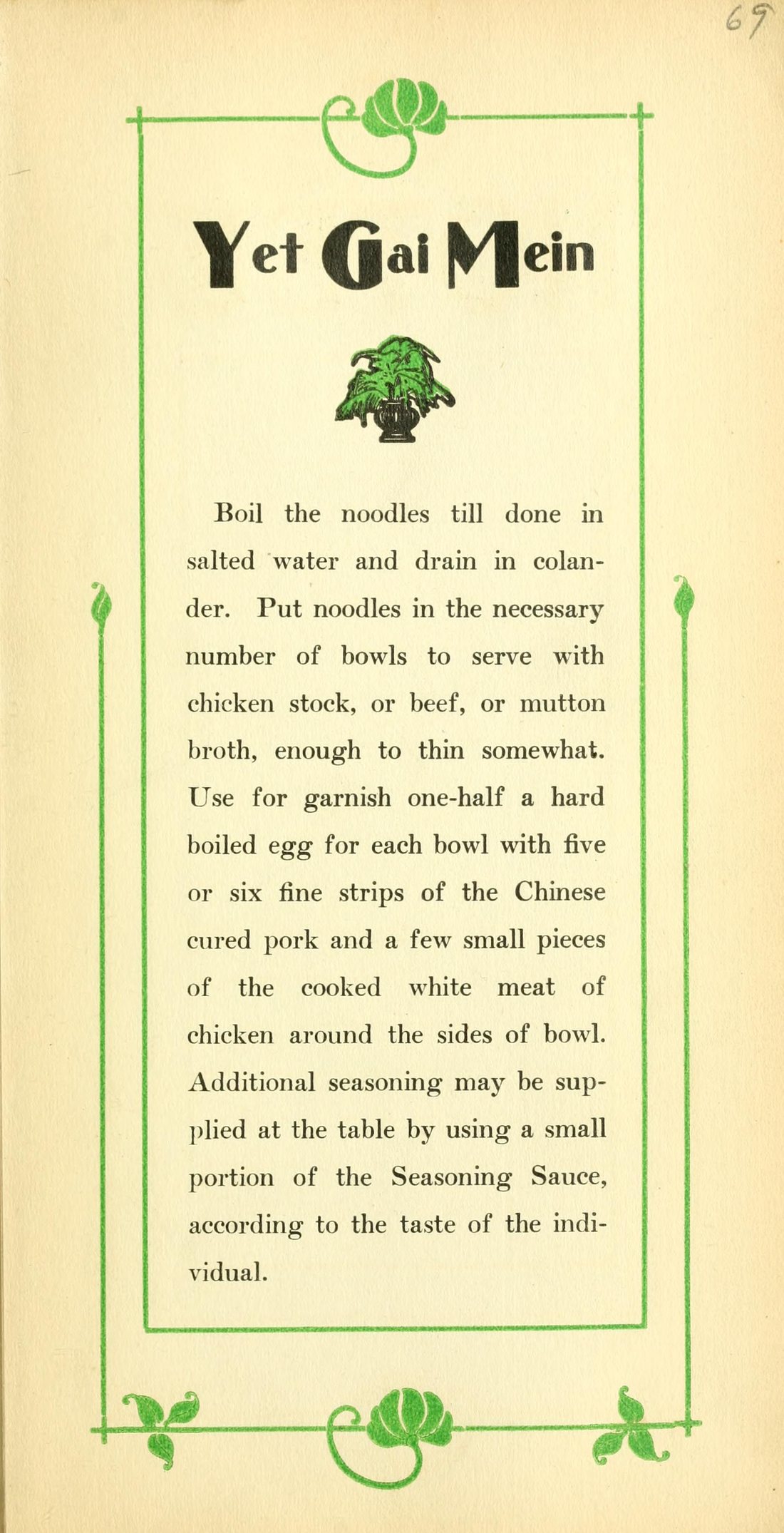
Three stories are told about where yakamein came from. One says it descends from a noodle soup on the menus of Chinese American restaurants. One says Black soldiers brought it home from the Korean War. One says Chinese railroad and plantation labourers passed a taste for noodle soup to Black co-workers in nineteenth-century Louisiana. Only the first has documents behind it: menus, cookbooks and photographs, the earliest from 1904. The second is contradicted by those dates. The third is plausible and widely endorsed but has never been tied to the dish by any record.
What none of the three explains is the part that matters most to New Orleans: how a Chinese American restaurant soup became a Black neighbourhood dish of corner stores and second lines, and when. That crossing is undocumented, and the Southern Foodways Alliance (SFA) states the responsible position plainly: the origins of New Orleans’ particular style “are fuzzy.”
Theory one: the chop suey house dish
This theory treats New Orleans yakamein as a local branch of a Chinese American restaurant dish that existed across the country before it was recorded in New Orleans. Winston Ho, a historian at the University of New Orleans, holds that Cantonese immigrants created the dish in North America in the late 1800s from ingredients available there. The claim is Chinese American, not Chinese: an invention of immigrant restaurant kitchens, not an import of an existing dish from China.
The documents
| Date | Evidence | Source |
|---|---|---|
| 1904 | ”Yet quo mein” on the menu of the Oriental Restaurant, New York | New York Public Library, via Ho |
| 1905 | ”chow mein, yock mein, gam get” in a newspaper story about a family puzzling over a Chinese menu | Milk River Valley News, Harlem, Mont. |
| 1907 | ”Yet Ca Mein” in The Chinese Cook Book in Plain English (Illinois) | Reported by the Chinese-restaurant historian who writes as Chandavkl; the recipe text has not been seen |
| 1911 | ”Yet Gai Mein”: noodles in broth, half a hard-boiled egg per bowl, seasoning at the table | Nolton, Chinese Cookery in the Home Kitchen, Detroit, p. 67 |
| 1914 | ”Yat Ko Main”: stock, noodles, minced ham, onion, celery, soy (“syou”) | Bosse & Watanna, Chinese-Japanese Cook Book, Chicago, pp. 12–13 |
| 1917 | 一個麵 / “YAT KOI MIN”: noodles, soy, sesame oil, chicken-and-pork stock | Chan, The Chinese Cook Book, New York, pp. 26–27 |
| 1918 | Painted menu reading “yet yok min” beside “chicken chop suey”, Ben Hong Low Restaurant, 156 Basin Street, New Orleans | Historic New Orleans Collection, 1983.159, via Ho |
| 1927 | ”Yet-Ca-Mein” with hard-boiled egg and sliced meat | MacPhael, Maclean’s, 15 May 1927 |
| 1929 | ”They strive with might and Yaka Mein” — a pun in a film synopsis | The Milwaukee Leader, 26 Dec 1929 |
| 1932 | ”Yet-Ca-Mein” with halved hard-boiled eggs, served with soy sauce | La Choy, The Art and Secrets of Chinese Cookery, Detroit |
| 1935 | A character orders yaka mein from a New Orleans Chinese restaurant in the film Whipsaw | As reported by Wikipedia |
| 1955 | ”Yat-mein” on the sign of Walter’s Place Restaurant and Bar, New Orleans, photographed by Ralston Crawford | Historic New Orleans Collection, 2013.0021.23, via Ho |
| 1963 | ”Yaka Mein .80” under SOUP in a Chinese take-out advertisement | The Key West Citizen, Fla. |
A second named scholar agrees on the age of the dish. Andrew Coe, author of Chop Suey: A Cultural History of Chinese Food in the United States, dates variations on yat gau mein in American Chinese restaurants to at least 1900 (as quoted by Atlas Obscura).
The cookbooks show the modern bowl taking shape. Nolton’s 1911 recipe and La Choy’s 1932 recipe are recognisably the New Orleans soup except for the meat: boiled wheat noodles, stock (beef is an option in both), half a hard-boiled egg, meat on top, green onion or parsley, and soy at the table. The 1927 Maclean’s writer already treated the name as a format rather than a fixed recipe — any combination of noodles, broth and garnish “would be quite in keeping with the name Yet-Ca-Mein.” The 1917 Chan recipe is the outlier, with no egg and with soy and sesame oil in the bowl.
What this theory does not show
The documents establish that a dish of this name was on Chinese American menus from 1904 and in a New Orleans Chinese restaurant by 1918. Ho calls the 1955 Walter’s Place photograph the earliest evidence of yakamein prepared by African Americans for African American customers. Nothing in the record shows the step between. The theory explains where the dish came from; it does not explain how it changed hands.
Theory two: soldiers home from Korea
This is the most repeated origin story in travel and food media: African American soldiers who served in the Korean War (1950–53) acquired a taste for Asian noodle soup and recreated it at home. No version of the story has been found attached to a named veteran, a unit, a date or a document. It is repeated assertion.
The chronology rules it out as an origin:
- The SFA dismisses it on the ground that New Orleanians were already making and eating ya-ka-mein before the Korean War.
- The 1918 New Orleans photograph, the 1935 film reference and the national menus from 1904 all predate the war, by between fifteen and nearly fifty years.
The story’s own instability counts against it. Atlas Obscura’s version says “World War II or Korean War veterans”, unable to name the war. Even people who repeat it hold it loosely: chef Chip Flanagan told the SFA in 2013 that he had “just recently heard a story … which sounded plausible”, while saying he did not know the history, and Ms. Green repeated it only as something heard (“the Korea soldiers brought it … some kind of way”).
One caveat in fairness. Refuting “veterans invented it” does not refute “veterans met similar soups abroad and reinforced a taste for it at home.” No one has documented that weaker claim either. Frank Mitchell’s anecdote cuts the other way: on R&R in Hong Kong during his Vietnam service he asked for ya-ka-mein and “They didn’t know what it was” (SFA, 2012) — which fits a Chinese American dish rather than a Chinese one.
Theory three: the railroad and the cane fields
The story most often told in New Orleans holds that Chinese labourers brought to Louisiana for railroad and sugar-plantation work passed a taste for noodle soup to their African American co-workers. The SFA describes it this way; the late chef Leah Chase held that the dish originated in New Orleans’ Chinatown, founded by immigrants brought from California for railroad and plantation work; and Atlas Obscura calls it “more likely.”
The labour history is real (see Chinese New Orleans): Cantonese contract labourers came to Louisiana sugar plantations between 1867 and 1871, and Louisiana planters hired some 1,600 Chinese workers out of California. The link to the dish is not. No nineteenth-century menu, labour-camp account, diary or newspaper item connects Chinese labourers to a noodle soup eaten by Black Louisianans. The frequently repeated detail that the workers were building a railroad from New Orleans to Houston has not been traced to any primary source or named historian. And the theory points at a different setting from the documents: Ho’s archival work places the dish in urban Chinese restaurants, not labour camps. Chase’s account is the recollection of a serious authority on Black New Orleans food, not documentary research.
The gap, 1918 to 2006
Between the 1918 Basin Street photograph and the first New Orleans newspaper uses of the name that have been found, the written record is thin:
- Photographs and menus. Walter’s Place, 1955 (“Yat-mein”); House of Lee, Metairie, 1967 (“Yat ca mein”); Chinese Kitchen, New Orleans, c. 1970s (“Yat ka mien”) — all via Ho.
- Digitised newspapers. A Library of Congress (Chronicling America) search for the main spellings found the name in Montana, New Jersey, Alabama, Minnesota, Wisconsin and Florida between 1905 and 1963, and not once in the digitised Louisiana papers. That collection holds few New Orleans titles after the 1920s, so the silence is weak evidence.
- The city’s own papers. The earliest uses found in the nola.com digital archive are both in Gambit in 2006: Ian McNulty’s “Food in Flux” (1 May), which called it “a dish that might be even harder to find these days than calas”, and “Soul Survivors” (5 June), on Minnie’s Catfish Corner. The archive thins out before the mid-2000s, and the Times-Picayune print morgue and the Louisiana Weekly were not searched.
What fills the gap is memory. Linda Green, born in 1957, says her mother, grandmother and great-grandmother all cooked it with pork chops; her mother sold it at the Bean Brothers bar at Third and Danneel and at church. Frank Mitchell remembered “the Chinamen’s Place” on Orleans Avenue between Marais and Villere in Tremé, selling it for fifty cents when he was too young to go inside (“he was selling alcohol there, too”), and took it for a Chinese dish because a Chinese man sold it. Maurice Haynes’s grandmother, Dorothy Gibson, made it on winter Saturday afternoons. Lucinda Mitchell first ate it at Pinky’s, by the hospital, at nine or ten. These are dated by the speakers’ lives, not by documents, and none fixes the moment of transfer. Frank Mitchell’s Tremé bar is suggestive — a Chinese-run business selling the dish to a Black neighbourhood — but it is one memory.
Summary
- Documented: a Chinese American restaurant dish under some form of the name yat gaw mein existed by 1904 nationally, in New Orleans by 1918, and was being made by and for African Americans in New Orleans by 1955. Its egg, broth and table seasoning are printed in cookbooks from 1911.
- Contradicted by chronology: the Korean War (or Second World War) veteran origin.
- Plausible but unproven: that the New Orleans style came out of Creole–Chinese contact, whether in Chinatown restaurants or through nineteenth-century labour.
- Unknown: how and in which decade the dish crossed from Chinese restaurants into Black New Orleans kitchens and corner stores. That is the open question at the centre of the dish, and the place where the popular stories live.
The dish’s relatives in Hampton Roads and Maryland are a cross-check: the same Chinese American carry-out soup, independently adopted in other Black neighbourhoods, argues against any purely local invention. The popular claims are collected on What the Popular Story Gets Wrong.
Recipes in the collection
- Yat Ko Main (1914 Chinese American Noodle Soup) — the Bosse & Watanna recipe
- Chop Suey (Beef, Lamb, Pork, Veal or Smoked Ham) — the dish that shared the 1918 menu board, in a 1944 Army version
- Yakamein (New Orleans Beef Noodle Soup)
- Ms. Linda’s Original Ya-Ka-Mein (Louisiana Cookin’)
Comments (0)