Yakamein · 7 of 9
The Cousins: Yock, Yat Gaw Mein and Dirty Yak
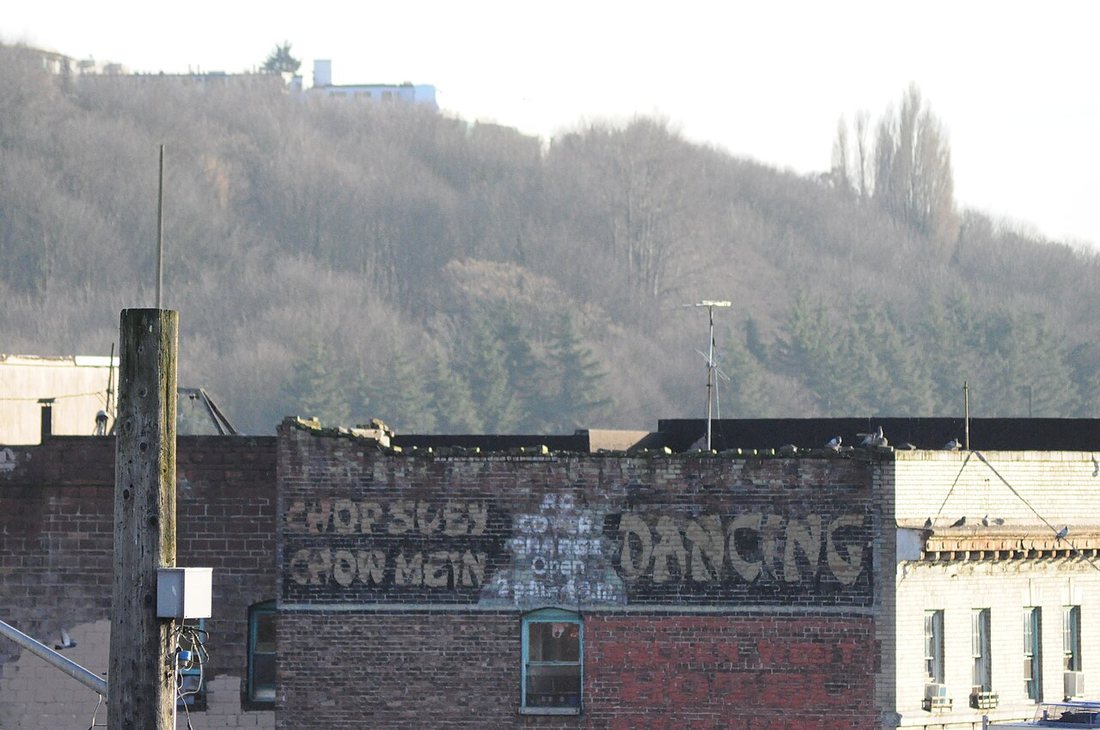
New Orleans is not the only place where an old Chinese American noodle dish survived as a Black neighbourhood food. In Hampton Roads, Virginia, it is yock, sold by the quart under a crown of warm ketchup. In Baltimore it is yat gaw mein or dirty yak, closer to a gravy than a soup. In Cambridge, Maryland, it is spaghetti with tomato sauce and soy. Washington, D.C., carry-outs list yat gaw mein too.
The pattern is the same everywhere, and so is the local story. Each is a Chinese American carry-out dish eaten in a Black neighbourhood, and in each place the local press reports two things: nobody knows where it came from, and it belongs to the town. Those claims are pride, not evidence. Taken together, the cousins are the strongest argument against any purely local invention of New Orleans yakamein — the same ancestor turned up in several port cities independently of any war.
Hampton Roads: yock and the box of yock
Tidewater yock is wheat (“flour-and-water”) noodles with a ketchup-forward sauce, soy, raw onion, boiled chicken or pork and often a hard-boiled egg, sold in quart containers or takeout pails — the “box of yock.” Matthew Korfhage described it in the Virginian-Pilot (17 August 2018): “The sauce’s primary ingredient is hot ketchup, mixed to taste with soy sauce, cider vinegar and chile pepper. On top, you’ve got raw onions, most likely some boiled chicken, and maybe a hard-boiled egg. It’s sweet, boomingly savory, starchy, salty, spicy, a little sour, and most importantly – very cheap.”
The dated record
- 1926. “Ransdell’s Oriental Tea Room advertised yok-a-mein for 20 cents in Portsmouth,” as reported by the Virginian-Pilot from its own archive in 2018 and again in 2026. The advertisement itself has not been seen.
- The Depression. Lorraine Eaton (Virginian-Pilot, 15 October 2013) mentions a Depression-era picture of a Portsmouth Chinese restaurant with “Yock” stencilled on the window; the photograph was not located.
- 1938. The Suffolk telephone directory lists the Horseshoe Cafe, 360 East Washington Street, as serving “Choice Oriental and American Dishes Including Chop Suey and Yock-A-Mein” (Suffolk-Nansemond Historical Society, 2019). Its owner, Tsuruju (Tsuruyu) Miyazaki, was a Japanese citizen later interned at Rohwer, Arkansas. Whether this was the same business as the “Golden Horseshoe,” where Bernice Cofield later made yock for 25 years, has not been established.
These are independent of New Orleans and predate both the Second World War and Korea. Winston Ho, historian at the University of New Orleans, notes the Virginia tradition is attested since at least the 1920s.
Noodles, restaurants, churches
Norfolk noodle factories have made “yock noodles” for decades. Eaton reported in 2013 that Fiber Foods, owned by Greg Shia, turned out 1,500 to 3,000 pounds (about 680 to 1,360 kg) of its trademarked “Yock-A-Mein” noodles a week. Sources disagree on the firm’s age: the Pilot called it “50-plus-year-old” in 2013, while the company says it was established in the 1930s. Its marketing claim that Atlantic Fleet sailors spread yock nationwide is unsupported.
The restaurants were a family network. Korfhage reported the closing in 2018 of Far East on Princess Anne Road after 47 years and Sun Wah on Tidewater Drive after more than 80 years in the family, both related to the owners of Sing Wong in Portsmouth. Sing Wong’s Patsy Wong described her method: “We use just Hunt’s ketchup, we add a little water. We have noodles, ketchup, meat – and if it’s pork or chicken, then raw onions. … Then you can season it with soy sauce, apple cider vinegar and red pepper, and that’s it.” On origins she said, “I don’t know how it started.”
Yock is also a church food. Eaton wrote in 2013 that “for decades, yock has been a fall and winter fundraising staple for local African American churches,” and that, “like fried blue crabs, it rarely crosses the color line.” She recorded one batch at Tabernacle Christian Church in Suffolk: 180 hard-boiled eggs, the meat of eight pork butts and 28 chickens, “vats of ketchup and precisely diluted soy sauce,” a 30-gallon bucket of factory noodles, and more than 150 quarts. Cofield ladled soy and noodles into each quart; Mary Whitley added onion, chopped egg and meat; Cofield finished it with “a crown of warm ketchup.”
The tradition was alive in 2026: the Pilot reported a “757 Yock Wars” contest in Portsmouth on 28 February 2026, and yock still on the menu at Mak’s Chinese Restaurant in Chesapeake and Mama Chan’s in Portsmouth (as reported in March 2026). One judge said he looked for ketchup, soy sauce, noodles, onions, chicken and shrimp — and that “the boiled egg was new to him.” The egg is not universal in Tidewater.
Local origin stories, reported in 2013, are undocumented: that yock grew up in the early 1900s when African Americans came to the area for government jobs, or that sailors brought it back from the Far East.
Washington, D.C.
The evidence is thin. A reader writing on Ho’s yakamein page in 2020 described “yat gaw mein” on Chinese carry-out menus in D.C. at “neighborhood joints catering to significant African American clientele.” Korfhage (2018) recorded Dianna Williams-Munford’s memory of women cooking it in Washington to sell at rent parties: it “didn’t have Tidewater’s signature ketchup base. The main liquid was soy sauce.” A Norfolk stylist’s reply — “That’s. Not. Yock!” — sums up the regional argument.
Baltimore: yat gaw mein and dirty yak
Christina Tkacik, in the Baltimore Banner (16 May 2025), described the dish at Pimlico Chinese Carry Out on Park Heights Avenue, run for 42 years by a couple from Hong Kong, as thick noodles in a brown sauce with onions, shrimp and a hard-boiled egg, often with ketchup added, under the names “yak, yat gaw mein, yakamein, yakame, and ‘dirty yak’.” Chesapeake Bay Magazine (2022) confirms that in Baltimore “it’s sold in Chinese restaurants as yat gaw mein.”
Accounts of the Baltimore form differ. Wikipedia calls it shellfish-based (shrimp, crayfish or blue crab instead of brisket); the Virginian-Pilot (2026) calls dirty yak “more of a stir-fried noodle with shrimp or beef and a thick, dark sauce.” Both are consistent with a gravy rather than a soup, which matches the Chandavkl blog’s remark that “the version with gravy is still served to this day in Baltimore.” No date for its arrival and no published recipe with quantities have been found.
Cambridge, Maryland: the tomato yock
Niambi Davis, in Chesapeake Bay Magazine (9 February 2022), recorded Cambridge cook Victoria Taylor’s version: “spaghetti noodles, tomato-based sauce, soy, and sometimes Worcestershire sauce,” with “a choice of meat, a squirt of ketchup, some onions, and a hard-boiled egg.” “As far as Ms. Taylor knows, Cambridge yock has no Asian connection.” Remembered sellers include a man called Florida Boy, who sold it from his house, and Streeters Bar and Club; a yock cook-off joined the city’s Groove City Cultural Festival in 2018.
Spaghetti, ketchup or tomato, soy and egg is recognisably the Tidewater formula on a supermarket noodle — the substitution Patsy Wong warned against (“The pasketti noodles out of the store? That’s not going to work”). Ms. Taylor’s view is a cook’s understanding of her own tradition, not evidence of a separate invention. No date for Cambridge yock has been found.
Further afield
| Place | What | Date | Source |
|---|---|---|---|
| Texas | ”ya ka mein” | 1918 | John T. Edge, as reported in the Virginian-Pilot, 2013 |
| Iowa | ”ya ka mein” | 1936 | same |
| Petersburg, Va. | ”ya ka mein” | 1965 | same |
| Las Vegas | on Chinese restaurant menus | 1950s | Ho |
| Sioux City, Iowa | ”Yetcamein … served in a delicious brown gravy” | late 1970s | Chandavkl, as an eyewitness |
| Newark, Del. | ”chicken yak” | — | Bernard L. Herman, via the Pilot, 2013 |
| Montreal | ”still lives on” | 2023 | Chandavkl |
Edge, then director of the Southern Foodways Alliance, traced the dish’s early roots to working-class port cities; his three dated finds are reported in the 2013 Pilot article, but the documents behind them have not been seen. Philadelphia and Pittsburgh are named by Wikipedia; no independent dated evidence for either has been found.
The common ancestor, and the sesame oil
The Chandavkl blog frames these as “permutations of a simple, basic, longstanding Chinese-American dish,” descended from “a simple noodle soup made with soy sauce and sesame oil” — a description that matches Chan’s 1917 recipe, which seasons the bowl with soy, oil and “a few drops sesamum-seed oil.” It distinguishes a soup line from a minority “dry, perhaps lo mein-ish” line, and notes the dish “disappeared long ago from major centers of Chinese population.”
None of the surviving branches, as described, uses sesame oil. None of the New Orleans, Tidewater, Baltimore or Cambridge descriptions mentions it. What each branch kept is soy and, in most places, the hard-boiled egg; what each added is local — Creole seasoning in New Orleans, hot ketchup and cider vinegar in Tidewater, brown gravy in Baltimore, tomato in Cambridge.
What is not related
Resemblance is not descent. Three dishes are often linked to yakamein without evidence:
- Phở. Beef, broth, noodles, scallion and table hot sauce make the likeness real, but no source proposes a connection, and Vietnamese immigration to New Orleans came more than half a century after the 1918 New Orleans attestation. Modern overlap is real in the shops — Ian McNulty (NOLA.com, 2019) reported that Minh Tran of Riteway Soul Food starts his yakamein stock “the same way he begins the pho” — but that is coexistence, not ancestry. Maurice Haynes’s belief that it “originated like in Vietnam, from what I read” is, by his own account, secondhand.
- Korean noodle soups. The only proposed link is the Korean War veteran story, which fails on chronology (Where It Came From). No source identifies a Korean dish as an ancestor.
- 牛肉麵, Chinese or Taiwanese beef noodle soup. Despite the “ngau yoke mein” etymology sometimes offered (The Name), no source shows descent from it. The documented ancestor is a Chinese American restaurant dish, not an imported regional Chinese one, and its earliest recipes are not beef dishes.
Recipes in the collection
- Yat Ko Main (1914 Chinese American Noodle Soup) — close to the common ancestor
- Yakamein (New Orleans Beef Noodle Soup) — the New Orleans branch
- Phở Bò (Vietnamese Beef Noodle Soup) — a look-alike, not a relative
- Taiwanese Beef Noodle Soup — 牛肉麵, for comparison
Comments (0)