Yakamein · 1 of 9
What Yakamein Is
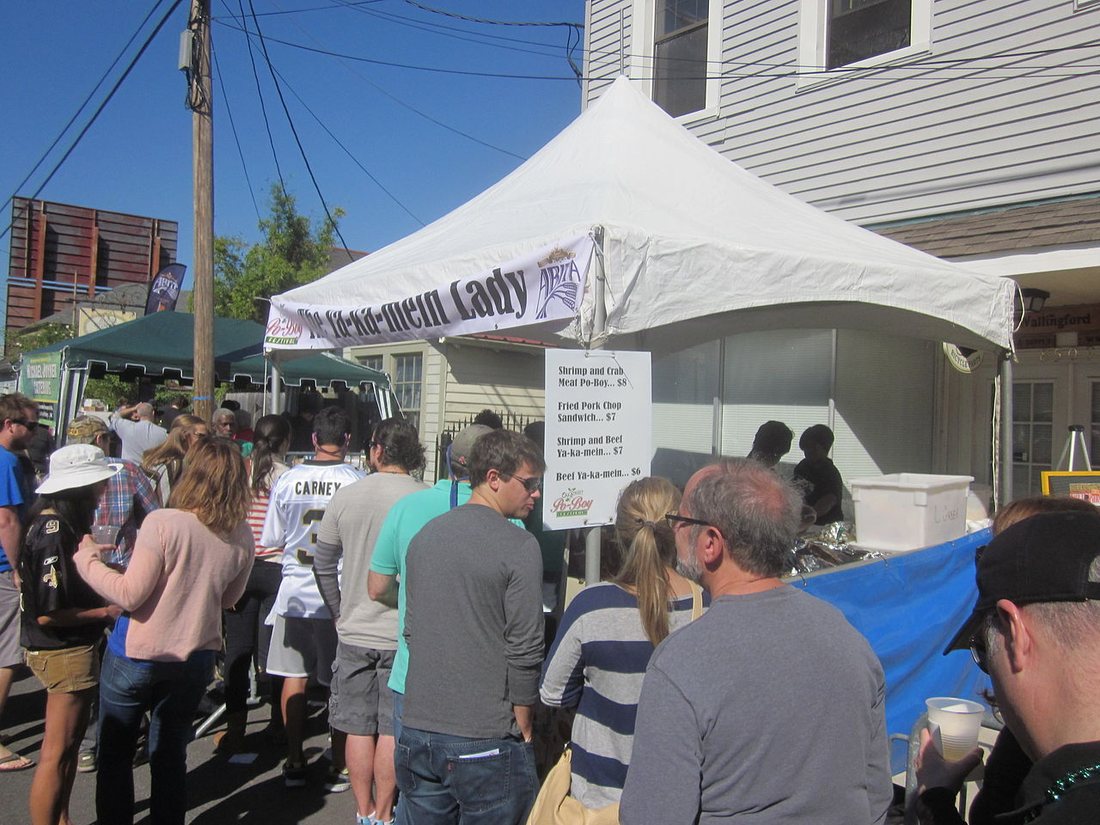
Yakamein is a beef noodle soup sold in New Orleans out of corner stores, bars and coolers at second-line parades: ordinary spaghetti, chopped stewed beef, half a hard-boiled egg and a heap of green onion, drowned in a dark, salty beef broth seasoned with soy sauce and Creole seasoning, with hot sauce and ketchup added by the person eating it. The Southern Foodways Alliance (SFA), which recorded an oral-history project on the dish, put its setting in six words: “bar food. Second line food. Corner grocery food.”
Almost every element of that bowl is older than its New Orleans reputation. The spaghetti, the half egg per bowl and the habit of seasoning at the table all appear in Chinese American cookbooks between 1911 and 1932. What New Orleans added is mainly the beef, the Creole seasoning, the ketchup and the hot sauce. The rest of this section follows those threads: where it came from, the Chinatown that served it, what the name means, and its relatives in Virginia and Maryland.
The canonical bowl
The sources agree closely on the core. The SFA project, the recipe adapted from Linda Green in Louisiana Cookin’ (2017), the Garden & Gun recipe credited to her, and the America’s Test Kitchen recipe (Matthew Fairman, 2021) all build the same thing.
| Component | Usual form |
|---|---|
| Noodle | Dried spaghetti, cooked soft |
| Broth | Beef, from simmering the meat itself; darkened and salted with soy sauce; seasoned with Creole seasoning |
| Meat | Beef stewed or boiled until tender, then chopped or shredded to bite size. Chuck is the most published cut; eye of round and brisket also appear |
| Egg | Hard-boiled, halved or quartered, sitting in the bowl |
| Green onion | Raw, chopped, a handful on top. Every source has it |
| At the table | Soy sauce, hot sauce and ketchup |
Philipe LaMancusa, whom the SFA called its “ya-ka-mein scholar”, gave the shortest working definition on tape in 2012: “There’s no set taste for ya-ka-mein except brown. It’s got to taste brown and salty, and it’s got to have a handful of green onions.” Lucinda Mitchell, who sold it from a fruit stand outside Charity Hospital, gave hers the same year: “It’s roast beef, spaghettis, green onion, and egg, and a sauce that I put together personally.”
Soy sauce is “the twist”
Linda Green, the best-known vendor of the dish, told SFA interviewer Sara Roahen in 2013 that “the only thing the twist is is soy sauce”, and that it belongs in the pot, not only on top: “You got to cook that soy sauce.” Her mother’s method put soy on after the broth was made as well. Published recipes split on this point. Garden & Gun puts ½ to ⅔ cup (120–160 ml) of soy sauce into the stock; the Louisiana Cookin’ card puts none in the broth and finishes each bowl with a dash; the NYT Cooking recipe (Millie Peartree, 2023) leaves soy to the table entirely. Making It compares the published versions in detail.
Ketchup is not a mistake
Ketchup is listed as a garnish in the Louisiana Cookin’ recipe and appears both in the broth and on the table in the Garden & Gun version. Ms. Green keeps it on the counter for customers rather than in the cup: “I don’t put that in there for them.” Hot sauce she does add — Tabasco in every cup, which she said is “something that connects it.” Maurice Haynes, who cooked it on the sidewalk outside a second-line bar, likewise left soy, hot sauce and ketchup to the customer.
The spaghetti question
Spaghetti is often explained as a cheap New Orleans stand-in for Chinese noodles. The evidence points the other way: the substitution happened in Chinese American kitchens, not in Black New Orleans ones. Winston Ho, a historian at the University of New Orleans who has done the archival work on the dish, holds that Cantonese immigrants created it in North America in the late 1800s “from whatever ingredients they could find in North America — spaghetti noodles instead of Chinese noodles for example.” The often-repeated reason (Chinese noodles being scarce and expensive) has not been traced to any documented source; the conclusion matches Ho, the mechanism is unproven.
The noodle is not uniform even in New Orleans testimony:
- Linda Green: “I use number four spaghettis, the regular spaghettis”, adding that “my mama always used the spaghettis” (SFA, 2013).
- Maurice Haynes: “the original noodles are the linguines for the ya-ka-mein but some people use spaghettis, angel pasta” (SFA, 2012).
- LaMancusa recalled two women at Circle Food Store disagreeing, one for angel hair and one for spaghetti, and remembered his first bowl, from a corner market on St. Claude Avenue, made with ramen-like noodles and dried shrimp.
- The SFA project records linguine, udon and ramen as substitutions.
Every street-style published recipe uses spaghetti. The two that do not (udon at Oxlot 9 in Covington, 2016; unspecified noodles in John Folse’s seafood version, 2025) are restaurant reinterpretations. America’s Test Kitchen cooks the pasta “fully tender”, not al dente, which matches the soft street texture.
Half an egg, back to 1911
The half egg is the most stable measurement in the dish. Five independent modern recipes give exactly half a hard-boiled egg per bowl: Louisiana Cookin’ (2 quarters each, 4 eggs for 8 bowls), Garden & Gun (5 eggs for 10), TODAY (Toya Boudy, 2024), America’s Test Kitchen (3 eggs for 6) and Food & Wine (Brian Jupiter, 2023).
The ratio is printed long before New Orleans claimed the dish. Jessie Louise Nolton’s Chinese Cookery in the Home Kitchen (Detroit, 1911, p. 67) garnishes its “Yet Gai Mein” with “one-half a hard boiled egg for each bowl”, plus strips of cured pork and chicken, and adds that “Additional seasoning may be supplied at the table.” La Choy’s The Art and Secrets of Chinese Cookery (Detroit, 1932) garnishes “Yet-Ca-Mein” with “halves of hard boiled eggs” and says to serve it with soy sauce. Maclean’s (1927) uses sliced hard-boiled egg. The one early outlier is Shiu Wong Chan’s The Chinese Cook Book (New York, 1917), which has no egg at all.
No source explains why the egg is there. What can be said is that it is not a New Orleans addition.
What varies
The SFA records pork, chicken and seafood versions, and the Louisiana Cookin’ headnote says “other proteins like pork or shrimp are also common.” The dated variants:
- Pork chop. Linda Green’s mother, Shirley Green, made it at home “with a pork chop. That’s what black families were doing”, boiled and “chop[ped] up real good”; her grandmother and great-grandmother did the same (SFA, 2013). Beef is Ms. Green’s own change, made for vending: “beef carries more than pork do” when travelling, and does not spoil as readily.
- Shrimp, chicken, smoked sausage. Ms. Green listed all three as home variations in 2013. Menus listed in Eater (2023) and on Yelp offer beef, chicken, shrimp and combinations; Haynes defined a “combination” as shrimp, chicken, beef and pork together.
- Pork, ham and char siu. Ian McNulty (NOLA.com, 2019) described John & Mary’s Food Store’s “yatkamein” as a mix of shrimp, pork and ham with char-grilled pork and cilantro; Eater (2023) said its broth is “spiked with char siu roasted pork.”
- Alligator, oysters, duck, no meat. McNulty reported in 2019 that Ms. Green had developed versions with “oysters, duck, alligator or no meat at all.” She described a vegetarian version made for Jazz Fest in 2013, and NOLA.com reported a vegan version new at her 2025 booth.
- Vegetables. The Louisiana Cookin’ card offers boiled cauliflower, broccoli or carrots as optional garnish; McNulty (2019) found broccoli and cauliflower with ramen noodles at the Rampart Food Store.
Atlas Obscura’s summary is fair: “There are as many versions of the dish as there are corner stores and grandmothers who make it.” It is a folk dish with no governing authority.
How it is sold
Yakamein has mostly been sold to be carried, not sat over. Ms. Green started “at the second line”, and in 2013 sold a 16-ounce (about 475 ml) cup there and a 12-ounce (about 355 ml) “festival-sized” cup at festivals, for seven and eight dollars. At Jazz Fest she held the components in a cooler at about 34 °F (1 °C) and assembled each order in a lidded Styrofoam cup. Red Rooster’s menu sells “YET-CA-MEIN” by the 16- and 32-ounce cup; McNulty’s 2019 headline put it as “hangover relief by the quart.”
It is eaten with a fork. “I don’t carry spoons with me when I’m doing ya-ka-mein,” Ms. Green said, and then the broth is drunk from the cup: “That juice coats the inside of your body.” The broth’s reputation as a hangover remedy, and the nickname “Old Sober” that goes with it, are taken up on their own page.
Second-line vending had a legal problem: the Times-Picayune reported in 2011 that no city permit allowed food vendors to follow a moving parade, although they had done so for years. The dish was nonetheless at Jazz Fest by 2005 and on the 2026 official vendor list under Ms. Linda’s Catering.
Recipes in the collection
- Yakamein (New Orleans Beef Noodle Soup) — the Garden & Gun version, soy in the broth, chuck simmered 3–4 hours
- Ms. Linda’s Original Ya-Ka-Mein (Louisiana Cookin’) — the seasoning-packet card, with its substitute
- Beef Yakamein (America’s Test Kitchen) — trinity strained out, MSG in the broth
- Seafood Yakamein (John Folse) — a restaurant consommé version
- Yat Ko Main (1914 Chinese American Noodle Soup) — the ancestor, from a 1914 cookbook
- Creole Seasoning Blend (Jeff’s) · Emeril’s Essence (Creole Seasoning) · Cajun Seasoning
Comments (0)