Yakamein · 6 of 9
"Old Sober" and the Hangover Question
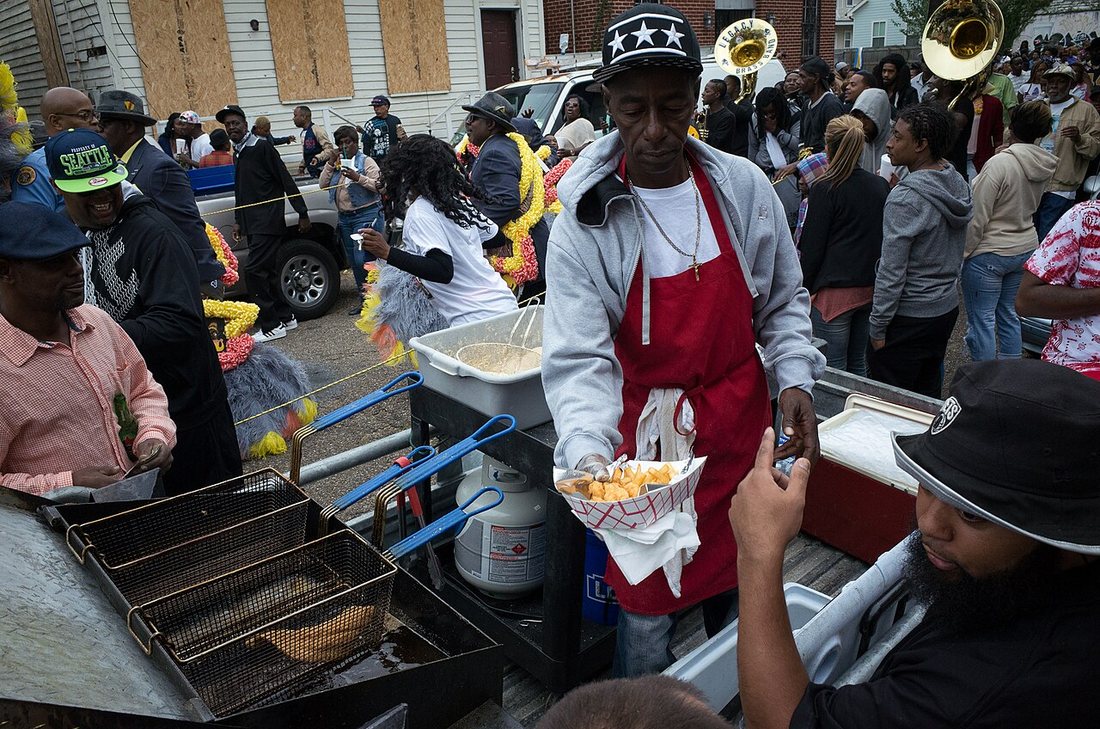
Yakamein’s best-known nickname is “Old Sober”, and its best-known reputation is as a hangover cure. Both are real parts of how the dish is eaten in New Orleans. Neither is as old, or as well supported, as the confident way they are usually stated would suggest.
The nickname cannot be traced in print before 2006, and the dish’s best-known maker did not know it growing up. The cure has never been tested: no trial has ever looked at yakamein, or at any broth or soup, as a hangover remedy, and the reviews of hangover treatments find good evidence for nothing at all. What remains is a tradition with a sound social basis and an unproven medical one.
What the nickname means
The meaning is not in dispute. The people who sell and eat the dish tie it to bars and to the end of a night’s drinking. Linda Green, in her 2013 Southern Foodways Alliance oral history:
“they call it Old Sober, and I connect with that because it was always in the black bars. … at the end of the night that’s the thing that they get and bring home. That’s to sober them up” (Roahen, SFA oral history, 2013, p. 12).
Maurice Haynes, interviewed for the same project in 2012, described the same use: customers “come buy the ya-ka-mein to try to come down off of their drinking”, and “Before they’d go home they’ll eat a little bit, sober up a little bit, and eat the rest in the morning” (pp. 14–15). SFA’s own short description of the dish, “bar food. Second line food. Corner grocery food”, puts the bar first.
How old is the name?
The earliest print found: 2006
The oldest use found is in Ian McNulty’s Jazz Fest preview “Food in Flux”, in Gambit, May 1, 2006. Describing Linda Green’s booth, he called yakamein “an only-in-New-Orleans soup made from any combination of meat, egg, greens and noodles in a spicy, salty broth that carries the endearing nickname ‘old sober’ for its purported qualities as a hangover cure.”
Two limits apply. The nola.com digital archive thins out before the mid-2000s, and the Times-Picayune print morgue and the Louisiana Weekly could not be searched. So 2006 is the earliest date found, not the date of coinage. Writing “endearing nickname” in 2006 implies the name was already in use by then.
Nothing older in the national record
Chronicling America, the Library of Congress newspaper collection (mostly pre-1964), has 733 pages using the phrase “old sober” nationally and 13 in Louisiana between 1855 and 1895. The Louisiana pages checked use it as an ordinary adjective — “an old sober politician” (Baton Rouge, 1866), “an old sober Methodist horse” (Baton Rouge, 1856). None uses it of food. The same collection holds no Louisiana page with the dish’s name in any spelling, although it was printed elsewhere in the country from 1905 on (see What the Popular Story Gets Wrong).
The people who grew up with the dish did not use it
The strongest evidence is testimony. Linda Green was born in 1957 and raised in Central City, where her mother and grandmother cooked the dish. Asked by Sara Roahen whether she knew the term growing up, she answered:
“When I was coming up, no, we didn’t know it. I didn’t know it. I didn’t know it, no.” (p. 14)
Her household called the dish “ya-ka-meat”. Maurice Haynes’s grandmother made it on winter Saturday afternoons, not as a bar food (p. 17). Chip Flanagan, a chef, first ate yakamein around 2000 and learned “Old Sober” only afterwards: “you’re hungover, that’s what you have the next day” (p. 13). A 2025 writer in the Provincetown Independent put it more bluntly — “countless writers say [it] goes by the nickname ‘Old Sober,’ though nobody I know calls it that” — a single voice, but consistent with the rest.
Not everyone accepts the hangover role. Asked whether yakamein helps a hangover, Lucinda Mitchell of Mitchell’s Fruit Stand said: “No indeed unless you put some hot sauce in it” (p. 72).
What can be said: “Old Sober” is bar-culture slang of uncertain age, in print since May 2006, and not used by every family that made the dish. Its coiner and first date are unknown.
The hangover evidence
What a hangover is
The Alcohol Hangover Research Group’s consensus definition is: “the combination of mental and physical symptoms, experienced the day after a single episode of heavy drinking, starting when blood alcohol concentration approaches zero” (van Schrojenstein Lantman et al., Current Drug Abuse Reviews, 2016).
No treatment has good evidence
Three systematic reviews cover the trials:
| Review | Scope | Conclusion |
|---|---|---|
| Pittler, Verster & Ernst, BMJ, 2005 | Randomised trials of any intervention | ”No compelling evidence exists to suggest that any conventional or complementary intervention is effective for preventing or treating alcohol hangover.” |
| Jayawardena et al., Human Psychopharmacology, 2017 | Treatment and prevention | Several products improve “some, but not all, of the symptoms”, and “further research is necessary”. |
| Roberts et al., Addiction, 2022 | 21 placebo-controlled trials, 386 participants | ”Only very low quality evidence of efficacy is available to recommend any pharmacologically active intervention.” |
The only food-like treatment in the 2005 review’s trials was fructose or glucose, with no significant effect reported. No trial or review of broth, soup, salty food, or a meal after drinking was found. Yakamein, and soup in general, has never been tested.
A hangover is not mainly dehydration
The usual case for a salty broth is that it replaces water and salt lost through drinking. Later measurement does not support that premise:
- A 2010 review of hangover pathology found that electrolytes and markers of dehydration such as vasopressin “were not significantly related to hangover severity”; the “most convincing” relationship was with immune factors (Penning et al., Current Drug Abuse Reviews, 2010).
- A 2024 study concluded that “alcohol hangover and dehydration are two co-occurring but independent consequences of alcohol consumption”; drinking water did not relieve the hangover (Mackus et al., Alcohol, 2024; the authors declare industry consultancies).
- A small 2026 crossover trial in 13 men found water taken during drinking “did not affect hangover symptoms” (Imai et al., Frontiers in Pharmacology, 2026).
- A 2024 binge-drinking study measured blood sodium and found it went up, not down: “binge drinking causes a transient increase in serum sodium” (Podobnik et al., Toxics, 2024; 40 participants, one short session).
There is older evidence the other way. A 1978 study of seven men found the highest vasopressin levels in those with the worst symptoms, and suggested that severity “may” be associated with hydration (Linkola et al., Acta Physiologica Scandinavica). The later syntheses do not bear that out, but it should not be dropped from the record.
A 2024 narrative review argues that a hangover is a form of sickness behavior caused by alcohol-driven inflammation (Turner et al., Alcohol: Clinical and Experimental Research, 2024), though one 2021 study found salivary cytokine changes did not track severity, so that picture is not settled either.
The 2013 American Chemical Society item
The claim that “a study” showed yakamein cures hangovers traces to one event. On April 9, 2013, the American Chemical Society issued a press release on a talk by Alyson E. Mitchell of UC Davis at a symposium called “Chemistry of the Bar”, part of the society’s 245th National Meeting, held in New Orleans. The release itself describes the talk as “an overview of the chemistry of hangovers”. It describes no measurement of yakamein.
The headlines turned it into something else — “Yak-a-mein soup can beat a hangover: study” (National Post, April 11, 2013) — and NOLA.com in 2019 still referred to “the findings of a scientific study”. It was a conference overview that mentioned the local dish, not a study of it. Mitchell’s own advice in the release ends: “the only sure way to prevent a hangover is to abstain… or drink responsibly.”
She gave two specific reasons the dish might help:
- Broth, “because it contains salts that can help replace sodium, potassium and other salts lost in the urine.” The 2010, 2024 and 2026 work above does not support the premise that a hangover is a salt or water deficit.
- Eggs, “which contain cysteine, which helps to remove acetyldehyde from the body.” The cysteine evidence comes from supplements, not food. A 2020 trial in 19 men reported effects at a dose of 1,200 mg of L-cysteine, based largely on correlational analysis, and the paper carries a published erratum. The related compound N-acetylcysteine failed in two randomised trials (2021 and 2024). No study has shown that the cysteine in a hard-boiled egg affects a hangover.
What a hot, salty bowl plausibly does
None of this makes the tradition foolish. Yakamein is hot, salty, cheap, filling and sold near the bars at the hour people leave them. A bowl of noodles, beef and broth at the end of a night, or the next morning, is consistent with what people want when they have been drinking, and Linda Green ties the habit to the city’s Black bars: “it was always in the black bars.” That holds whatever the age of the nickname.
What it is not, on the evidence, is a treatment. The specific mechanisms claimed for it — replacing lost sodium, egg cysteine clearing acetaldehyde — are either contradicted by later measurement or untested at food amounts. The reviews’ bottom line applies to yakamein as to everything else: no food or drug has good evidence as a hangover cure. The history of the dish itself is on Where It Came From, and the bowl is described on What Yakamein Is.
Comments (0)