Using the Oven: Heat, Launch, Turn, Recover
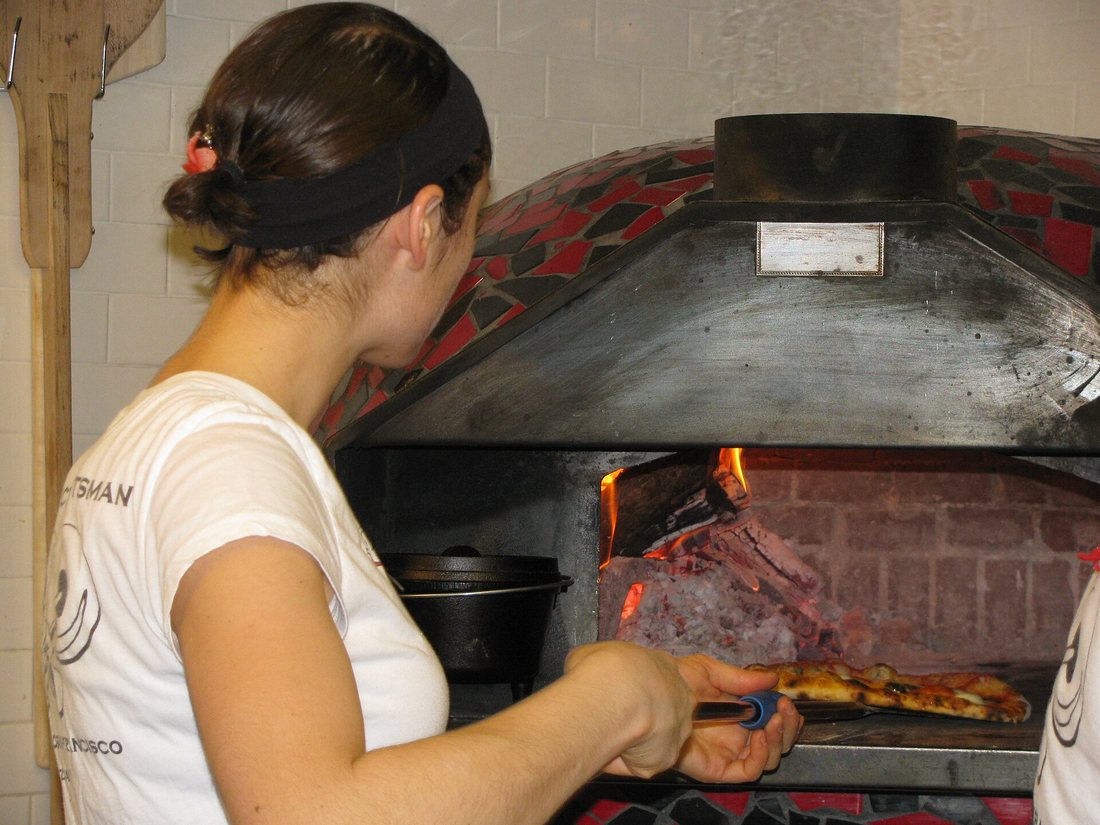
The small turning peel: a quarter turn every 20–30 seconds, once the bottom has set.
Pizza in a wood-fired oven is a two-minute job that takes an hour of preparation. The oven has to be hot all the way through; the dough has to slide off the peel; and the pizza has to be turned before the side nearest the fire burns. None of it is difficult, but every step has a way to fail. This page gathers the technique from the manufacturers and from the test kitchens that have baked hundreds of pizzas in these ovens.
1. Heat the oven — and measure the stone
The flame is not the signal; the stone is. Gozney warns that beginners “often see a flame and assume the oven is ready, but the stone floor may still be too cool.” A portable oven takes 15 to 45 minutes to heat, depending on fuel, wind and cold; a masonry oven takes hours.
- Use an infrared thermometer on the stone, near the fire. Built-in gauges, including the Karu 2 Pro’s digital hub, read the air.
- Target stone temperatures:
| Style | Stone | Source |
|---|---|---|
| Neapolitan | 750–900 °F (400–480 °C) | Ooni (at least 750 °F); AVPN floor 716–806 °F; Janjigian 800 °F; English 850–900 °F |
| New York–style | about 750 °F with the flame low | Ooni |
| Pita | 600–700 °F, far from the flame | Ooni |
| Flammkuchen | about 570 °F | Ooni |
- On the very first firing, follow the manual: the Karu 2 Pro’s asks for the fuel to be kept “red hot for at least 30 minutes” before cooking.
- Keep the door closed during preheating if the oven has one. It holds the heat and the flow of hot air across the roof.
2. Manage the fire
- Small, dry hardwood; add a little at a time onto glowing embers.
- Keep a flame rolling across the roof — that is what cooks the top.
- In the Karu, set the chimney vent partly closed for wood (fully open for gas), and wear gloves to open the fuel hatch — flames “lick up the hatch.”
- See wood and fire for species, dryness and size.
3. Launch
The pizza has to slide from the peel onto the stone in one motion.
- Peels: a wooden peel for launching (it releases dough more readily) and a perforated metal peel for retrieving; excess flour falls through the holes. Most cooks use both, plus a small round turning peel.
- Keep the launching peel cool and dry. Ooni warns that steam on a warm peel “can act like glue”; Gozney: “Never try and use the peel to launch a fresh pizza unless it is cool to the touch.”
- Dust lightly. Flour or semolina; the pizza maker Dan Richer uses half rice flour, half wheat flour, because rice flour resists moisture. Too much flour or cornmeal burns on the stone and tastes bitter — Wirecutter’s excess cornmeal caught fire.
- Top the pizza on the peel, quickly, and give it a shake to check it moves before it goes near the oven. A pizza left sitting with its sauce on will stick.
- The motion: push forward and pull the peel back sharply — “as much about the backwards movement … as the forward,” like pulling a tablecloth from under the dishes.
- Size: stretch the pizza an inch or two smaller than the oven so there is room to turn it.
- Launch away from the flame, not right beside it.
4. Turn
- Wait for the bottom to set before the first turn — about 30 seconds, or until the crust at the back starts to colour and rise. Turning too early tears the base.
- Then turn a quarter or a half turn every 20–30 seconds, always putting the pizza back on the same spot.
- Timing: a Neapolitan pizza takes 60–120 seconds; a New York–style pizza at lower heat, 4–5 minutes.
- For a pale top, lift the pizza toward the roof on the peel for a few seconds at the end (“doming”).
5. When it goes wrong
| Problem | Cause | Fix |
|---|---|---|
| Sticks to the peel | warm or damp peel; toppings sat too long; too little flour | cool dry peel; shake before launching; semolina or rice flour; launch quickly |
| Burnt bottom, pale top | stone too hot for the flame | let the stone settle to 800–900 °F; feed the fire for a stronger flame |
| Burnt edge or toppings | too close to the flame | launch farther from the fire; turn more often; a smaller pizza |
| Pale, soft base | stone not hot enough, or not recovered from the last pizza | preheat longer; check with the thermometer; move to a fresh spot |
| Pale top | fire too small | build a rolling flame; keep the door closed while heating |
| Soupy middle | too much sauce or cheese; wet mozzarella | less topping; drain tomatoes and fresh mozzarella; add fresh cheese after baking |
| Torn base | turned too early | wait ~30 seconds; a torn pizza folds into a calzone |
| Bitter, burnt taste | flour or cornmeal burning on the stone | dust less; brush the stone between pizzas |
6. More than one pizza
The stone is a battery. Each pizza takes heat out of it: testers measured a drop of about 100 °F per pizza and about five minutes to recover. Wait between pizzas, check the stone, and launch each pizza on a different spot from the last. A door helps an oven recover between pizzas.
7. Clean up
- Let the fire burn out. Don’t remove ash until the oven is completely cold — Gozney warns that “after 24 hours ashes can still be hot.”
- Empty the fuel tray into a metal container with a lid.
- Clean the stone by burning it off at full heat for about 30 minutes and brushing it. Never use water or soap on the stone — it cracks from thermal shock and absorbs chemicals. Stains are normal.
- Clean the glass door with a dry paper towel, then a mix of 1 part vinegar to 3 parts water (Ooni).
- America’s Test Kitchen empties ash and half-burnt wood and sweeps the oven after every use.
8. A Michigan winter
- Bring a portable oven indoors for the winter if it can be carried. Ooni says its ovens are “built to live outdoors” under a cover; testers disagree — America’s Test Kitchen has “seen rust and mold form even when our ovens were under wraps,” and Serious Eats recommends bringing ovens indoors for the winter.
- Cooking in the cold is possible, with care:
- brush off snow before lighting;
- keep the stone indoors between cooks, so it starts dry and warm;
- put the back of the oven to the wind;
- expect a longer preheat — Ooni says 15 to 30 minutes.
- Heat a cold oven slowly. Gozney recommends “a low slow fire up to prevent thermal shock to the stone” in real cold.
- Wind moves the temperature. Elizabeth English calls an infrared thermometer “a must-have … as the temperature can fluctuate drastically with a huge gust of wind.” Gozney says not to use its oven in strong wind at all.
In this dive: The history · What makes it Neapolitan · How the oven cooks · Choosing an oven · The Ooni Karu 2 Pro · Wood and fire · Using the oven · Safety and the law · The dough · Pizza styles · Beyond pizza · Corrections
Comments (0)