The History: From a Roman Bakery to a Backyard Oven
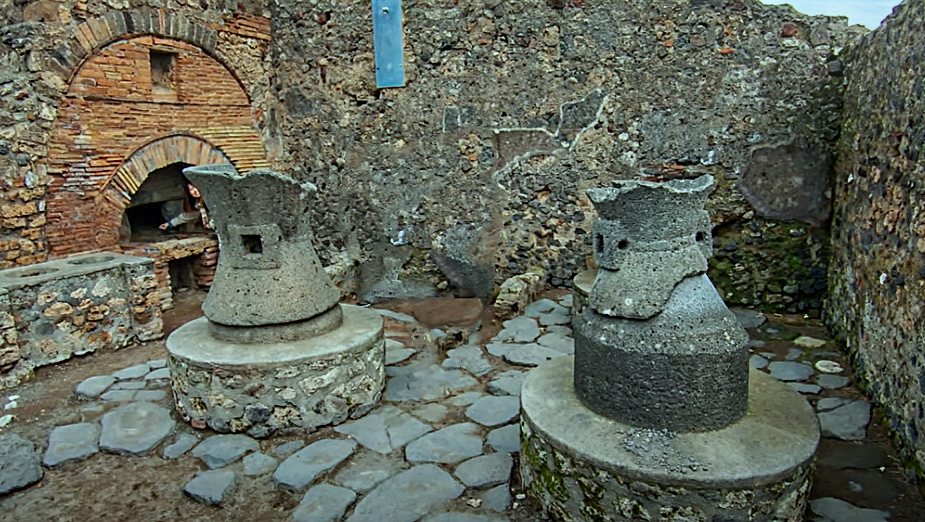
A Pompeii bakery: the millstones in front, the domed oven behind. Mill and oven shared one building — and the oldest known “pizza” is rent owed on a mill.
The wood-fired pizza oven is two old things joined late. The domed oven is Roman, or older; the flat, topped dough called pizza is Neapolitan, and for most of its life it was cheap street food with no fixed recipe. Their marriage into the modern Neapolitan pizzeria is a story of the eighteenth and nineteenth centuries — and nearly every famous date in it turns out to be softer than the story that carries it.
The domed oven
Pompeii was full of bakeries, and a Pompeian bakery was usually a mill and an oven in one building. At the bakery of Popidius Priscus, the Archaeological Park of Pompeii describes grain ground between large lava millstones — a cone-shaped lower stone and an hourglass-shaped upper one, turned “by slaves or animals” — and bread “baked in different shapes in the large oven at the centre of the building.” The park has since published a second bakery (Regio IX, Insula 10) where the mill room was a prison: barred windows, and grooves cut in the floor to guide blindfolded donkeys round and round — in the park director’s words, “the most shocking side of ancient slavery.”
The Latin word for that oven was furnus, and it survives in the languages that inherited it: Italian forno, Spanish horno, French four. The domed, wood-fired oven spread with the Mediterranean world, and in Spain the beehive-shaped horno was carried to the Americas, where Pueblo cooks in New Mexico still bake in it.
Not every oven is a dome. A tandoor is a tall clay jar heated from the bottom, and bread is slapped onto its inside wall; the word runs back through Persian tanūr to Akkadian tinūru, which appears in the Epic of Gilgamesh. A tabun bakes bread on a bed of hot stones. The domed oven bakes on a floor, under a low vault — and the Neapolitan version does something the others do not: it keeps the fire burning beside the food while it cooks.
The communal village oven was often a tax. Under French seigneurial law, peasants were obliged to bake in the lord’s oven — the four banal — and pay for the privilege, a monopoly abolished on the night of 4 August 1789. The “shared village bread oven” is a romantic image of a compulsory service.
The word “pizza” is rent
The oldest known use of the word is in a Latin lease from Gaeta, May 997, printed in the Codex diplomaticus Cajetanus (1887). The tenants of a mill (pistrinum) on the Garigliano river owed the bishop, every Christmas, “twelve pizze and a shoulder of pork and a loin,” and at Easter twelve more pizze and a pair of chickens.
The oldest pizza on record is a rent payment, owed on a mill — the same mill-and-bakery building as Pompeii’s. What a pizza was in 997 the lease does not say. It is a word in a list, and any description of it as a topped flatbread is a guess.
Naples: pizza before the Margherita
The first detailed portrait of the Neapolitan pizzeria is an essay called “Il Pizzajuolo” by Emmanuele Rocco, in Francesco De Bourcard’s Usi e costumi di Napoli (published in the late 1850s or 1860s; the exact year is disputed). It is worth reading because it describes the pizza before the rules:
- How it was made: “Take a piece of dough, roll it out with a rolling pin or stretch it with the palms of your hands, put on it whatever comes into your head, dress it with oil or lard, bake it in the oven, eat it.” Both the rolling pin and the lard are forbidden or absent today.
- What went on it: the commonest pizza was garlic, oil, oregano and salt — today’s marinara, without tomato. Others were topped with grated cheese and lard and “a few basil leaves,” or “thin slices of mozzarella.” Tomato appears only as an occasional extra, alongside ham and clams.
- The oven: a pizzeria was a counter, some eating rooms and “an oven always lit that never satisfies its greedy mouth.” Street sellers carried small pizzas out from the shop, and boys breakfasted on pizza made from yesterday’s soured dough.
So basil and sliced mozzarella were on Neapolitan pizza decades before 1889. The historian Antonio Mattozzi’s archive-based history, Inventing the Pizzeria (2015), places the rise of the pizzeria itself in the late eighteenth and early nineteenth centuries, among a marginal class of pizza makers.
Founding dates, as the pizzerias tell them. Antica Pizzeria Port’Alba’s own website gives two: it “was born as a pizzeria in 1738” and was founded as “pizzeria and osteria” in 1830. Its plaque from the mayor calls it the oldest pizzeria in Naples still operating — not the oldest in the world. Pizzeria Brandi’s site says 1760 in one place and uses “1780” in its social handle.
The Margherita and the Queen
The story: on 11 June 1889, Raffaele Esposito of the Brandi pizzeria made three pizzas for Queen Margherita of Savoy at Capodimonte; she preferred tomato, mozzarella and basil — the colours of the Italian flag — and the pizza was named for her. A thank-you letter from the head of the royal table service hangs in the pizzeria.
The story is contested in peer-reviewed scholarship. Zachary Nowak, “Folklore, Fakelore, History: Invented Tradition and the Origins of the Pizza Margherita” (Food, Culture & Society, 2014), examines the letter. As summarised in Italian sources, the objections are the type of stamp, the missing letterhead, the handwriting, the signature, and the absence of any copy in the royal household’s records; and the court cook, Amedeo Pettini, never mentions the episode in his cookbooks. According to the same summaries, the story and the name were first promoted in the 1930s and 1940s.
Two more facts complicate it:
- Even the EU regulation that protects Neapolitan pizza does not say the Margherita was invented in 1889. It says the pizza “dates from 1796–1810” and was presented to the queen in 1889.
- An Italian newspaper story reported for 1880 — nine years earlier — has a pizzaiolo named Giovanni Brandi summoned to Capodimonte to make pizza for the Queen, with no pizza called “Margherita.” That report comes from a single secondary source and is not confirmed.
The honest summary: tomato, mozzarella and basil were not invented in 1889, and the royal letter is disputed. The one party that clearly benefits from the story is the pizzeria that tells it.
America: coal, not wood
The first American pizzerias burned coal. Lombardi’s in New York advertises itself as “America’s First Pizzeria®, Est. 1905,” and bakes in a coal oven. The documentary record, assembled by the pizza historian Peter Regas from city directories and Italian-language newspapers, is different: a pizzeria operated at 53 Spring Street from about 1898, under Filippo Milone and then Giovanni Santillo, who was advertising an “Antica Pizzeria Napoletana” there in 1904. Gennaro Lombardi, a 17-year-old new arrival, may have worked there in 1905; he owned the business briefly in 1908 and again from about 1918. The 1905 date traces in print to a 1953 Collier’s article.
Frank Pepe opened his pizzeria in New Haven in 1925, in a coal-fired brick oven the company describes as 14 feet square; its white clam pizza dates, by the company’s account, from 1964. New Haven’s apizza — from Neapolitan ‘a pizza — is still a coal-oven style. Why the early pizzerias chose coal is not documented in any source consulted here; the usual explanation (it was the cheap bakery fuel of Northeastern cities) is plausible and unproven.
The American wood-fired pizzeria is a later revival, and the domestic masonry oven later still: Forno Bravo began importing and selling Italian ovens and free “Pompeii Oven” building plans in 2003 — naming the backyard oven after the Roman bakeries it descends from.
Michigan’s contribution is the least wood-fired thing in pizza. Detroit-style pizza was born in 1946 at Buddy’s Rendezvous on Six Mile and Conant, baked in steel pans borrowed from the auto plants. Little Caesars was founded in Garden City in 1959, and Domino’s began in Ypsilanti in 1960. The pan and the delivery chain are Michigan’s.
The portable oven
The small outdoor pizza oven is a product of the last fifteen years:
- Ooni was registered in the UK on 3 December 2012 under the name Tapaninaho Limited, after its co-founder Kristian Tapaninaho; it became Uuni — Finnish for “oven” — in 2017, and Ooni on 17 July 2018. Its first oven launched on Kickstarter in 2012. The company now claims more than three million ovens sold.
- Gozney went the other way. Its founder built restaurant ovens first — the company began as Tanafor Limited in 2010 — and came down to portable ovens; Ooni began with a portable and went up.
With them, the idea of a 900 °F pizza stopped requiring a masonry oven, a builder and a weekend of fires to cure it.
In this dive: The history · What makes it Neapolitan · How the oven cooks · Choosing an oven · The Ooni Karu 2 Pro · Wood and fire · Using the oven · Safety and the law · The dough · Pizza styles · Beyond pizza · Corrections
Comments (0)