What Makes It Neapolitan: The Rules, and Where They Disagree
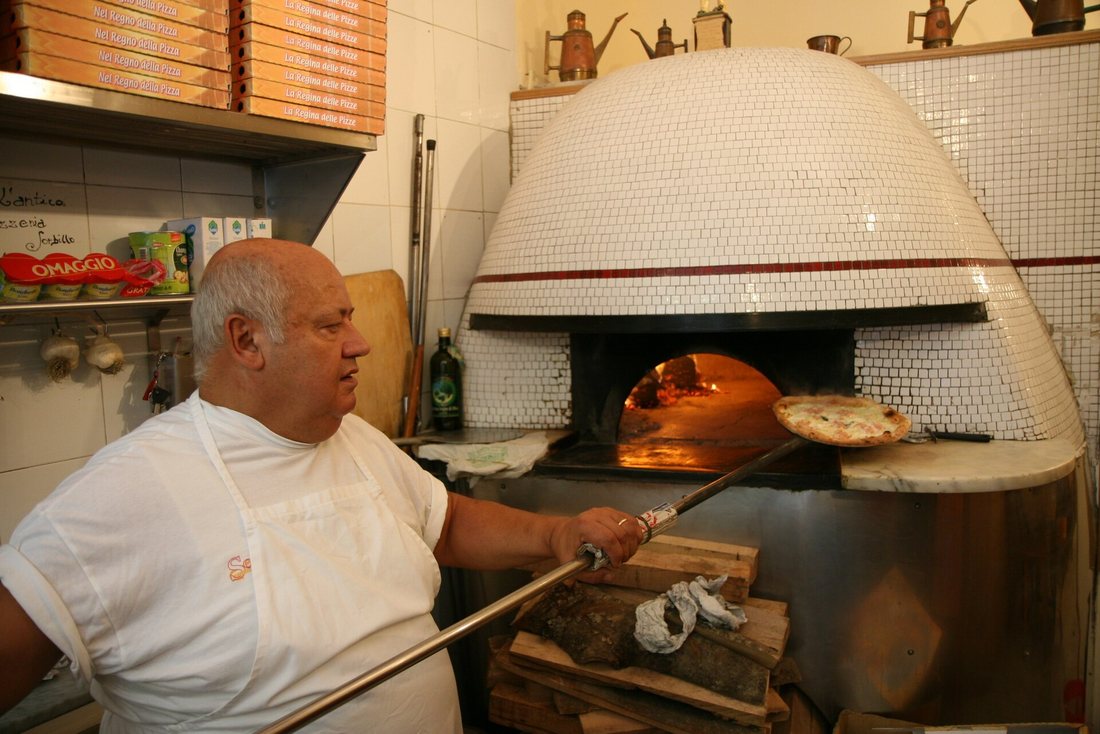
A pizzaiolo at a tiled dome oven in Naples, turning the pizza toward the fire on a long metal peel.
“Neapolitan pizza” is the only pizza with a rulebook — in fact with three. There is a European Union regulation, a private trade-mark specification written by a Naples association, and a UNESCO listing. They agree on the spirit and disagree on the details, sometimes in ways that are simply wrong. Read side by side, they are the best available description of what the wood-fired oven is supposed to do.
Rulebook 1: the EU’s “traditional speciality guaranteed” (2010)
Commission Regulation (EU) No 97/2010, dated 4 February 2010, registers “Pizza Napoletana” as a traditional speciality guaranteed (TSG). The date is often given as 2009, which is when Italy and Germany settled their objections; the registration is 2010.
It does not protect the word “pizza” — or even “pizza napoletana.” The registration was made “without reservation of the name.” Poland objected that the name “is not specific in itself.” What the EU protects is a mention and a logo, not the words; a pizza that breaks the rules may still be sold as Neapolitan pizza, only without the TSG seal.
What it specifies:
| EU TSG (2010) | |
|---|---|
| Size and shape | Round, no more than 35 cm; centre 0.4 cm thick; raised rim 1–2 cm; “tender, elastic and easily foldable into four” |
| Dough | per litre of water: 50–55 g sea salt, 3 g brewer’s yeast, about 1.8 kg flour — roughly 56% hydration |
| Mixing | in a mechanical kneader, “preferably one with a dough hook” — the machine is in the spec |
| Rising | 2 hours in bulk, then balls of 180–250 g for 4–6 hours |
| Shaping | by hand only; no rolling pin, no press |
| Oven | ”exclusively in wood-fired ovens,” with a baking temperature of 485 °C: floor about 485 °C, dome about 430 °C; 60–90 seconds |
| Toppings | Marinara: tomato, oregano, garlic, oil. Margherita: tomato, Mozzarella di Bufala Campana PDO (or fior di latte for the “STG” version), basil, oil |
It also describes the oven: a floor of four refractory circular sections under a refractory dome, and a pizza turned toward the fire and returned to its first spot because “positioning the pizza in a different place would … burn the base.”
The regulation’s own history section contains an impossible date. It says Neapolitan pizza first appeared “between 1715 and 1725,” citing the cook Vincenzo Corrado — who was born in 1736.
Rulebook 2: the AVPN specification
The Associazione Verace Pizza Napoletana (AVPN) was founded in Naples in 1984; its specification, the Disciplinare, is not a law but the rules for using its collective trade mark, “Verace Pizza Napoletana.” Member pizzerias around the world are inspected, and the mark can be withdrawn. Its current English edition (2024) is more detailed than the EU’s, and differs from it:
| AVPN (2024) | |
|---|---|
| Dough | per litre of water: 40–60 g salt, 0.1–3 g fresh yeast (or a third as much dry, or sourdough under 10% of the flour), 1,600–1,800 g “00” or “0” flour — about 56–63% hydration. “Never add any fat or sugar.” |
| Fermentation | 12 to 24 hours in total; ideal 18–20 °C at 60–70% humidity |
| Balls | 200 g for a 22–24 cm pizza; 280 g for 28–35 cm |
| Centre thickness | 0.25 cm — thinner than the EU’s 0.4 cm |
| Oven floor | about 380–430 °C |
| Oven dome | about 485 °C |
| Bake | 60–90 seconds |
| Wood | ”wood that does not give off smoke or odors that could change the aroma of the pizza … (generally oak, ash, beech and maple)” |
The two rulebooks put 485 °C in different places. In the EU regulation, 485 °C is the floor and the dome is cooler; in the AVPN specification, 485 °C is the dome and the floor is cooler. The AVPN’s version agrees with measurement — a research oven in Naples ran its vault at about 546 °C and its floor at about 453 °C (see how the oven cooks).
The oven the AVPN describes
The AVPN’s description of the traditional oven is the clearest account of why the Neapolitan oven looks the way it does:
- a double dome that traps a layer of air, for insulation and for drawing smoke out of the mouth;
- a floor 105–140 cm across, under a vault only 40–45 cm high — a low dome, much flatter than a bread oven’s;
- a mouth 44–50 cm wide and 22–25 cm high — the height about half the width;
- the floor laid in four cone-shaped pieces on a bed of sand and salt, which “acts as a thermal diffuser, insulator and thermal battery.”
The dimensions were once measured in Neapolitan palmi of 26.45 cm. The low dome is the point: it holds the fire’s radiant heat close over the pizza, which is what cooks the top in ninety seconds.
Wood is no longer required — by one of the rulebooks
The AVPN now certifies gas and electric ovens. Its 2024 specification says: “Traditionally, cooking used to take place only in wood-fired ovens; currently, more sustainable alternatives such as gas or electric ovens are possible,” under a heading titled “Exemption from the wood-fired oven,” provided the oven is approved by the association. When the change was made could not be established; the AVPN’s own web page still says pizza must be baked “exclusively in a wood-fired oven.”
The EU regulation still says wood only. So “a real Neapolitan pizza must come from a wood-fired oven” is true under EU law and no longer true under the AVPN’s trade mark.
Rulebook 3: UNESCO (2017)
In 2017 UNESCO inscribed “Art of Neapolitan ‘Pizzaiuolo’” on its Representative List of the Intangible Cultural Heritage of Humanity. It protects a craft, not a food: “a culinary practice comprising four different phases relating to the preparation of the dough and its baking in a wood-fired oven, involving a rotatory movement by the baker.” The wood-fired oven is written into the definition.
What the rules mean at home
A backyard pizza is not bound by any of this, and a home oven cannot meet some of it. What is useful is the logic underneath:
- A lean dough. No oil, no sugar — because at 800 °F and above, both brown so fast that the crust burns before the middle cooks (see the dough).
- A long, cool fermentation of 12–24 hours, for flavour and a dough that stretches.
- A hot dome over a slightly cooler floor, and a bake of about ninety seconds, turning the pizza toward the fire.
- Toppings in small quantities: a Margherita takes only 60–80 g of tomato and 80–100 g of mozzarella.
- Tomatoes crushed by hand and not cooked beforehand. The AVPN says hand-crushing avoids “breaking the seeds which would give a bitter taste,” and allows no “further heat treatment” — the tomato’s only cooking is in the oven. The collection’s sauce is Uncooked Pizza Sauce.
In this dive: The history · What makes it Neapolitan · How the oven cooks · Choosing an oven · The Ooni Karu 2 Pro · Wood and fire · Using the oven · Safety and the law · The dough · Pizza styles · Beyond pizza · Corrections
Comments (0)