The Ooni Karu 2 Pro, Examined
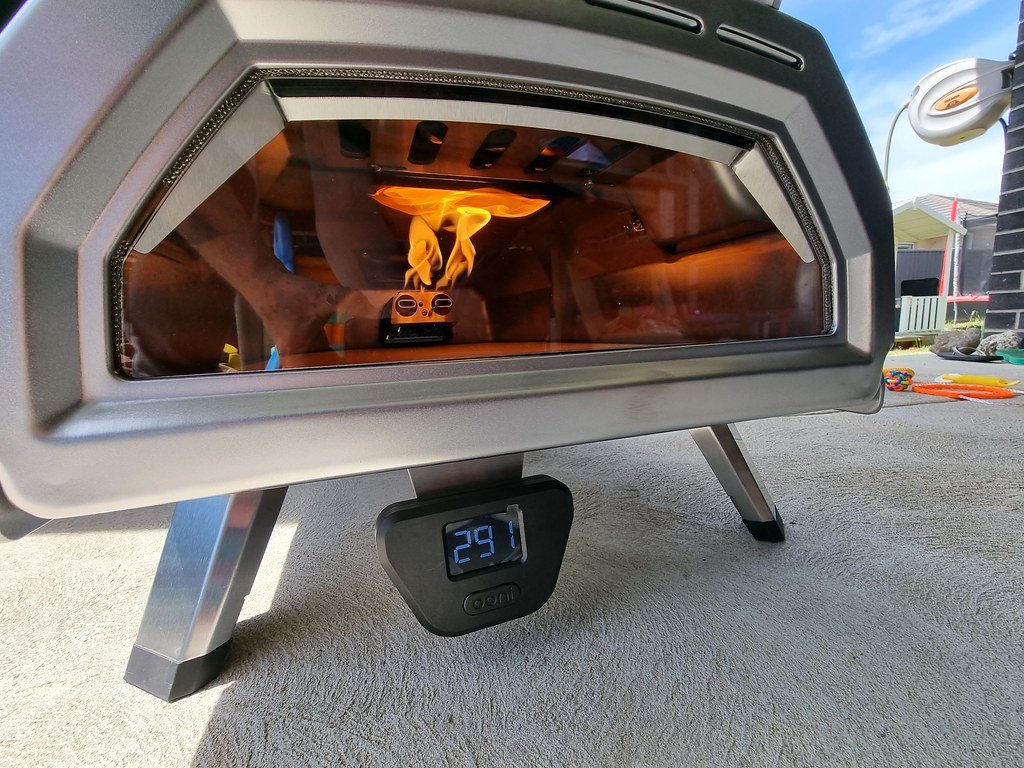
An Ooni Karu-series oven with a glass door and a digital display on the front. That display reads the air inside the oven, not the stone. The exact model is not confirmed; this is not the collection’s oven.
The oven this collection is weighing is the Ooni Karu 2 Pro — a multi-fuel portable oven that burns wood or charcoal, with an optional gas burner. It has not been bought. This page is a close reading of what Ooni says about it, what its manual says, and what independent testers measured — including where those three disagree.
What it is
From Ooni’s product page (September 2026):
| Price | $849 (gas burner about $100 extra) |
| Cooking area | 17” wide; cordierite stone 15 mm thick, in two halves |
| Largest pizza | 16” (claimed) |
| Fuel | wood, charcoal; gas with the separate burner — not at the same time |
| Temperature | up to 950 °F (500 °C), claimed in 15 minutes |
| Weight | 62.6 lb |
| Door | borosilicate glass, with an airflow system Ooni says keeps soot off |
| Thermometer | ”Ooni Connect” digital hub with Bluetooth and a food probe |
| Airflow | a chimney baffle and a rear baffle |
| Warranty | 5 years when bought directly from Ooni |
It launched in autumn 2024 (Ooni’s announcement is dated 7 October 2024). It replaces the Karu 16: Ooni’s old Karu 16 address now leads to the Karu 2 Pro. The smaller Karu 2 ($449, 12-inch pizzas, 34 lb) has the same glass door and fuel system with an analogue air gauge.
The digital thermometer reads the air, not the stone
This is the most important thing to know about the Pro’s headline feature. Ooni’s own launch article says the hub displays “the oven’s internal air temperatures.” It does not read the stone, and the stone’s temperature is what decides whether a pizza will cook. Ooni’s own guides still tell owners to check the stone with an infrared thermometer and to launch only when it reads at least 750 °F (400 °C), and 715–850 °F for each pizza after that. An $849 oven with a digital thermometer still needs a separate infrared gun.
What testers measured
- America’s Test Kitchen (2025) rated the Karu 2 Pro “Highly Recommended.” On wood, the average stone temperature after preheating was 760 °F, while the air reached 1,069 °F — hotter than Ooni’s own 950 °F claim for the air, and far hotter than the stone. On propane the numbers were almost the same. ATK measured the largest pizza that fit at 15 inches, not 16, and the Bluetooth link dropped beyond about 20 feet. Downsides: heavy and “cumbersome to move and store,” wood and charcoal “a little trickier to dial in … requires more babysitting,” and the fuel chamber has to be emptied of ash and half-burnt wood and the oven swept after every use.
- Serious Eats (2026) named it its “Best High-End, Multi-Fuel Pizza Oven”: pizzas in under two minutes, a door that “makes it heat up more quickly and efficiently,” and room for 12–14-inch pizzas “without risk of them burning too easily.” Against it: “wicked expensive,” the gas burner costs extra, and its igniter sits at the back. Serious Eats also warns that flames “lick up the hatch” when the fuel door is opened: wear gloves to add wood.
- Neither published a wood-only test of how many pizzas one load of fuel makes in the Pro. (For the smaller, doorless Karu 12, Wirecutter got two.)
What the manual says about wood
The Karu 2 Pro manual is mostly diagrams; its text on fuel is short:
- burn “dry, non-treated hardwood (up to 23 cm / 9 inches long and 7.5 cm / 3 inches in diameter)”;
- add no more than 0.5 kg (1.1 lb) at a time;
- keep no more than 1 kg (2.2 lb) in the tray at once;
- on first use, heat the oven and keep the fuel “red hot for at least 30 minutes” before cooking;
- “Do not cook before the fuel has a coating of ash”;
- light only with firelighters meeting the European standard EN 1860-3 — never spirit or petrol;
- don’t use the chimney cap while it is lit, and don’t remove the door while it is lit;
- let the fire burn out on its own, and remove the ash only when the oven is completely cold.
The manual contradicts itself — and Ooni’s website. Every other language in the same PDF gives the tray maximum as 1.3 kg (2.9 lb); only the English says 1 kg. And Ooni’s web guide says logs “not larger than 20 cm (8 inches),” where the manual allows 9 inches. The safe reading is the smaller of each: 8-inch pieces, no more than 1 kg in the tray. The detail that matters most in practice — how to set the baffles for wood and how often to add a piece — is not in the manual at all; Ooni puts it in its app and videos. Serious Eats reports that the vent is fully open for gas and “closed partway for wood or charcoal.”
What the Pro would and would not do
It would make Neapolitan pizzas in under two minutes, New York-style pizzas up to about 14–15 inches, flatbreads, and anything that fits in a skillet — steak, vegetables, a skillet cookie. With the gas burner it would give a fallback for a windy night.
It would not behave like a masonry oven. With a thin shell and a 15 mm stone, it cools within a couple of hours of the fire going out, so the long, falling-heat sequence of bread, roasts and slow cooking is mostly out of reach (see beyond pizza).
Two practical questions for a Michigan owner: at 63 lb, carrying it into a garage every winter is possible but awkward, and testers advise doing so rather than trusting a cover (see using the oven). And from 1 January 2027, wood shipped into Michigan from another state must be certified heat-treated — boxed cooking wood ordered from out of state included, and a “kiln-dried” label alone does not qualify (see wood and fire).
Marketing to take with salt
- Ooni calls the Karu 2 Pro “the biggest advance in wood-fire cooking since someone first rubbed two sticks together.”
- Ooni billed the older Karu 16 as “the only pizza oven Recommended for Domestic Use by the Associazione Verace Pizza Napoletana.” That endorsement was not checked against the AVPN’s own list, and whether it carries over to the Karu 2 Pro could not be found.
- Heat-up times in advertising are routinely beaten by the stopwatch across the industry; Ooni’s own cold-weather guide says to allow “at least 15 minutes and at most 25–30.”
In this dive: The history · What makes it Neapolitan · How the oven cooks · Choosing an oven · The Ooni Karu 2 Pro · Wood and fire · Using the oven · Safety and the law · The dough · Pizza styles · Beyond pizza · Corrections
Comments (0)