How the Oven Cooks: Radiation, a Hot Floor, and Ninety Seconds
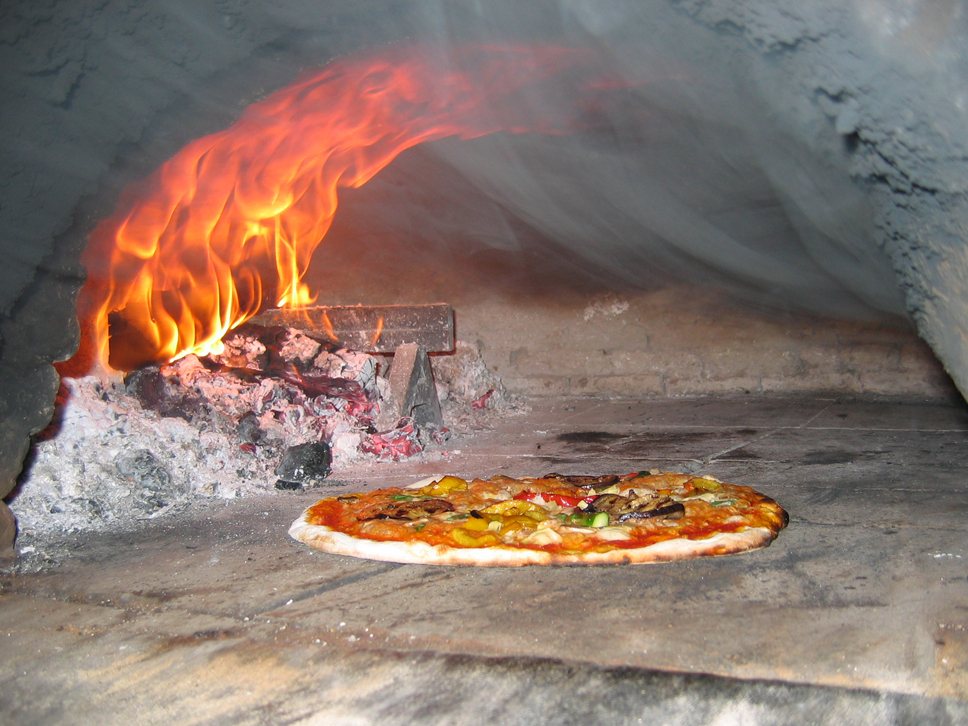
The flame curls up and across the dome. Most of the heat that cooks the top of a pizza arrives as radiation from that fire and the hot vault above it.
A wood-fired pizza oven works nothing like a kitchen oven. A kitchen oven heats air, and the air heats the food, slowly. A pizza oven heats stone, and the stone and the fire throw heat at the pizza from above and below at once. That is why a pizza that takes twelve minutes at 500 °F in a kitchen takes ninety seconds in a Neapolitan oven.
Three kinds of heat — and which one matters most
Heat reaches a pizza in three ways:
- Conduction — directly from the hot floor into the base of the dough.
- Convection — from hot air and gases moving over the pizza.
- Radiation — infrared energy thrown off by the glowing dome and the flame itself, which travels across the oven like light and lands on the top of the pizza.
The popular explanation is simple: the floor cooks the bottom by conduction and the hot air cooks the top by convection. J. Kenji López-Alt of Serious Eats put it that way in 2019. Measurement says radiation does most of the work.
A team from the University of Naples Federico II and the University of Tuscia instrumented a traditional wood-fired oven (Falciano, Masi and Moresi, Journal of Food Science, 2022 and 2023). Heating a pizza-sized tray of water on the floor, they found that about 73% of the heat arrived by radiation and 15% by convection from the vault, and only 12% by conduction from the floor. A metal tray of water is not a pizza, and dough sitting directly on the stone probably takes a larger share from the floor, but the dome’s radiation is plainly the biggest single input. Kenji reached the same point by experiment. Testing a pizza insert for a kettle grill, he found the thin lid “too thin and conductive. Rather than storing heat and re-emitting it as radiant energy the way a real stone oven does, heat is conducted then radiated outwards into the air” — and testing two other ovens, he blamed pale tops on “a lack of radiant heat.”
This is why the flame matters. A small wood oven needs its fire to throw a flame that curls up the back and rolls across the roof. Gozney’s manual says the flame “should roll across the length of the oven’s roof.” That arc of flame and the hot dome above it cook the top of the pizza.
The temperatures, measured
In the Naples oven, burning dry oak at a steady 3 kg an hour:
- the vault ran at about 546 °C (1,015 °F);
- the floor at about 453 °C (847 °F);
- pizzas baked in 60–80 seconds on a floor of about 440 °C.
The AVPN’s specification gives the same shape: a floor of 380–430 °C (716–806 °F), a dome of about 485 °C (905 °F), and a bake of 60–90 seconds.
The pizza itself never gets very hot. A 2024 review by the same group found that the base of a pizza peaked at about 100 °C, and the top of a Margherita at only 67 °C — the water in the dough, tomato and cheese holds the temperature down while the surfaces char. They also measured more browning on the top than the bottom, which is the radiant heat at work.
The floor drops under every pizza. Where a pizza sat, the floor fell from about 442 °C to 325–348 °C; the bare floor beside it held at 439 °C. Test kitchens measured the same thing in portable ovens: Wirecutter found three different ovens each lost about 100 °F per pizza and needed about five minutes to recover. This is why pizza makers move each new pizza to a fresh spot, and why a home oven turned out one pizza after another soon starts producing pale, soft bases.
Balancing the floor and the dome
The whole craft of a wood-fired oven is keeping the floor and the dome in step:
- Floor too hot for the dome → burnt bottom, pale top. Elizabeth English of Quanto Basta, in Portland, Maine, told Serious Eats she bakes at 850–900 °F because “anything hotter and the bottom gets too dark before the top does.” Andrew Janjigian settled on a stone of 800 °F in a portable oven as “more forgiving.”
- Dome too cool, or the fire too small → pale top. The fix is a bigger, livelier flame — or “doming”: lifting the pizza on the peel toward the roof for a few seconds at the end.
- One side burning → turn it. The fire is at one side or the back, so the pizza is turned every 20–30 seconds, and always returned to the same spot so that it does not land on hotter, untouched stone.
Thermal mass: why a masonry oven stays hot and a portable one doesn’t
A masonry oven is a heat battery. The Naples oven took four to six hours at a steady fire to reach equilibrium. Once there, its brick stored enough heat to hold the floor and vault steady while baking one or two pizzas at a time. The AVPN’s traditional oven sits on a bed of sand and salt that the specification calls a “thermal battery.” A masonry oven with its fire out keeps cooking for hours: Mugnaini says its smallest masonry kit “holds 250–350 [°F] overnight.” That falling heat is what makes the traditional sequence possible — pizza at full heat, then flatbreads and bread, then roasts, then slow-cooked dishes overnight.
A portable oven is the opposite design. A thin steel shell and a stone about 15 mm thick heat in fifteen to forty-five minutes and cool almost as fast. Ooni says a Karu stays warm “up to a couple of hours” after the fire dies. Gozney’s Dome is heavier, with a 30 mm stone and thick insulation, which buys more stored heat at the cost of weight. See choosing an oven for what that trade means in practice.
A wood-fired oven is a very inefficient machine. The Naples oven turned only 13% of the wood’s energy into the oven chamber; 46% went up the flue and 26% out through the walls. Feeding the fire three times faster raised the temperature but lowered combustion efficiency from 87% to 79%. A bigger fire is not a better fire.
Stone and steel
A portable oven’s cordierite stone and a kitchen baking steel behave differently. Serious Eats explains that steel is “far more conductive” and heats and releases heat quickly, while a stone is “more like a battery, providing a long-lasting reserve of heat.” A steel is the best substitute for a pizza oven inside a kitchen oven; outdoor pizza ovens all ship with stone, and no source consulted recommends a steel inside a 900 °F live-fire oven. (One widely repeated claim — that a steel is “more radiant” than a stone — does not survive the numbers: oxidised steel’s emissivity is about 0.79 against rough brick’s 0.93, so its advantage is conduction, not radiation.)
Measuring it
An infrared thermometer reads only the surface it is pointed at. It cannot read air, and the dial on the front of many portable ovens reads air, not the stone — so the two will not agree. Point the gun at the floor where the pizza will go, close to the flame; a reading taken where the last pizza just sat will be low. Shiny metal fools it: polished steel has an emissivity of about 0.07 and reads far too cold. And many guns stop at about 550 °C (1,000 °F), which is roughly where a hot dome sits. For more, see using the oven.
The Breads section’s ovens page compares gas, electric, convection and stone-deck ovens for bread; a pizza oven is the extreme end of the deck-oven family.
In this dive: The history · What makes it Neapolitan · How the oven cooks · Choosing an oven · The Ooni Karu 2 Pro · Wood and fire · Using the oven · Safety and the law · The dough · Pizza styles · Beyond pizza · Corrections
Comments (0)