Thirty-Eight Minutes at Narita
20 March 2026. The last stop of the trip, on the way home: Narita Airport, between 15:22 and 16:00.
Eleven photographs. Nine of them are shop shelves. The tenth is a counter. And the eleventh, taken at exactly four o’clock, is a plate of sushi — which means this was not, as I had first written it up, thirty-eight minutes of duty-free.
I sat down and ate. More on that at the bottom, because it turns out to be the point.
成田空港限定
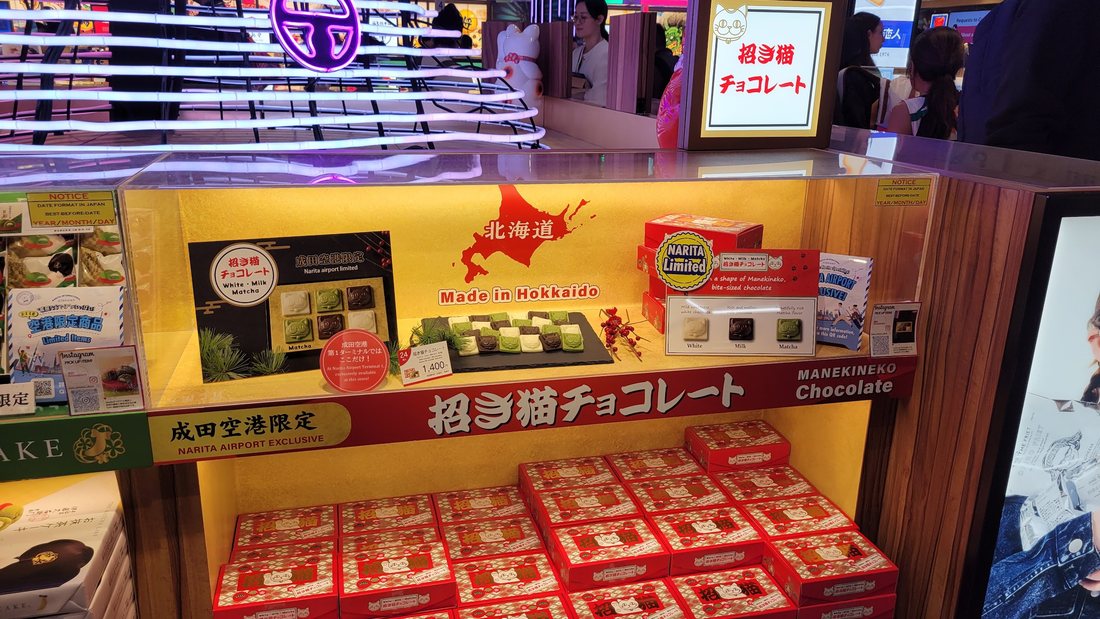
Every sign in these photographs says some version of the same four characters:
成田空港限定 — Narita Kūkō gentei — “Narita Airport limited.”
Not “available at Narita Airport.” Limited to it. You cannot buy this box in Tokyo, forty miles away. It exists only in this building.
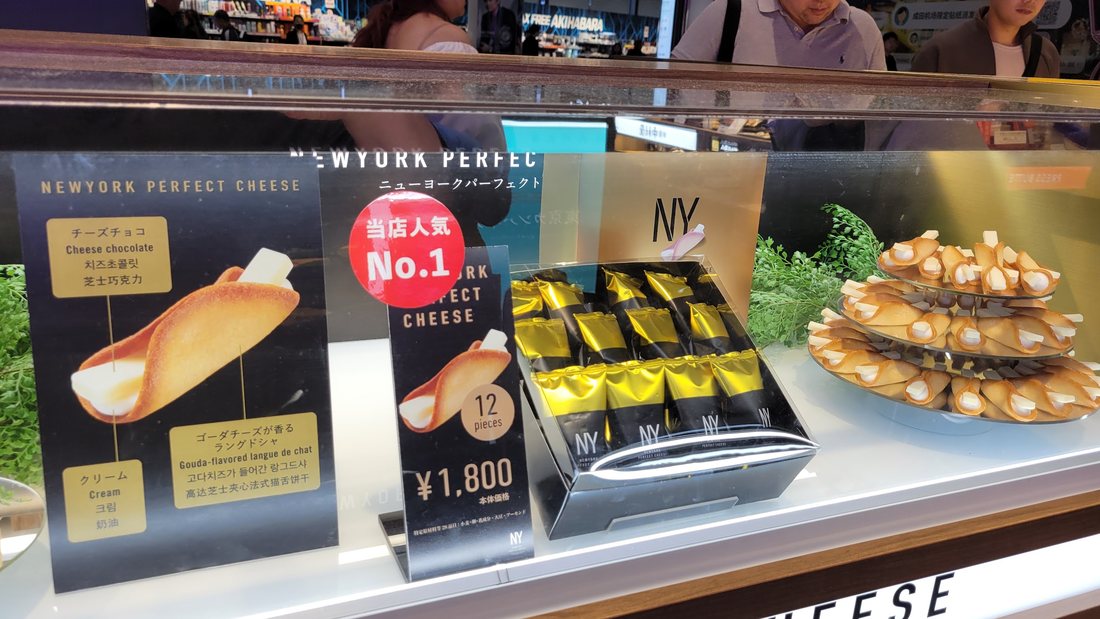
⭐ And here is what makes it more than a marketing trick. Japan has an enormous, genuinely old tradition of meibutsu (名物) — the local speciality, the thing a particular place is known for and which you are socially expected to bring back for your colleagues. That obligation has a name, omiyage (お土産), and it is not casual: coming back from a trip empty-handed is a real, if minor, failure of manners.
So there is a deep, pre-existing cultural machine that says a place has its own food, and you bring it home. What airport retail did was notice that an airport is a place, and plug straight into it.
That is a genuinely clever piece of commercial reasoning. A terminal is somewhere nobody is from, that nobody visits deliberately, and that has no cuisine of its own. Declaring it a meibutsu region and manufacturing exclusives for it is inventing a tradition from scratch — and it works, because the underlying obligation is real.
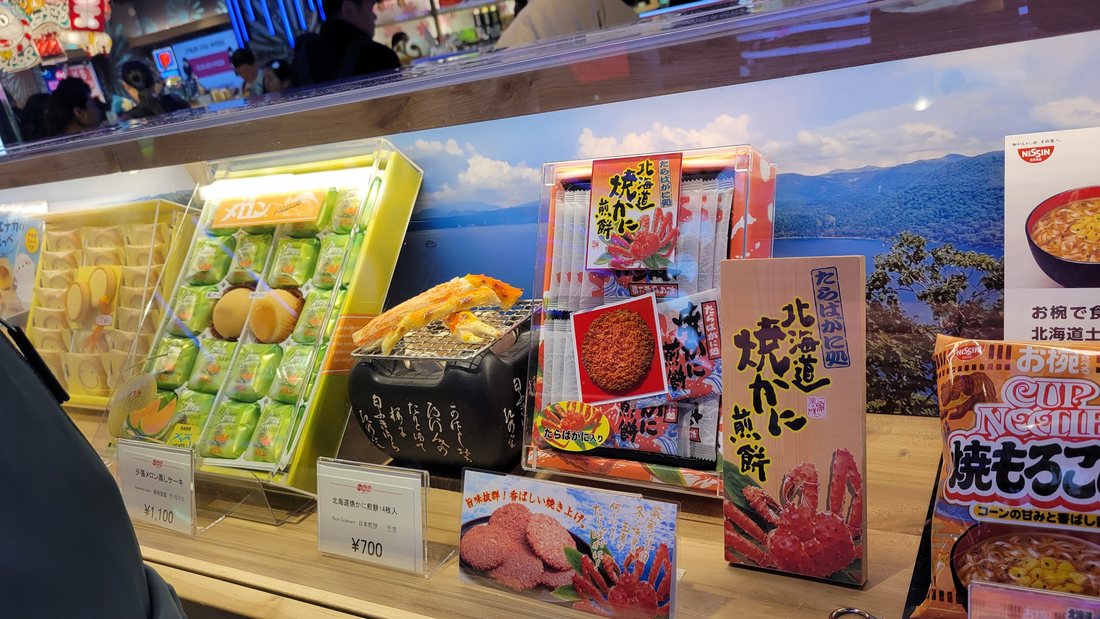
⚠ And note the layer I did not expect: the Hokkaido counter. A shelf in Narita selling Hokkaido-limited goods is selling you the exclusivity of a different place, in an airport, in a third region. The word 限定 is doing the work whether or not the limit means anything anymore.
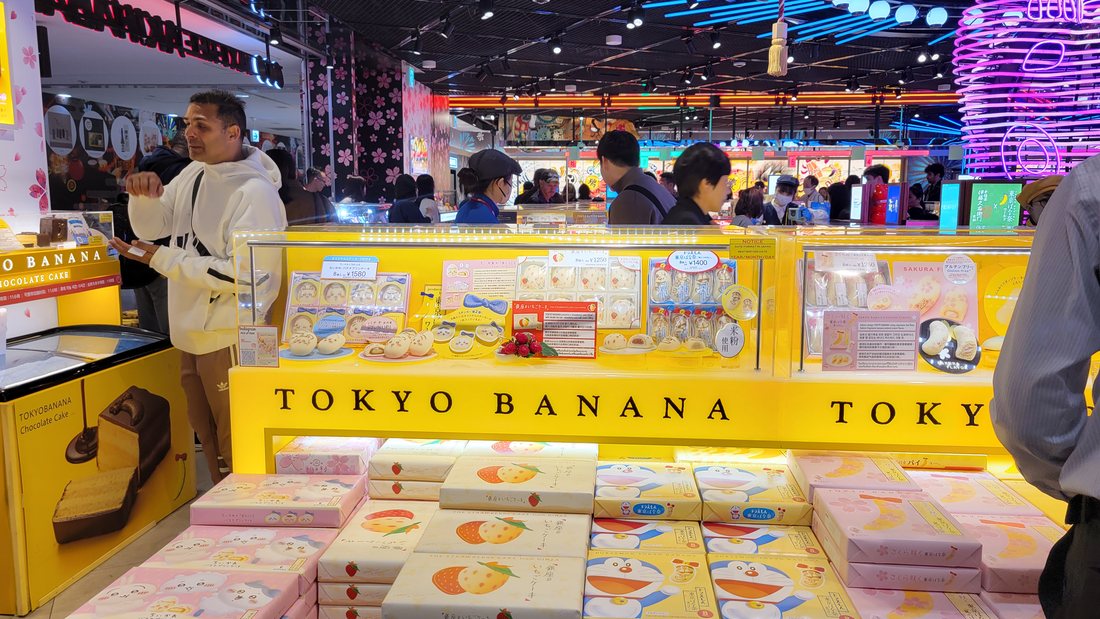
Tokyo Banana is the most successful example of the whole category — a sponge cake with banana custard, invented in 1991, sold overwhelmingly as a Tokyo souvenir, and now so completely identified with the city that it functions as the default omiyage for anybody flying out of it.
⚠ It is not an old regional speciality that happens to be on sale at the airport. It is a modern product that occupied the shape of one, extremely well.
The last meal
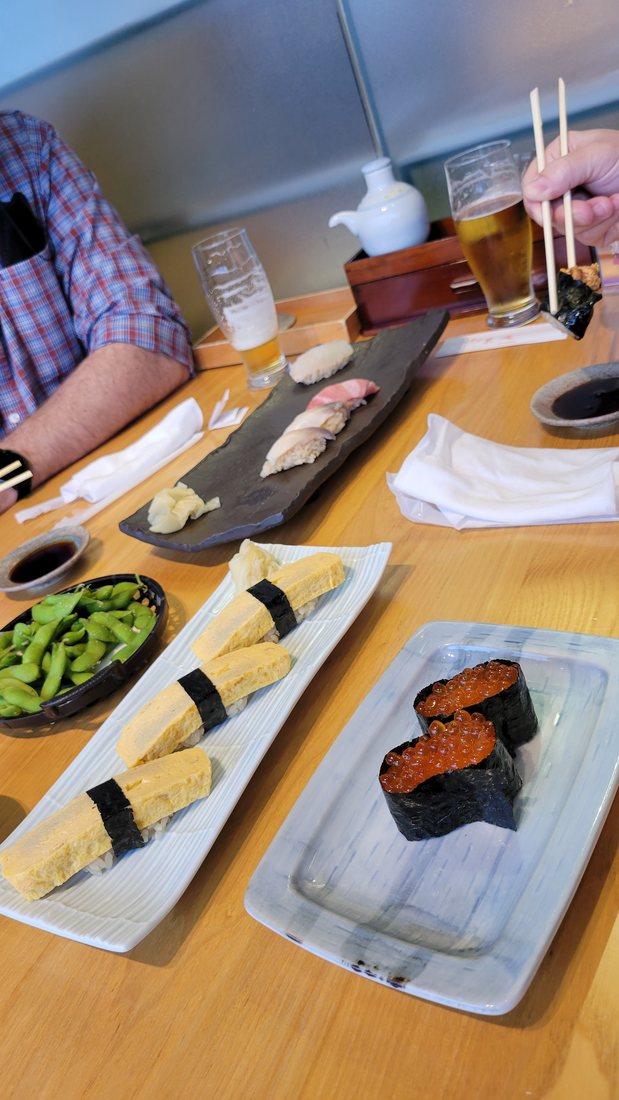
16:00. An airport sushi counter, and I can read most of this off the photograph:
- A slate board of nigiri with pickled ginger — three pieces. ⚠ I am not going to name the fish from this angle; one is clearly a red-fleshed tuna cut and the others I would only be guessing at.
- A plate of tamago nigiri — the sweet layered omelette, banded to the rice with nori. Three pieces, unmistakable.
- A plate of ikura gunkan-maki — salmon roe in a nori “battleship” wrap. Two pieces, also unmistakable.
- Edamame, and a beer, and a small ceramic pitcher.
For a departure-gate meal eaten against a clock, that is a very respectable plate. And it is a particularly Japanese thing that the airport sushi is good — the same instinct that makes a railway-station bento worth eating.
The correction I owe this page
When I first went through this folder I wrote it up as “not a visit — thirty-eight minutes in the souvenir arcade before a flight.”
The timestamps say otherwise. The shelf photographs run 15:22 to 15:25. The meal is at 16:00. I spent three minutes photographing shops and then sat down for the better part of half an hour and had lunch. The shelves were the queue, not the visit.
I have kept the original title because thirty-eight minutes is still the honest length of it. But the characterisation was wrong, and it was wrong because I read the folder by filename and did not open the last picture.
And to be clear about one thing
There is an obvious story here that I am not going to tell, because it is not true.
I lived in Japan in 1985 and 1986 — two years at MCAS Iwakuni, most weekends spent driving the southern coast, and it is the best food I have ever eaten. The tidy version of this page writes itself: forty years later he finally returns, and gets no further than the terminal.
That is not what happened. I have been back to Japan several times since. This was simply a connection on the way home from a work trip, and it was a perfectly good sandwich — well, a perfectly good plate of sushi — in an airport.
Back to Travel, or on to Japan, 1985–86.
Comments (0)