The Thai System
Thai is my favourite of the curries, and I think the reason is that it has the most internal logic of any of them. Once you see the system, every paste on the shelf explains itself.
First: kaeng is not “curry”
The Thai word is แกง (kaeng, romanized gaeng or geng), and it means a liquid seasoned dish — not specifically a coconut curry, and not specifically anything spicy. There are kaeng with no coconut milk (kaeng pa, “jungle curry”), kaeng that are sour and thin (kaeng som), and kaeng that are essentially clear soups.
So when a menu translates every one of them as “curry,” it is doing the same flattening the word page describes. Useful to know, because it explains why a “Thai curry” you order in two places can be two unrelated experiences.
The paste is the recipe
This is the structural difference from Indian cooking and it is worth stating baldly.
An Indian curry is generally built in the pan: onions down, ginger-garlic in, ground spices bloomed, tomato, then the main ingredient — the seasoning is assembled as you go, in layers.
A Thai kaeng is built before you turn on the stove. All the aromatics — chilies, lemongrass, galangal, garlic, shallot, coriander root, makrut zest, peppercorn, shrimp paste, and in some pastes the dry spices — are pounded together into one homogeneous mass. Then you fry that mass and add liquid. The composition happens in the mortar.
Which means the paste is not an ingredient in the recipe. The paste is the recipe, and everything after it is assembly. That is why a Thai cook will judge a curry by the paste and why buying a good one matters so much (which to buy).
The family map
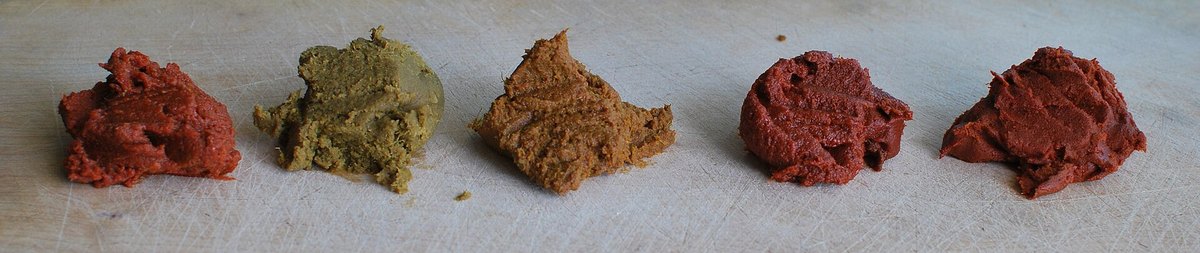
Here is the set, sorted by what actually distinguishes them — which is not colour. Colour is a consequence.
| Paste | Thai | The distinguishing variable |
|---|---|---|
| Red | kaeng phet | Dried red chilies, soaked. The base paste. |
| Green | kaeng khiao wan | Fresh green chilies. Usually the hottest. |
| Yellow | kaeng kari | Red-paste base plus Indian dry spice and turmeric. |
| Massaman | kaeng matsaman | Roasted whole warm spices — Persian/Muslim lineage. |
| Panang | phanaeng | Red base plus peanut, thick, barely any liquid. |
| Khua | kaeng khua | Red base without dry spice; used with fruit and seafood. |
| Jungle | kaeng pa | No coconut at all. Water-based, fierce, herbal. |
| Sour | kaeng som | No coconut, no lemongrass; tamarind sour, thin, chili-hot. |
| Khao soi | — | Northern; red-ish paste plus curry powder, with egg noodles. |
Look down the “distinguishing variable” column and the logic falls out. Most of these are red paste with one decision changed: add dry spice and turmeric → yellow. Add peanuts → panang. Take the dry spice out → khua. Take the coconut out → jungle. Red is the trunk and the others are branches, except green (a different chili) and massaman (a different tradition entirely).
Cracking the cream: the one technique that separates good from average
If there is a single skill on this page, it is this.
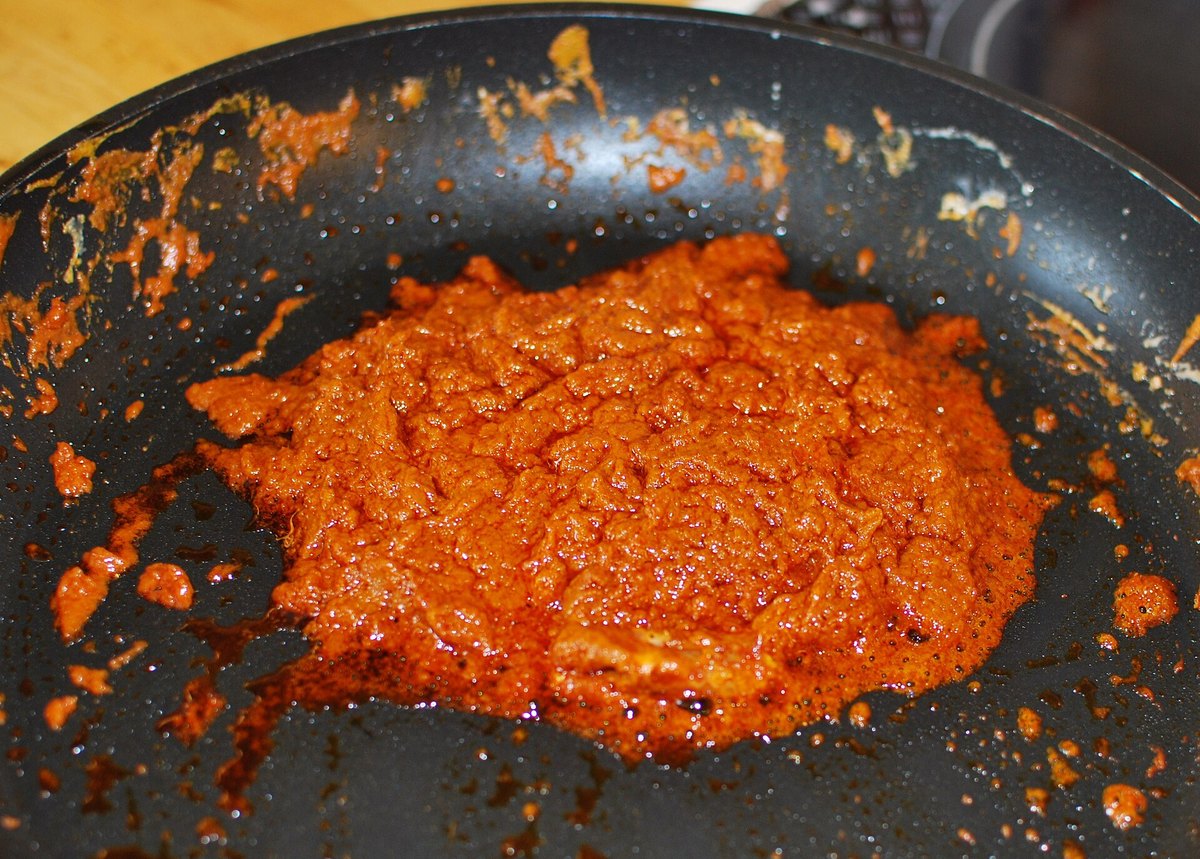
Real coconut milk is an emulsion of coconut fat in water, and it will break if you heat it hard enough — the fat separates out as a clear, fragrant oil. Thai cooking does this on purpose and then fries the paste in the liberated fat. The Thai name for the visible sheen of oil that comes back to the surface at the end is แตกมัน (taek man) — “the fat breaks out.”
The method:
- Open a can of full-fat coconut milk without shaking it. Spoon the thick cream off the top — the top third or so.
- Put the cream alone in the pan over medium heat and let it bubble, stirring, for five to ten minutes. It will thicken, then go grainy, then a clear oil will separate at the edges. That is the crack.
- Fry the paste in that oil for a couple of minutes until it smells cooked and darkens.
- Then add the rest of the coconut milk, the protein, and the seasoning.
Why it matters: the flavour compounds in the paste are largely fat-soluble. Fried in coconut fat they dissolve into the fat and distribute through the whole dish. Dumped straight into a pot of coconut milk and simmered, a lot of them never leave the paste at all. It is the same curry, cooked two ways, and it does not taste the same.
🔴 The correction to my own file. My Thai Green Curry reads “Heat oil in a wok. Fry curry paste 2 minutes… Add one can of coconut milk” — then a second can and a cup of broth. That is the common Western shortcut: fry in neutral oil, then treat coconut milk purely as liquid. It works, and it is what most published recipes say. But it skips the crack, and it ends up with roughly three cans’ worth of liquid for a pound and a half of chicken, which is a soup. The traditional version cracks the cream, fries in coconut fat, and uses less total liquid. I would cook it the second way now.
Seasoning: the four-way balance
A Thai curry is finished by taste against four axes, and none of them is “salt to taste”:
- Salty — fish sauce (nam pla), essentially always, not table salt.
- Sweet — palm sugar, which is caramel-ish and less aggressively sweet than white sugar.
- Sour — usually tamarind, or lime added off the heat.
- Hot — from the paste, adjusted with fresh chili.
The proportions differ per curry: massaman leans sweet and sour, green leans hot and salty, khua leans sour. Adjust at the end, off the boil, and taste against rice rather than off a spoon — a curry that tastes correct alone is usually under-seasoned for the rice it is served over.
The herbs that go in last
Thai basil (horapha, anise-scented) wilted in off the heat; torn makrut lime leaves; sometimes fresh green peppercorns on the stem, which are wonderful and almost impossible to buy outside an Asian grocery’s freezer.
Note the “off the heat.” These are volatile. A basil leaf boiled for five minutes has given up.
Comments (0)