From a Grinding Stone to a Tin
The history of curry is usually told as India invented it, Britain stole it. That story is satisfying and it is wrong in both halves. Here is what the documents actually say.
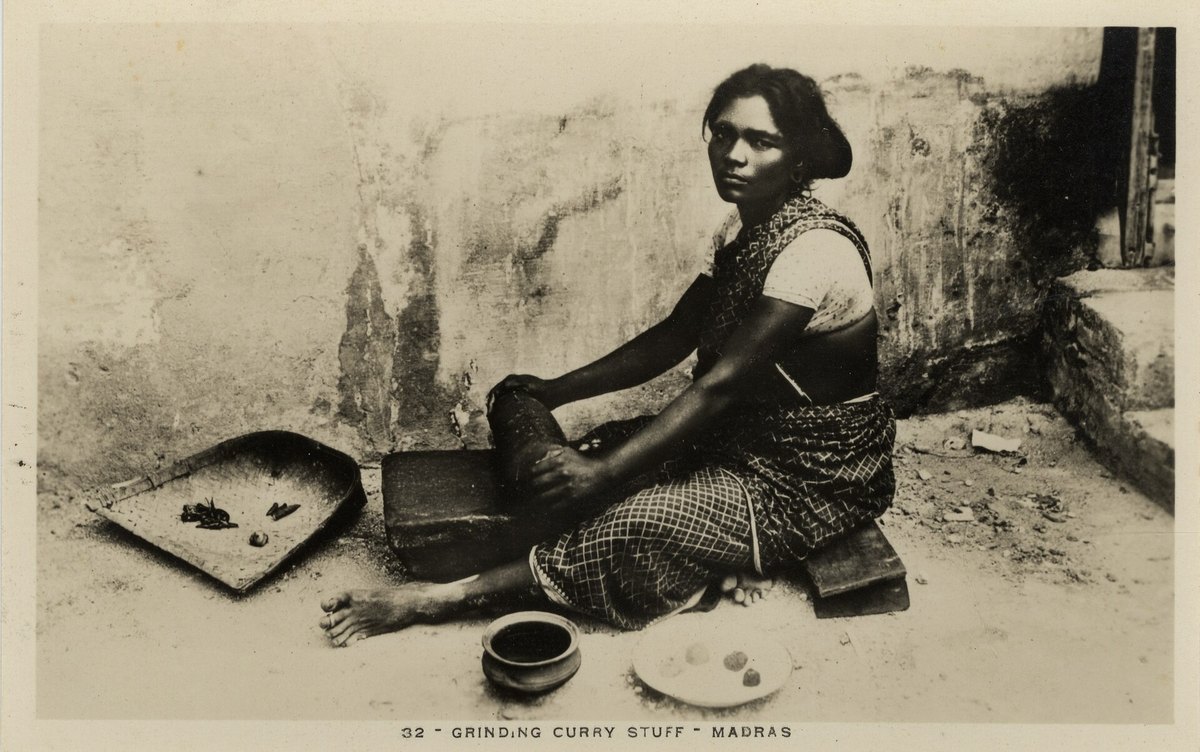
Before anything, there was grinding
Ground, spiced, cooked food is ancient in South Asia — grinding stones, turmeric, ginger and mustard have been recovered from Indus Valley sites, and residue analysis has found turmeric and ginger together on cooking vessels. So the technique — pound aromatics, cook them into a dish — is genuinely thousands of years old.
But almost nothing on a modern curry ingredient list is that old. Hold that thought.
The Columbian Exchange rewrote the recipe
Here is the correction that does the most work:
There was no chili in Indian food before the Portuguese.
Capsicum is American. It reached Asia in Portuguese ships in the sixteenth century, and it moved with astonishing speed — within a couple of hundred years it had displaced long pepper and, to a large degree, black pepper as the everyday heat in South and Southeast Asian cooking, because it grew locally and black pepper was a cash crop worth exporting.
The same ships brought tomatoes and potatoes. So the three things a Westerner most reliably pictures in a curry — the chili heat, the tomato base, the cubes of potato — all arrived from the Americas after 1500. A vindaloo, a tikka masala and an aloo gobi are all, in the ingredient sense, post-Columbian dishes.
Before that, heat came from black pepper and long pepper (Pippali), and long pepper’s near-total disappearance from Western kitchens is one of the quiet casualties of the chili.
1747: the first curry recipe in English has no turmeric in it
Hannah Glasse, The Art of Cookery Made Plain and Easy, 1747, carries a recipe titled “To make a Currey the India Way.” It is the earliest known curry recipe printed in English, and it is remarkable for what is not in it.
The 1747 version is essentially a stewed fowl seasoned with about thirty peppercorns and some coriander seed roasted on a clean shovel, finished with cream and lemon. That is it.
No turmeric. No chili. No cumin. No ginger. Turmeric and ginger only appear when she revises the recipe for the fourth edition in 1751.
I find that genuinely useful rather than just a curiosity, because it dates the moment the English idea of curry acquired its colour. Curry was not yellow in English until at least 1751, and the yellow arrived as an edit.
⭐ 1784: curry powder is advertised — at a perfumery
Curry powder was advertised commercially in 1784, and the advertisement survives. I went looking for a picture of it and ended up reading the whole thing, which turned out to be far more interesting than the date.
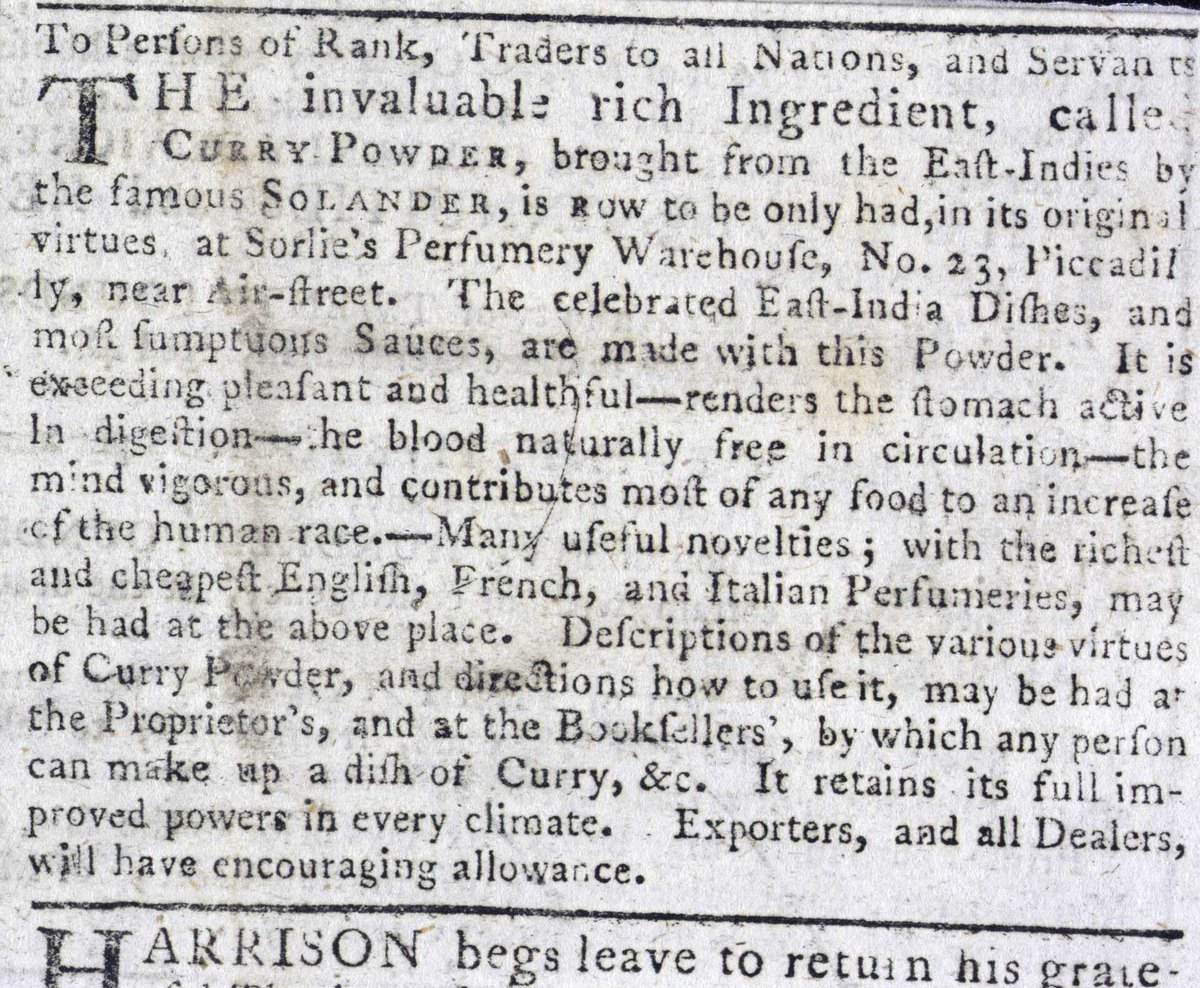
“To Persons of Rank, Traders to all Nations, and Servants — THE invaluable rich Ingredient, called CURRY POWDER, brought from the East-Indies by the famous SOLANDER, is now to be only had, in its original virtues, at Sorlie’s Perfumery Warehouse, No. 23, Piccadilly, near Air-street. The celebrated East-India Dishes, and most sumptuous Sauces, are made with this Powder. It is exceeding pleasant and healthful — renders the stomach active in digestion — the blood naturally free in circulation — the mind vigorous, and contributes most of any food to an increase of the human race. … It retains its full improved powers in every climate. Exporters, and all Dealers, will have encouraging allowance.”
Four things in that notice are worth stopping on.
It was sold at a perfumery, not a grocer. No. 23 Piccadilly also offered “the richest and cheapest English, French, and Italian Perfumeries.” That is not as odd as it sounds — aromatics were aromatics, and perfumers and druggists were who handled them — but it tells you what kind of product curry powder was at birth: an exotic imported preparation, sold beside scent.
It was sold as medicine. Digestion, circulation, “the mind vigorous” — and then a claim I did not expect to find in an eighteenth-century spice advertisement: that it “contributes most of any food to an increase of the human race.” That is an aphrodisiac and fertility pitch, in a newspaper, in 1784.
“It retains its full improved powers in every climate.” There is the entire argument for the product in one clause. The selling point was never that it tasted better than a freshly ground masala. The selling point was that it kept. Shelf stability is the invention.
“Exporters, and all Dealers, will have encouraging allowance.” A wholesale and export inducement, in the first advertisement. The tin was built to travel from day one — which is why it ended up in Japan, the Caribbean and Berlin.
(The notice trades on “the famous SOLANDER” as provenance — a naturalist’s name doing endorsement work. I have not chased down which Solander is meant or whether he had anything to do with it, and in an advertisement making fertility claims I would not assume much.)
What kind of invention that is
An Indian cook does not use one blend. They use a masala built for the dish, often ground that morning, in proportions that change with the dish, the season and the household. Curry powder replaces a variable with a constant. That is a manufacturing decision, not a culinary one — the same decision that gives us bouillon cubes and pancake mix.
⭐ And a period recipe that proves a point I make elsewhere
Nineteenth-century British publications fill up with curry-powder recipes. Here is one, printed in 1895, and it is unusually informative:
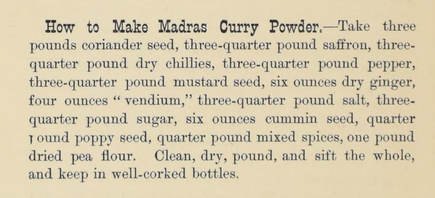
“Take three pounds coriander seed, three-quarter pound saffron, three-quarter pound dry chillies, three-quarter pound pepper, three-quarter pound mustard seed, six ounces dry ginger, four ounces ‘vendium,’ three-quarter pound salt, three-quarter pound sugar, six ounces cummin seed, quarter pound poppy seed, quarter pound mixed spices, one pound dried pea flour. Clean, dry, pound, and sift the whole, and keep in well-corked bottles.”
Read the proportions. Coriander is three pounds — by a distance the largest single item, more than three times anything else. That is the claim I make on the spice cabinet page, that coriander is the bulk of a blend rather than a flavour note, arriving from an 1895 primary source rather than from me.
Three more things in that list:
- “Saffron” here almost certainly means turmeric. Real saffron at three-quarters of a pound would have cost more than everything else combined several times over; “Indian saffron” was a common name for turmeric.
- “Vendium” is vendhayam — Tamil for fenugreek. The southern spice, transliterated by someone writing it down by ear.
- A pound of dried pea flour. That is a filler, roughly a ninth of the total by weight, in a recipe printed as authentic. Bulking agents in curry powder are not a modern supermarket sin; they were in the instructions.
And note the salt and the sugar. The blend is pre-seasoned — which is the same thing my own Rub, Curry Powder Spice does, a hundred and thirty years later.
What “Madras” means on a British menu — and it isn’t Chennai
Since it comes up in my own recipe file: I have a Madras Beef Curry from Delia Smith, and it is a good braise. But the word on it needs a footnote.
Madras, on a British curry-house menu, is a heat grade. The ladder — korma, bhuna, madras, vindaloo, phall — is a British restaurant convention, an ascending scale of chili invented to let customers order by tolerance. It is not a map of Indian regional cooking. There is a real city (Chennai, formerly Madras) with a real and distinctive cuisine involving curry leaves, mustard seed, tamarind, coconut and sambar, and it bears only a loose relationship to what “a madras” means when you order one in Birmingham.
Neither fact makes the dish worse. It makes the label less informative than it looks.
The tin travels, and keeps travelling
The genuinely interesting part is what happened next. British curry powder — the standardized tin — became a global export product, and it seeded new cuisines wherever it landed:
- It went to Japan with the Royal Navy and became a national dish there (the story).
- It went to the Caribbean with indentured South Asian labourers and with British colonial supply, and Trinidadian and Jamaican curry powders are their own things now.
- It went to Germany in the post-war years and, with British-supplied ketchup, became currywurst.
- It went into coronation chicken, mulligatawny, and a whole strand of British cooking that is neither Indian nor pretending to be.
So the honest summary is a loop, not a theft: a Tamil word → a Portuguese loan → an English tin → a dozen national dishes that are now nobody’s idea of a copy.
Next
- The spice cabinet — the actual components.
- Curry powder vs garam masala — and the single rule about when each goes into the pan.
Comments (0)