The Day in the Middle of Nowhere
My own filename for this one is “The place in the middle of nowhere where I had dinner AND LUNCH”, which is both the best title on this site and a slight libel.
It was not nowhere. 16 March 2026, and the placemat on the table names the place and gives its address: Ẩm thực Phương Nam, on Phạm Văn Đồng in Long Thành, Đồng Nai province — about an hour east of Ho Chi Minh City. I ate there at lunchtime and went back for dinner the same evening.
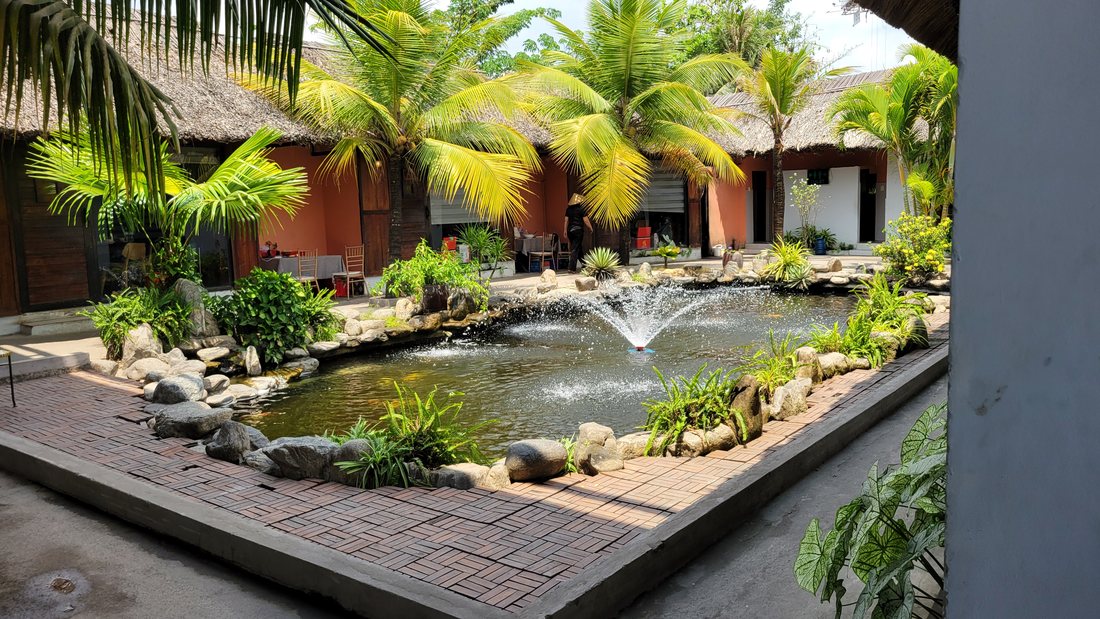
What kind of place it is
Thatched roofs, timber, open-sided pavilions, a koi pond with a fountain, and a lot of tables.
This is a recognisable and very specific kind of Vietnamese restaurant: the countryside banquet house, built out beyond the edge of a city, big enough for a company outing or a wedding, arranged so that a large group can sit in the open air and eat for three hours. It exists for exactly the occasion I was there for.
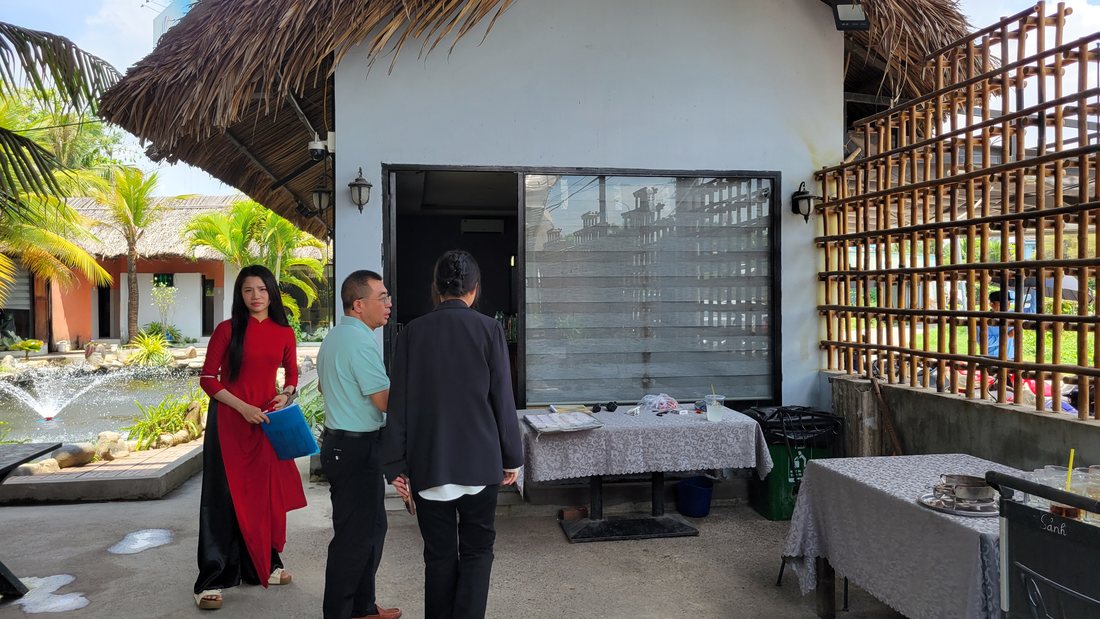
⭐ And when I came back that evening it was doing the other job. I had written the sentence above from the daytime photographs — an empty room, a pond, a lot of tables, and an inference about what a place like this is for. Then I went back at seven and photographed the far end of the site, which I had not seen at lunchtime.
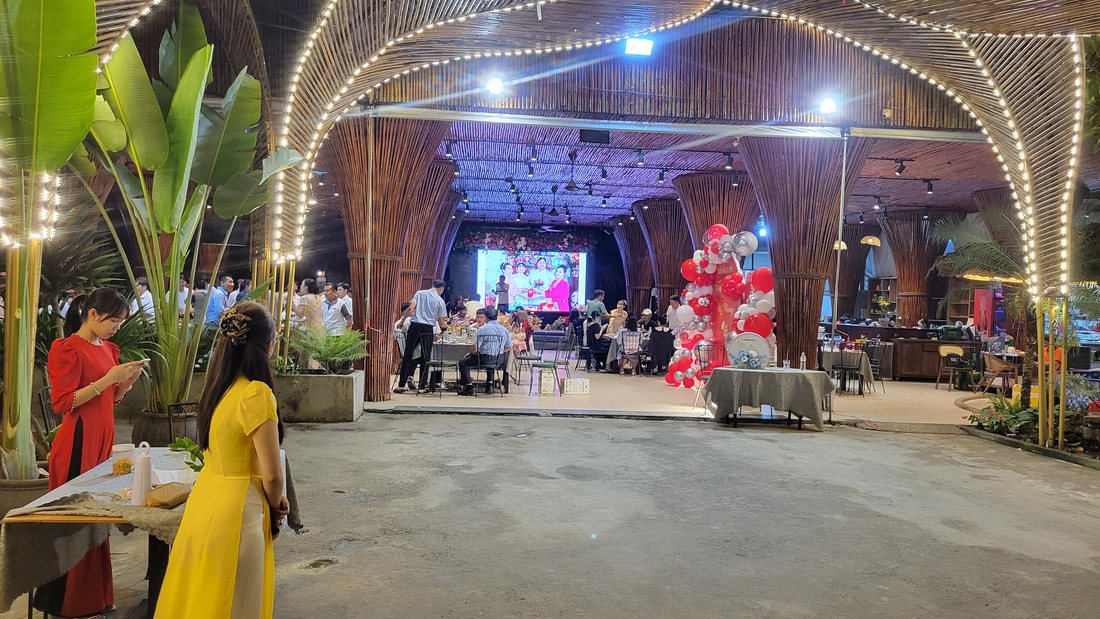
A hall, a stage, a balloon arch and a function in progress. The daytime guess was right, and it is one of the few times on this site that a guess got confirmed by a photograph I had already taken and not looked at.
The clams, and a correction I owe my own notes
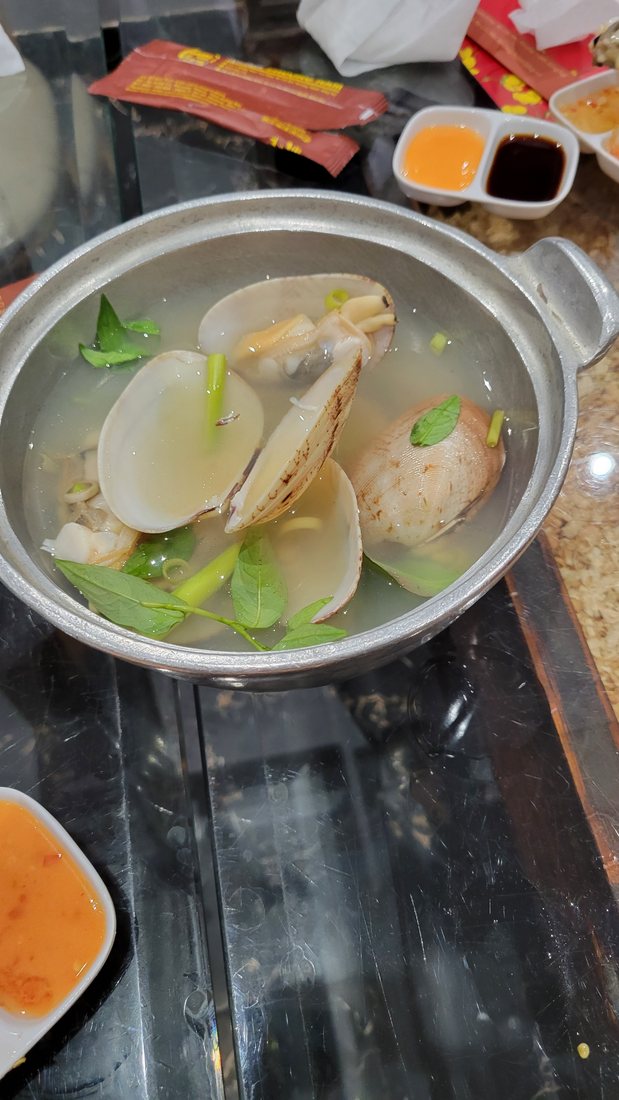
When I first went through these photographs I wrote them up as “a white pot of tiny clams.” Then I opened the file at full size, and both halves of that are wrong.
The pot is aluminium, not white. And the clams are not tiny — they are big, thick-shelled, several inches across, opened wide in a clear broth with green herbs and scallion.
That matters more than it sounds, because it changes what the dish is. Tiny clams in a pot would be a soup you spoon. These are large clams, barely covered, in a shallow amount of intensely flavoured liquid, with a dipping tray beside them — one orange compartment of chilli-salt-lime, one dark. You are not meant to drink that broth by the bowlful. You are meant to pick the clams out, dip them, and eat them with your hands, and the broth is the cooking medium and a half-mouthful at the end.
So the dish family is steamed clams — hấp — rather than a soup. That much I am confident of from the pot, the volume of liquid and the dipping tray.
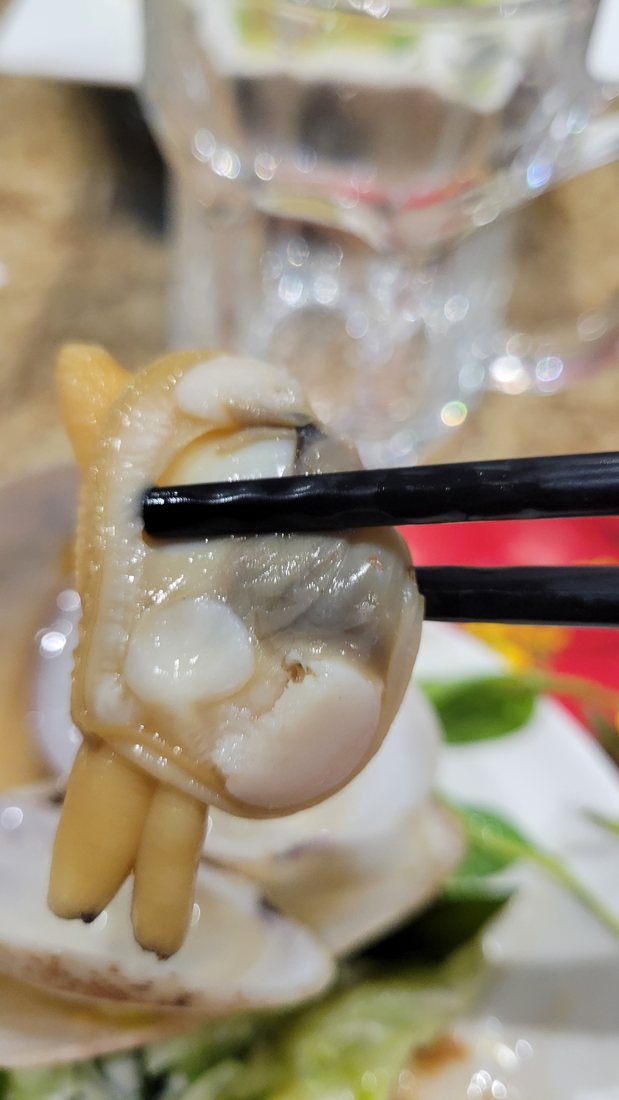
And here is the one that settles the argument, taken ten minutes earlier and not opened until now: a single clam, lifted clear of the pot on chopsticks. Look at the scale of it against the chopstick tips. That is not something you spoon out of a broth. It is a mouthful you pick up, one at a time, and it is the reason the dipping tray is on the table at all.
⚠ What I am not confident of: the exact preparation or its name. Vietnamese steamed clams come with lemongrass, with beer, with Thai-style broth, and with rau răm. The herb in my photograph looks to me like rau răm, which would make it the classic pairing — but I am identifying a leaf from a phone photo, so I am flagging that as my read, not a fact. The dish keeps no name on this page.
The battered pieces, which stay unidentified
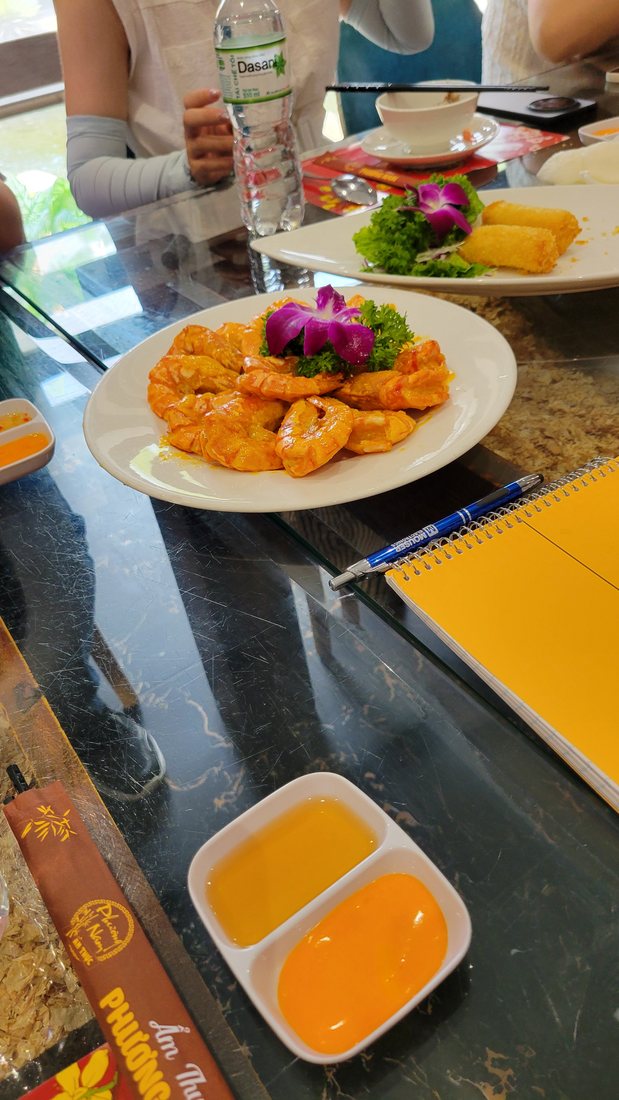
Battered, deep-fried, orange-brown, served with a two-compartment dip.
I do not know what they are. They could be prawn, they could be a fritter, they could be a fruit or a squash. I ate them, I liked them, and I cannot tell you what was inside, which after four months is simply the honest answer.
They stay on the page, and they stay unnamed. This is the same rule I applied to the tofu chilli in Japan in 1985 that I still cannot identify forty years later. A photograph with an invented caption is worse than a photograph with an admission under it.
Twice in one day
The thing I keep coming back to is that I went back. Lunch there, then dinner there, the same day, an hour outside the city.
That is not a tourist’s itinerary. That is what happens when somebody else is doing the driving and the choosing — and in this case it was our vendor who took us out here, which is why the day looks the way it does.
⚠ And I should correct something I nearly wrote on this page. Looking at a folder full of long tables and big group dinners, the easy conclusion is that this whole trip was one of being escorted about. That is not true, and it is worth saying plainly because it changes what the rest of this section is:
Almost everything I ate and almost everyone I met, I found by going out and exploring on my own. My colleagues more often than not did not come with me. The group meals — this one, the banquet rooms in Shenzhen — are the exception in these photographs, not the rule, and they are the ones with a host attached.
The pavement grill, the six-in-the-morning phở, the bánh mì, the broken-rice place: those were mine.
And then they handed me a mallet
The single most memorable thing that happened at this table has its own page, because it needed one: at the end of lunch, two waiters brought out a sealed clay pot on a chain with a chicken inside it, and the only way to open it was to hit it.
Gà Đập Niêu — the Chicken You Have to Break Out →
Comments (0)