Gà Đập Niêu — the Chicken You Have to Break Out
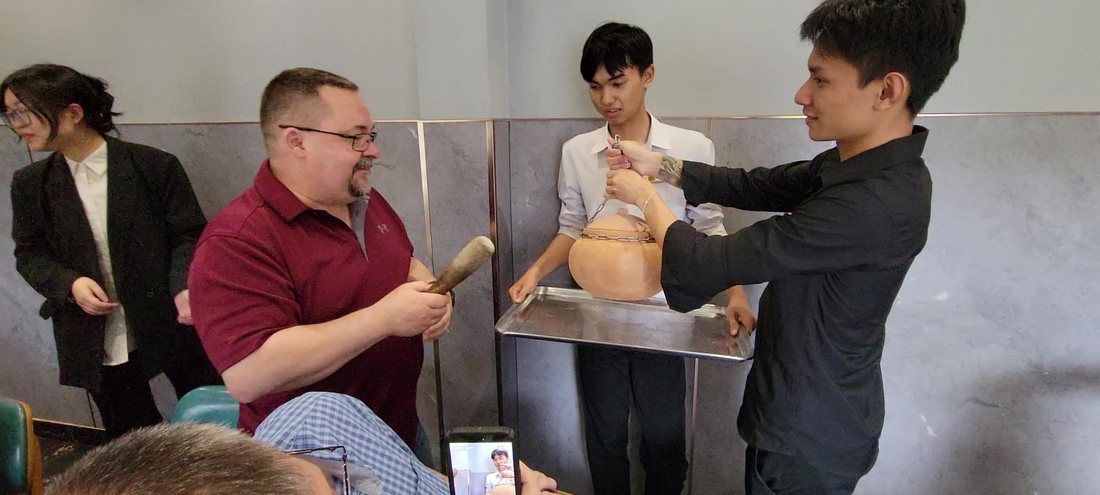
16 March 2026, three minutes past one in the afternoon, at the end of lunch in Long Thành, Đồng Nai. Two waiters walked up to the table. One was carrying a steel tray. The other was carrying a sealed clay pot on a chain, and he handed me a wooden mallet.
I did not know what the dish was called. I still would not, except that I filmed twelve seconds of it, and twelve seconds of video turns out to be enough to identify a dish, because everything you need is visible in the object.
Read the pot first
Before any of the history, look at what is actually being held out:
- It is a single closed vessel. No lid, no rim, no opening. A rounded belly and a shallow dome on top, thrown as one piece and fired unglazed.
- Around the shoulder, where the dome meets the belly, there is a visible horizontal ridge.
- The steel chain is clamped onto exactly that ridge, and hooked so the whole pot hangs free.
- The mallet is a wooden pestle — tapered, worn smooth, obviously used many times before.
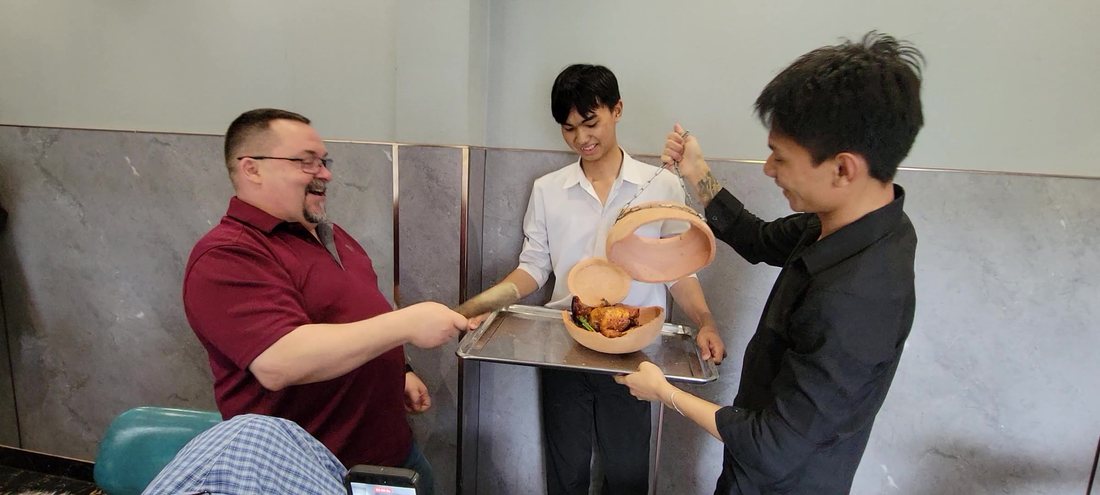
Every one of those is a design decision, and together they tell you the whole dish before anybody explains it. The pot has no way in. It was sealed shut with the bird inside and then cooked, and the only route to the chicken is through the wall. The ridge is where it is meant to fail. The chain is clamped on the ridge so it both suspends the pot and holds the two halves together — which is why, a second after the strike, the top half is still swinging from the chain while the bottom half has settled onto the tray as a bowl.
What it is called
Gà đập niêu — literally chicken, smash the pot. It is also sold as gà đập lu, lu being the bigger southern word for the same kind of earthenware jar.
The published descriptions of it are consistent and match what is in my video almost item for item: a whole free-range bird of about 1.2–1.5 kg, marinated, laid on a bed of lemongrass stalks inside the pot, sealed in, and cooked 45–60 minutes. One Đà Lạt version steams the sealed pot over hot volcanic stones after a first pass over charcoal. And the pots are specifically chosen or made so that when struck they split cleanly instead of shattering, precisely so that no clay ends up in the food.
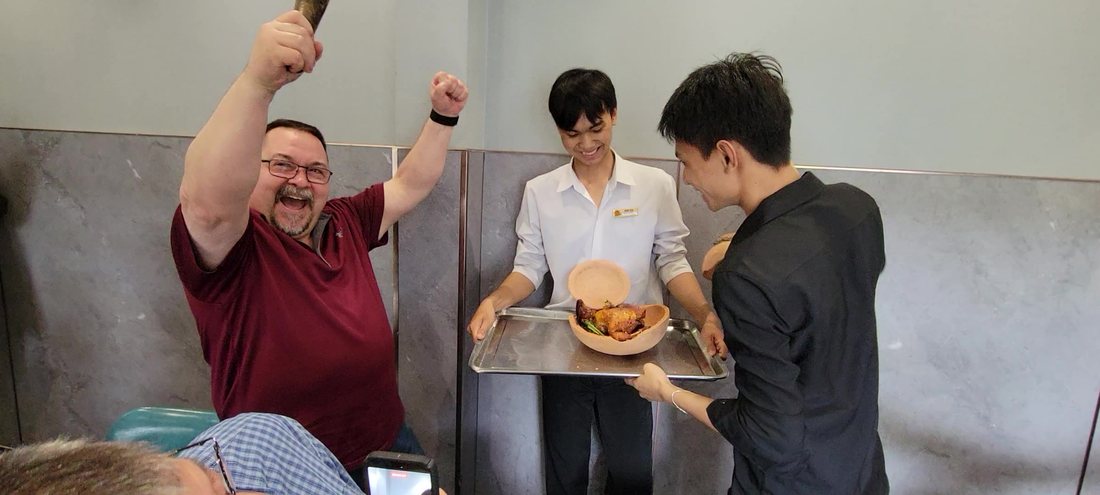
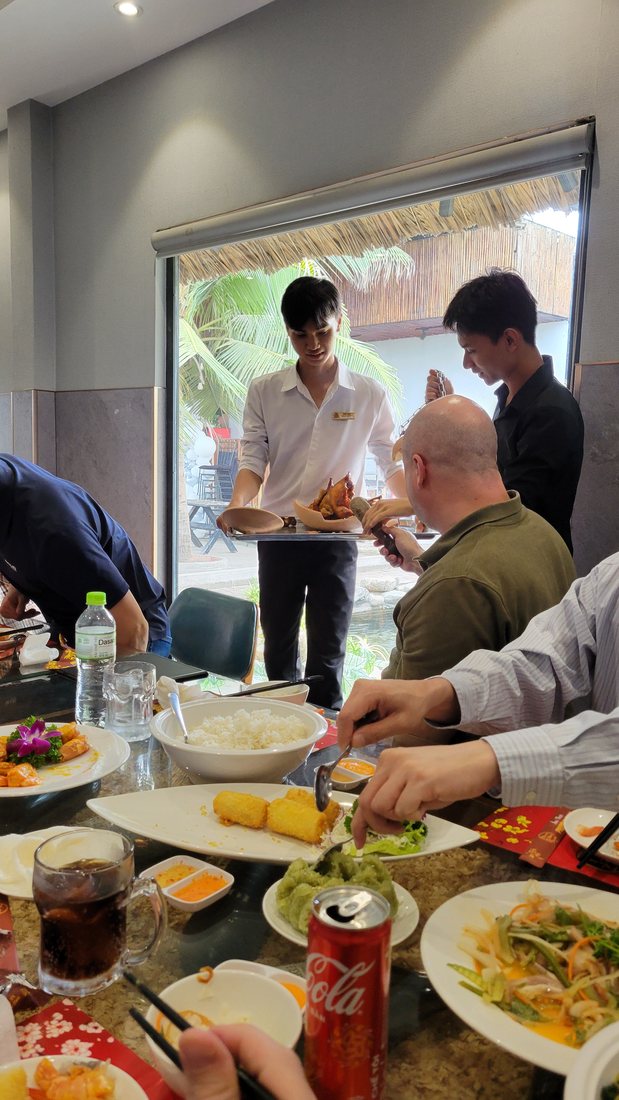
Which is exactly what happened. Mine broke into two pieces, both of them big enough to serve out of.
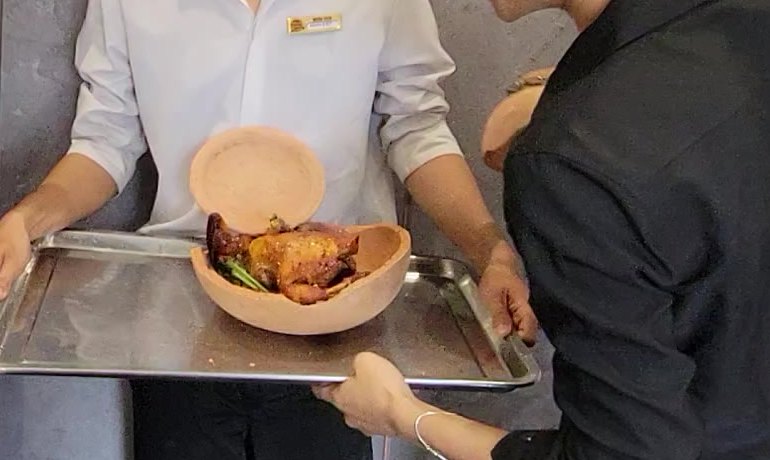
You can see the lemongrass under the chicken in that frame. The skin is amber rather than crisp-dark — which is what you would expect from something that spent its cooking time sealed in damp clay rather than open to a fire.
The mechanism, which is the reason the theatre exists
An unglazed clay pot, sealed, is an oven with no vent.
Nothing evaporates out of it. Nothing drips away. The fat, the juices, the lemongrass steam and whatever the marinade was doing all stay in a volume barely bigger than the bird, for the entire cook. It is the same logic as a tagine, a pit, a salt crust or a hangi — and the same trade-off: you get an extraordinarily moist bird and you do not get crackling skin, because crisp skin needs dry air and there is none in there.
⭐ So the smashing is not a gimmick bolted onto a normal roast chicken. It is a consequence. The seal is the cooking method; breaking it is simply the only way the seal can end. The restaurant has turned the unavoidable part into the show, which is good sense, but the order of causation runs that way and not the other.
That is worth saying because I assumed the opposite when it was in front of me. I thought I was being handed a mallet for the same reason American restaurants sing at you.
Where it comes from — and what it is not
Here is the correction I owe this page, because the obvious answer is the wrong one.
Vietnam has a genuinely old clay-baked chicken: gà nướng đất sét, also called gà đập đất and gà ăn mày — beggar’s chicken. That one has no pot at all. The bird is wrapped in lotus or banana leaf, packed in a lump of raw clay, and buried in a fire, for as long as several hours. It is a specialty of the southwest — the Mekong Delta, and Đồng Tháp Mười in particular — it carries a legend about a beggar who stole a chicken and hid it in mud, and the technique descends from the Chinese beggar’s chicken of Hangzhou.
That is not what I ate. A lump of raw clay dug out of a fire does not arrive at your table on a chain with a machined ridge around its shoulder. What I was handed was a manufactured pot — a thrown, fired, purpose-built, single-use vessel with an engineered fracture line. It is a modern restaurant format that borrows the idea of cooking in clay and breaking it open, and it is maybe a decade or two old, not centuries.
⚠ Which means the honest version is: an old technique, in a new object, sold as an event. I would rather say that than let the beggar’s-chicken legend do the work, because the legend belongs to a different dish that is cooked a different way.
The other half of the borrowing, which I only found by looking at my own footage
The restaurant format is explicitly said to be inspired by a northern folk game called đập niêu đất — smash the clay pot. It is a spring-festival game in the Red River delta villages: you are blindfolded, handed a stick, and sent forward at a row of clay pots hung about two metres off the ground, while everyone you came with shouts trái, phải, tiến, lùi — left, right, forward, back. Nobody much cares who wins.
⭐ And that is the detail my twelve seconds settle. Every published description of the restaurant dish I can find has the pot sitting on a tray while a waiter rotates and taps it. Mine was hanging in the air on a chain — which is not the restaurant convention, it is the game. Long Thành is a long way from the Red River delta, and whoever set that service up went back past the dish to the thing the dish was copying.
I did not get the blindfold. On the evidence of the video I would have missed.
What I cannot tell you
- What Phương Nam’s own kitchen actually did. Charcoal, gas, hot stones, how long, what was in the marinade — I have a pot arriving and a pot opening, and nothing in between. The 45–60 minutes and the lemongrass are from published accounts of the dish elsewhere; the lemongrass at least is confirmed by my own photograph, because it is under the bird.
- How it tasted, in any useful detail. Four months on, what I have is that it was very good and extremely moist, which is exactly what the method predicts and therefore not evidence of anything.
- Whether the pot gets reused. The Đà Lạt reporting says no, it is a one-use item. That is believable given it comes apart on the first hit, but I did not watch what happened to mine.
The place it happened
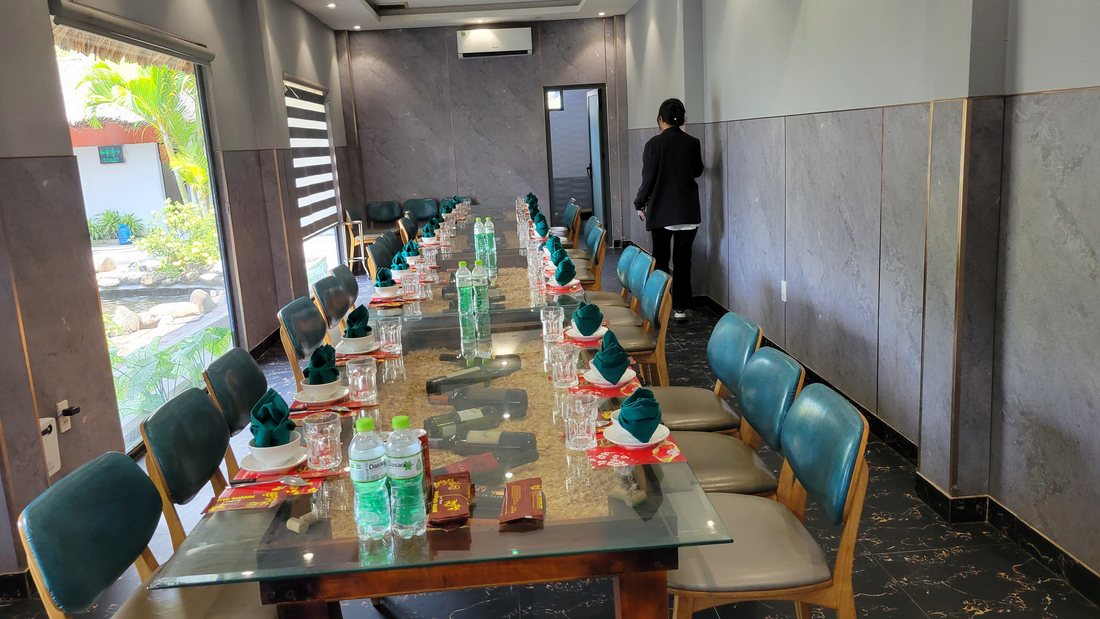
This was the same long table on the same day as the rest of the Đồng Nai lunch — a private room off the garden at Ẩm thực Phương Nam, on Phạm Văn Đồng in Long Thành. I went back there for dinner the same evening.
Comments (0)