Cơm Tấm Mộc
Of everything I ate on this trip, this is the plate I am most confident I can rebuild at home — and it is the one I photographed best, which is not a coincidence. I liked it enough to take the picture properly.
15 March 2026, half past six in the evening. In my own photo folder this restaurant is filed under the name “Very Good Small Restaurant A”, which tells you how much attention I was paying to the name at the time. The sign says CƠM TẤM MỘC.
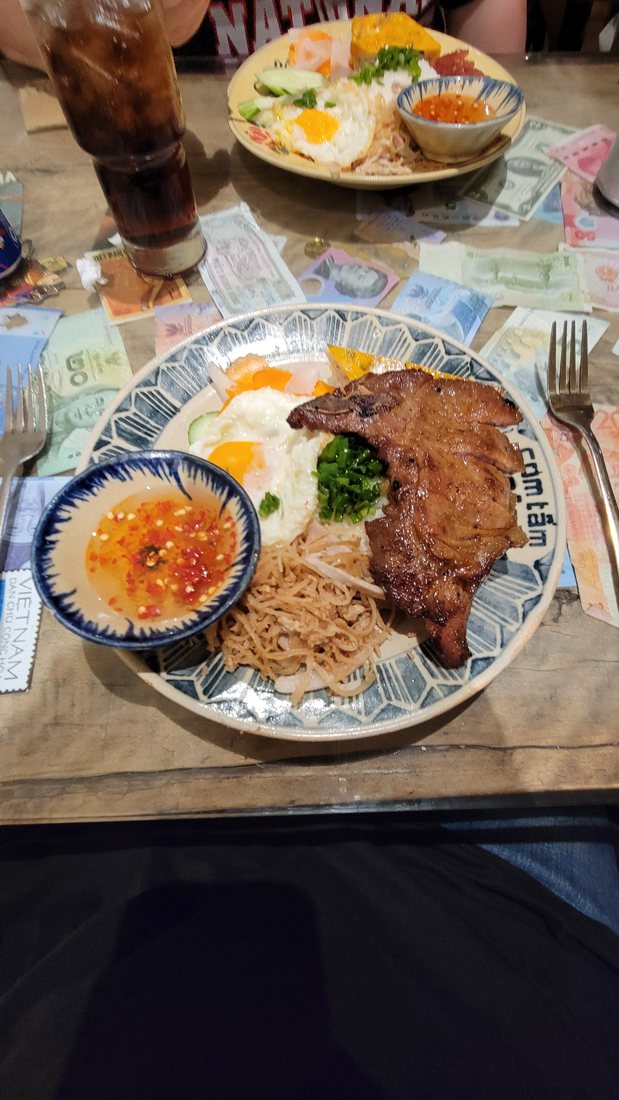
What is actually on the plate
Reading it straight off the photograph, left to right:
- Cơm tấm — the rice. Not ordinary long grain.
- Sườn nướng — a grilled pork chop, marinated and caramelised at the edges.
- Trứng ốp la — a fried egg, yolk soft.
- Cucumber and tomato.
- Nước chấm in its own bowl, to be poured over the whole thing rather than dipped into.
That is the canonical Saigon plate. Nothing exotic, nothing hard to source, and every element does an obvious job.
The rice is the whole story
Cơm tấm means “broken rice.” It is not a variety. It is the fraction — the grains that snapped during milling and fell through, historically the part that could not be sold whole.
It cooks differently, and that is the point: broken grains are smaller and more absorbent, so they come out slightly softer, a little more clumped, and they take a sauce far better than intact long-grain does. Pour nước chấm on a plate of ordinary steamed rice and it runs to the bottom. Pour it on broken rice and it stays where you put it.
⭐ So the defining dish of a city is built on the byproduct. The cheap fraction turned out to have a texture the expensive fraction does not, somebody built a plate around that, and now it is what the place is known for. That is a shape that turns up wherever a cuisine grew out of what people were given rather than what they chose — but it is unusually clean here, because nothing was substituted or disguised. The broken rice is just better at this job.
⚠ The honest hedge: the “it was the cheap leftover fraction” origin is what the dish is universally said to come from, and it is entirely consistent with how milling works. I have not gone and read a primary source on when Saigon started serving it that way, so treat the mechanism as solid and the history as the received account.
The menu, which I photographed all of
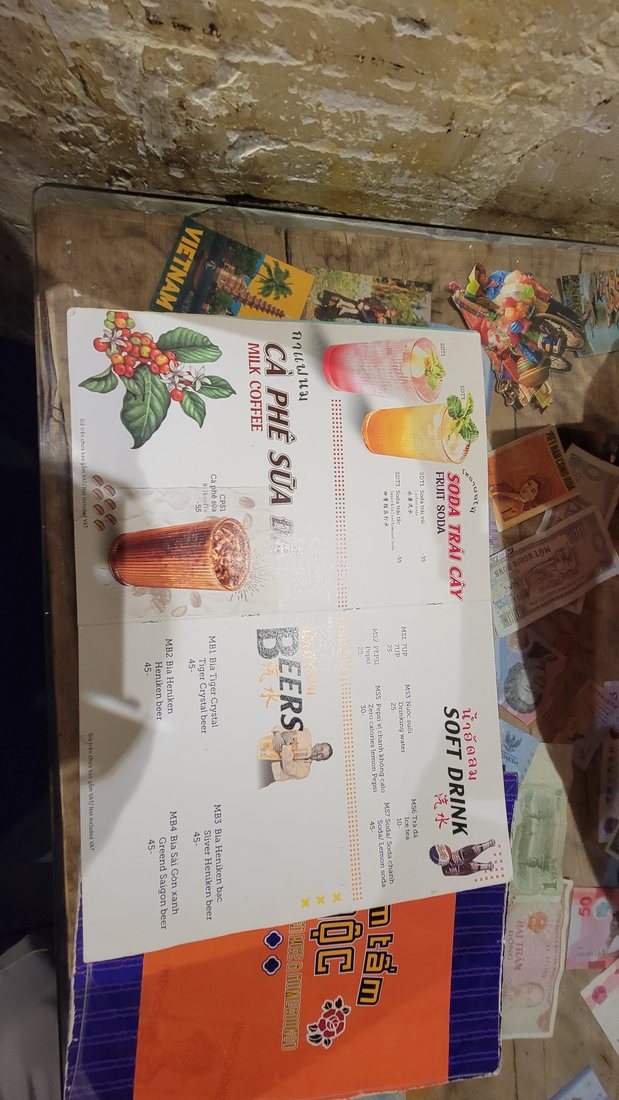
The menu is an illustrated placemat, and I photographed all sixteen frames of it, which in hindsight was the single most useful thing I did in Vietnam. Every dish is a photograph with a name under it. You order by pointing.
That is the same solution as the plastic food in Japan in 1985 that I have already written about — a restaurant deciding that the fastest way past a language barrier is a picture of the actual plate. Forty years and two countries apart, same answer.
The sections, read off the placemat:
CƠM TẤM SÀI GÒN · CƠM TẤM BĂNG CỐC – CHỢ LỚN · MÓN KHO (clay-pot braises) · MÓN MẶN · CANH PHẦN (soups) · MÓN RAU (vegetables) · NƯỚNG VÀ CUỐN (grilled & rolled) · MÓN GỎI & BÚN (salads & noodles) · MÓN TRÁNG MIỆNG (desserts) · CÀ PHÊ SỮA ĐÁ · SODA TRÁI CÂY · BANGKOK SWEET
⭐ CƠM TẤM BĂNG CỐC – CHỢ LỚN is the interesting one. Băng Cốc is Bangkok; Chợ Lớn is
Saigon’s Chinese quarter. So there is a Bangkok-via-Chinatown broken rice on the menu, sitting next
to the Saigon one, as a separate category — a restaurant treating a cross-border variant as its own
thing rather than blurring it into the house version. I did not order it and I wish I had.
One spread, read properly
Of the sixteen frames, this is the one that repays reading closely — a double page carrying MÓN MẮM, MÓN TRỨNG and MÓN KHO.
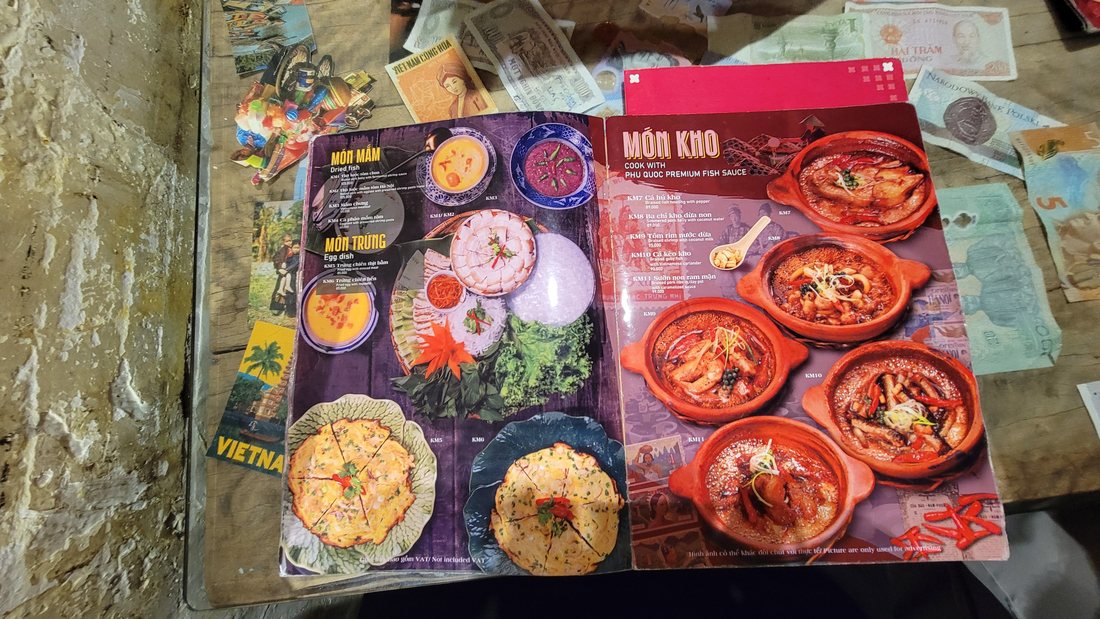
MÓN KHO carries its own subtitle in English: “COOK WITH PHU QUOC PREMIUM FISH SAUCE.”
⭐ That is a category defined by a method and a sourcing claim, printed as the section heading. Kho is the braise-in-caramel-and-fish-sauce technique; Phú Quốc is the island the fish sauce comes from — and it is not a marketing flourish, it is a protected designation of origin. Phú Quốc nước mắm received EU PDO status in 2012, the first Vietnamese product and the first Southeast Asian food to get one, which means only sauce made and bottled on the island may use the name. A menu section headed “cooked with Phú Quốc fish sauce” is doing the same work as “made with San Marzano tomatoes” on an Italian one.
And look at the five photographs under it: every single kho dish is in a clay pot, which is the other half of what kho means. Long, slow, low, in earthenware — the same material logic as the sealed pot they broke open at the table in Đồng Nai, used for the opposite job.
The listed dishes, with the restaurant’s own English:
KM7 Cá hú kho — “Braised fish howling with pepper” · KM8 Ba chỉ kho dừa non — simmered pork belly with coconut water · KM9 Tôm rim nước dừa — braised shrimp with coconut milk · KM10 Cá kèo kho — braised goby with Vietnamese coriander · KM11 Sườn non ram mặn — braised pork ribs in clay pot with caramelised sauce
⚠ “Braised fish howling with pepper” is a machine translation coming apart. Cá hú is a catfish; the translator read hú as the verb to howl and translated it. It is charming and it is also a small warning about trusting an English column on a Vietnamese menu.
🔴 And the other English line on that page is wrong in a way that matters. MÓN MẮM is captioned “Dried fish.” It is not. Mắm is fermented — fish or shrimp broken down under salt over months into a paste or a sauce — and the dishes listed under it say so: thịt luộc tôm chua (boiled pork with soured shrimp), thịt luộc mắm tôm Hà Nội, mắm chưng (steamed mắm), cà pháo mắm tôm (eggplant with shrimp paste). Dried and fermented are opposite answers to the same problem — one removes the water, the other lets microbes work in it — and this section of the site spends a lot of time on that distinction elsewhere. The menu is not lying, it is translating badly, but if you ordered off that English line expecting dried fish you would get one of the most pungently fermented things in the building.
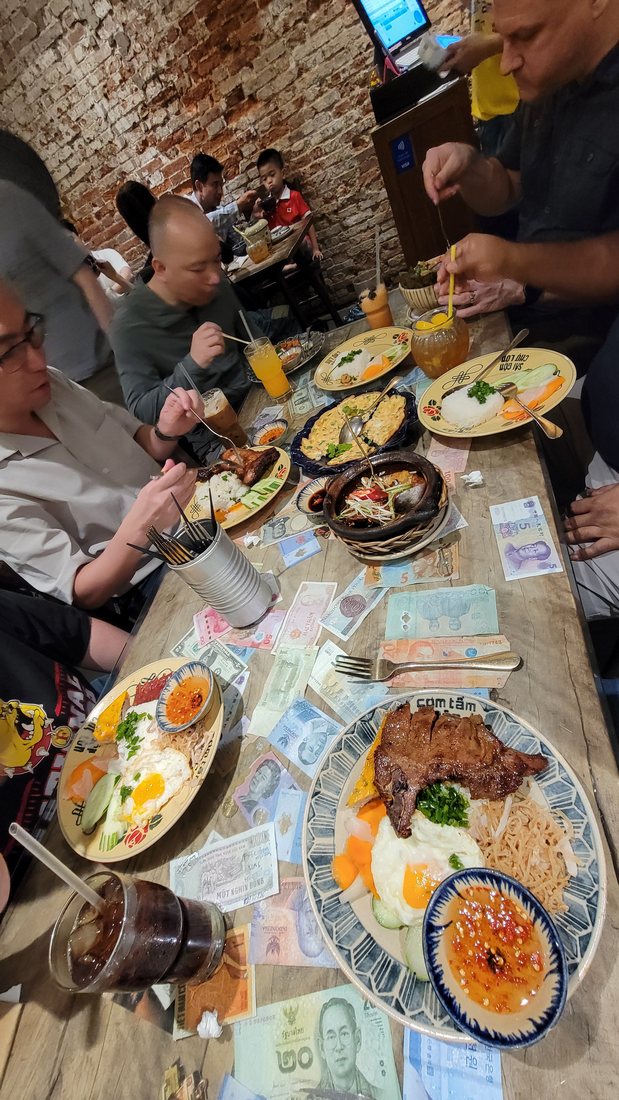
The bit that makes it work
If you build this at home and it tastes flat, it will be the nước chấm.
It is not a dipping sauce in the sense of a condiment you add if you like. On a cơm tấm plate it is the seasoning for the entire dish — the rice is unsalted, the cucumber is raw, and the pork is sweet rather than salty. The sauce is what pulls those together, and it wants to be poured on generously enough to pool.
Fish sauce, lime, sugar, water, garlic, chilli. It is a thirty-second job and it is the difference between the plate and a pork chop with rice.
Next: The Pavement Grill — the best food photographs I took.
Comments (0)