Country Ham and Red-Eye Gravy
There is a story everybody tells about how red-eye gravy got its name. It involves Andrew Jackson, a drunk cook, and a joke about bloodshot eyes.
It’s folk etymology, and the real explanation is sitting in the pan.
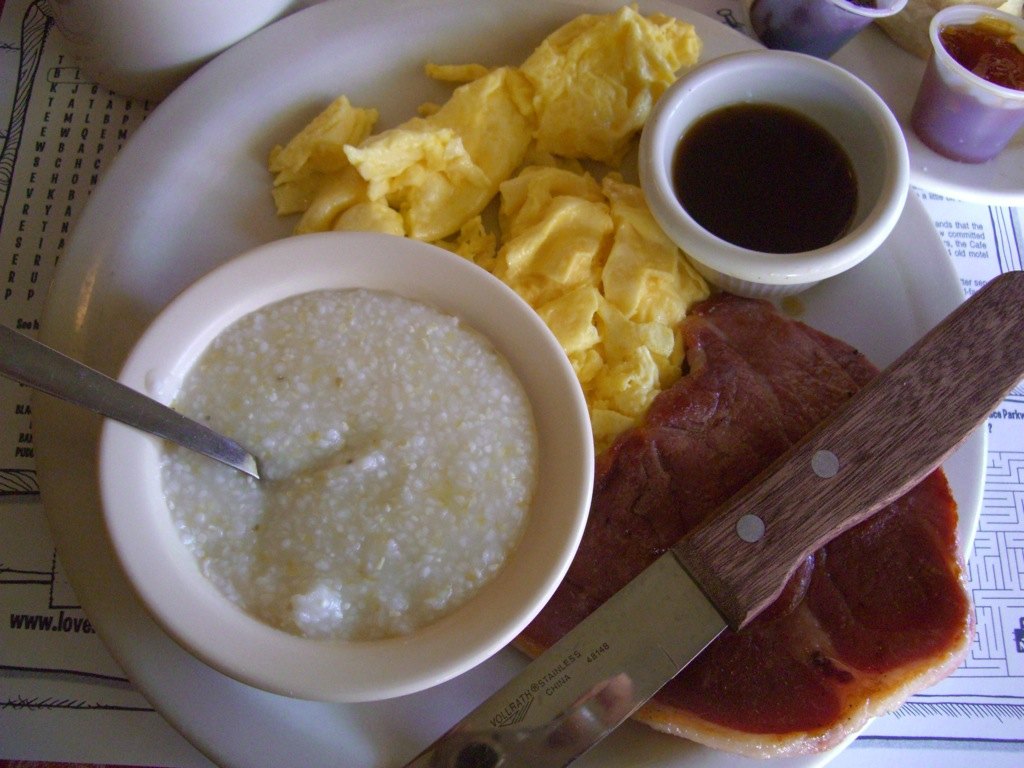
What country ham is
Country ham is the American catch-all for dry-cured ham aged at least six months. Not brined, not injected — packed in salt, hung, and left. The cure often includes pepper and sugar; it may or may not be smoked; and it is usually eaten cooked, sliced thin and fried hard in a skillet.
It is aggressively salty, dense, and nothing like the wet-cured pink ham most Americans mean by the word. Virginia, Kentucky and Tennessee are the heartland, and a well-aged one develops the same funk and depth as any long-cured ham anywhere.
Against prosciutto, which is the obvious comparison:
| Country ham | Prosciutto | |
|---|---|---|
| Aged | ≥ 6 months | 12–24 months+ |
| Smoked | Sometimes | Never |
| Eaten | Usually cooked | Raw |
⚠ And that “must be cooked” line needs care, because it’s often stated as a food-safety absolute and it isn’t quite. The real distinction is about trichinae treatment and ready-to-eat processing — a ham processed to a recognised ready-to-eat standard can be eaten as-is, and thinly-shaved aged country ham is served uncooked by people who know their producer. The general advice to cook it is sound; the reason usually given for it is a simplification.
🔴 The Andrew Jackson story
The tale goes: Jackson, at a tavern, tells a cook who is visibly drunk on white mule to bring him some country ham with gravy “as red as your eyes.”
It’s a good story. It is not the likely origin, and it has all the markers of folk etymology — a famous name, a punchy line of dialogue, no contemporary source, and an explanation that arrives long after the thing it explains.
⭐ The better explanation is simply what the gravy looks like.
Fry country ham in a hot skillet. Take the ham out. Deglaze the pan with strong black coffee. Pour it into a bowl and leave it a moment.
It separates. The rendered ham fat and juices rise and ring the edge in reddish-brown, while the darker coffee sits in the middle — a dark pupil inside a red ring. It looks like an eye.
That’s it. The name is a description of the finished gravy, not an anecdote about a president. Once you’ve made it and looked into the bowl, the Jackson story stops being necessary.
Making it
The whole thing is four steps and no thickener:
- Fry the ham slices in a cast-iron skillet over medium-high until browned and the fat has rendered. Country ham is already salty and already dry — do not baby it, but do not cook it to leather either.
- Take the ham out and keep it warm.
- Deglaze with black coffee — about a half cup to a cup, poured into the hot pan, scraping up the browned fond. Some cooks use part water, some add a pinch of sugar, some a splash of the ham’s own drippings back in.
- Simmer a minute or two and pour it over the ham, or over grits, or over biscuits, or all three.
🔴 There is no flour in it. Red-eye gravy is not a thickened gravy and should not be — it is a thin, dark, salty-bitter pan liquid. If yours is creamy you have made sawmill gravy, which is delicious and a different thing.
⭐ Why coffee at all? The unglamorous answer is that it was the hot liquid already on the stove at breakfast. But it earns its place: the ham is intensely salty and fatty, and coffee brings bitterness and acidity — the two things that cut salt and fat. It is the same job the halved oranges do in a Georgia peanut kettle, reached from a completely different direction.
Recipes: Country Ham and Red-Eyed Gravy · Redeye Gravy with Country Ham · Country Ham Sandwiches on Thick-Sliced Farm Bread
Where it sits
Red-eye gravy belongs to a breakfast that is really a working man’s first meal: ham, eggs, grits, biscuits, and something to pour over all of it. It shows up in the Hillbilly Lunches world too — country ham keeps without refrigeration, which is precisely why it was cured that way, and a slice between two pieces of farm bread travels.
⭐ And it is a preservation food first and a breakfast second. Six months of salt and time existed to get a hog through a year, not to make a delicacy. The delicacy is a side effect — which is more or less the story of every good thing in this section.
Back to: The South Is Not One Place
Comments (0)