Biscuits: The Flour Is the Recipe
Southern biscuit lore is almost entirely about hands. Don’t overwork it. Use cold fat. A light touch. Your grandmother had the knack and you don’t.
Some of that is true. Most of it is downstream of something much simpler and completely checkable:
Southern flour is different wheat, and the difference is enormous.
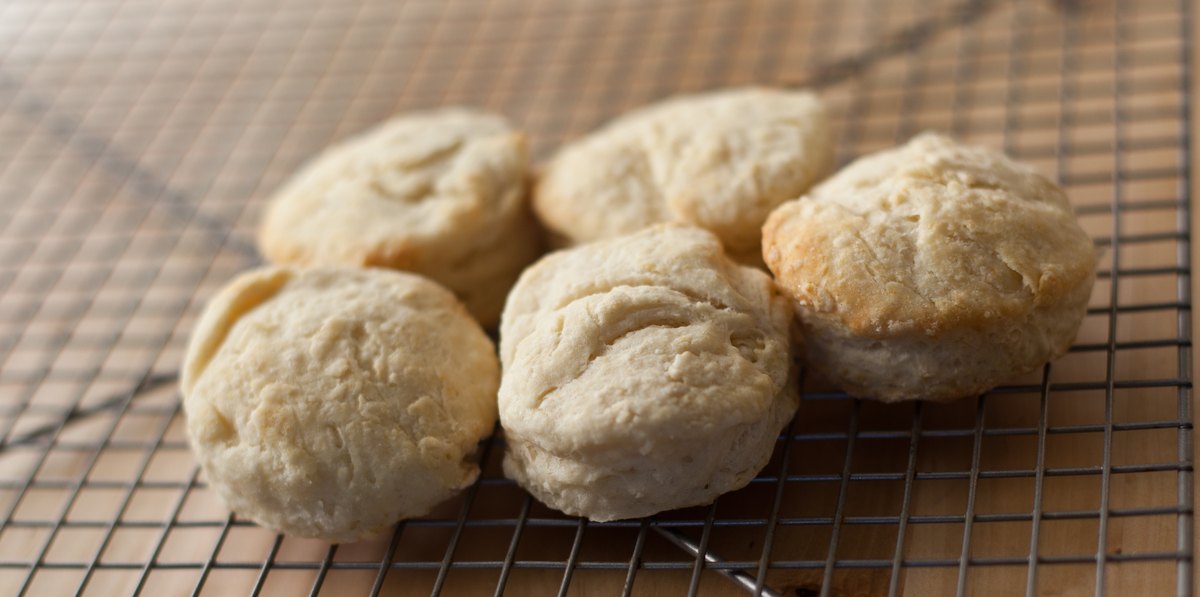
The number that explains it
White Lily — the flour a great many Southern bakers will tell you is non-negotiable — is milled from soft red winter wheat only, and it runs about 9% protein.
Compare that with what’s on a typical shelf:
| Flour | Protein |
|---|---|
| White Lily | ~9% |
| Gold Medal all-purpose | ~10.5% |
| King Arthur all-purpose | ~11.7% |
Protein is gluten potential. More protein means more gluten, which means more chew and structure — exactly what you want in bread and exactly what you do not want in a biscuit. A biscuit is supposed to be tender and short, and it should pull apart in layers rather than tear.
⭐ So a Southern baker using White Lily and a Northern baker using King Arthur are not performing the same recipe with different skill. They are working with materially different flour, and the Southern one has a large head start on tenderness. Hand a lifelong biscuit maker a bag of bread flour and their knack will not save them.
Why the wheat differs at all is climate: soft red winter wheat suits the warm, humid Southeast; hard wheats suit the northern plains. The regional flour follows the regional crop, and the regional bread follows the flour. Same shape of argument as the cornmeal — the ingredient is doing the work the folklore credits to people.
If you can’t get White Lily, the workable substitution is to cut all-purpose with a softer starch — roughly ⅔ all-purpose to ⅓ cake flour gets you near 9%. It is not the same, but it is much closer than technique alone will get you.
🔴 And then they closed the mill
This is the part that turns a flour spec into a story.
White Lily had been milled in Knoxville, Tennessee, since 1883 — over a century in one place, in the middle of the region that used it.
- Fall 2006 — The J. M. Smucker Company agreed to buy the brand.
- 2007 — the Knoxville mill closed. Production moved to two mills in the Midwest.
- Southern bakers revolted loudly enough that the New York Times covered it. ⚠ I have that the Times covered the change, and I’m not going to print a specific article date I couldn’t verify.
⭐ The complaint was not sentimental, or not only sentimental. The worry was that a flour defined by a specific regional wheat and a specific century-old mill would not survive being made somewhere else by somebody else. Whether the product actually changed is genuinely disputed and I’m not going to adjudicate it — but the fear was a supply-chain fear, and this section keeps finding that the supply chain is where the real story lives.
⚠ And it changed hands again. In 2018 Smucker divested its entire US baking business — Pillsbury, Martha White, Hungry Jack, White Lily and Jim Dandy — to the private-equity firm Brynwood Partners, completed 31 August 2018. So the brand your grandmother’s biscuits depended on has been through two owners and a mill closure since 2006. That is worth knowing before treating any bag as a fixed quantity.
What the technique folklore does get right
Having said the flour does most of it, the hand rules aren’t nothing:
- Keep the fat cold and in pieces. Those pieces melt in the oven, steam, and leave the gaps that make layers. Rubbed-in-warm fat gives you a scone.
- Work it as little as it will tolerate. Every extra turn develops gluten you’ve just spent money avoiding.
- Buttermilk, and not only for flavour — the acid reacts with the soda for lift and tenderises alongside.
- Cut straight down and don’t twist. Twisting seals the cut edge and the biscuit can’t rise there.
- Sides touching on the pan so they push each other up. Spaced-out biscuits brown all over and rise less.
Lard versus butter is a real fork, not a nostalgia point: lard has no water in it, so it makes a shorter, more tender biscuit, while butter is ~16–18% water and contributes steam and flavour. The mountain tradition is lard because lard is what a hog gives you.
Recipes: Biscuits, Buttermilk (Proof Recipe) · Ad Hoc Buttermilk Biscuits · Mountain Lard Biscuits · Sweet Potato Biscuits
What goes on them
A biscuit is a vehicle, and the things Southerners put on it are half the point:
Sawmill gravy — sausage, drippings, flour, milk. Tomato gravy, which is thriftier and older than it looks. Red-eye gravy, made with coffee, which has its own page. Sorghum molasses, poured over cold leftovers. Blackberry jam. Fried fatback. Raw ramps, in spring, in the mountains.
⭐ Notice how many of those are cold-biscuit dishes. Biscuits were made in quantity in the morning and the leftovers were lunch — which is the whole logic of the lunch-pail cooking further up in the hills.
Next: Greens and Pot Likker — the best-documented argument in Southern food.
Comments (0)