Rice · 12 of 15
Spain and Latin America: Paella, Arroz Rojo and Rice with Beans
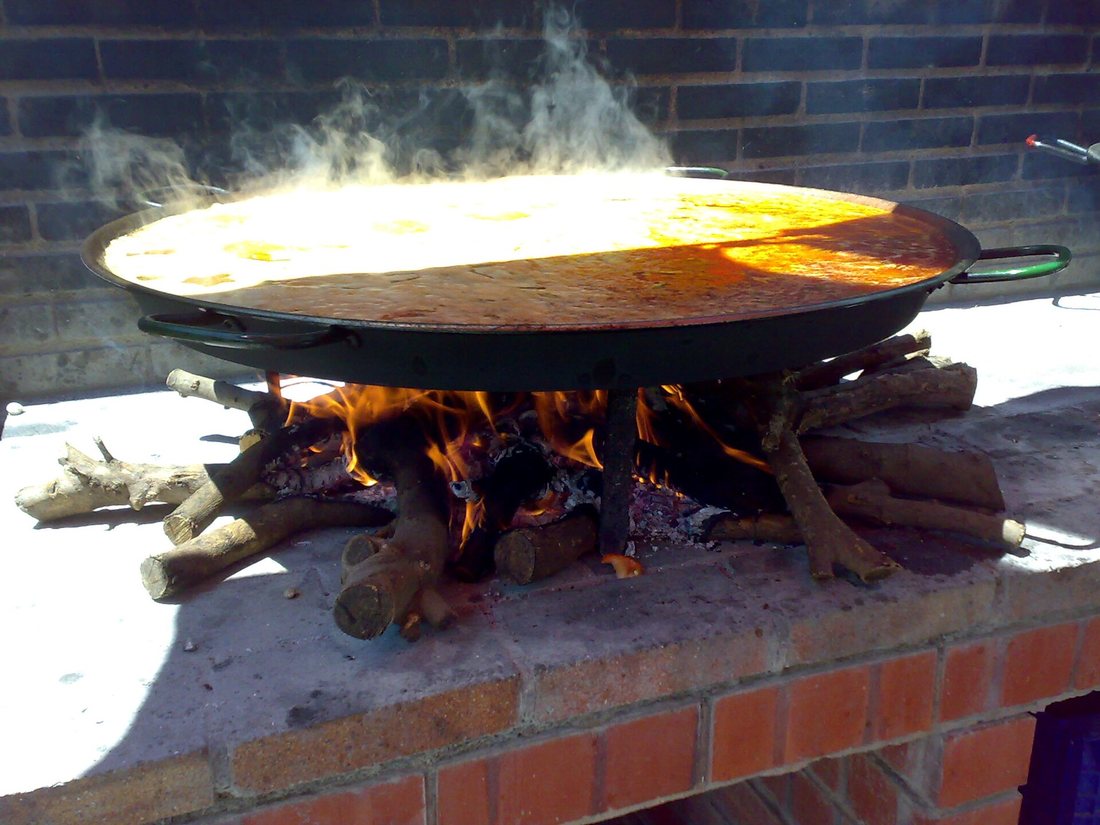
Rice reached Spain with al-Andalus, and Spain carried it to the Americas, where it met beans, tomatoes and chillies and became the everyday rice of two continents. Paella is one of the rice dishes cooked in the kitchen these pages are written for, as is Mexican fried rice; the recipes below are sourced, not that kitchen’s own.
Spain
Rice arrives
The Valencian rice denomination’s own history credits “the Muslim culture settled in these lands since the late tenth century” with rice cultivation in Valencia, in the marsh its Arab inhabitants called al-buhera — the Albufera. (A popular claim that rice was grown “almost immediately” after the conquest of 711 is not supported by anything found.) After Jaume I’s conquest in 1238 the Albufera became royal land; the expulsion of the Moriscos in the seventeenth century removed the expert farmers and caused an agricultural crisis. Valencia’s paddies cover about 17,500 hectares today, restricted to land that is naturally wet.
A Valencian rice crust is written down by 1520. Rupert de Nola’s Llibre del Coch tells the cook of a baked rice that “you will see the rice has made a crust which is very good.” Whether the Valencian crust and the Persian one were independent inventions, as earlier versions of this site said, is not established either way.
Three rice denominations
Spain has exactly three protected rices:
| Denomination | Where | Rices |
|---|---|---|
| Calasparra | Murcia and Albacete — a mountain rice at about 450 m, irrigated with running water | Bomba and others; provisional 1982, confirmed 1986 — the oldest of the three |
| Arroz de Valencia | The Albufera and other Valencian wetlands | Senia-type (including Bahía), Bomba and Albufera |
| Arròs del Delta de l’Ebre | Catalonia | Bahía, Tebre, Fonsa, Bomba and others — “all of the japonica subspecies” |
Bomba is officially a short grain. The Ebro delta specification lists it at 5–5.5 mm, length-to-width 1.9–2.2, “spherical.” The Valencian council says it has “good resistance to overcooking” and firms as it rests, which is why it forgives a cook. Senia, which this site had not mentioned, gives “a very creamy texture.” (Wikipedia’s claim that bomba came from an Indian variety has no source.)
What makes a paella valenciana
The word is the pan. In Valencian, paella means a frying pan, from Old French paele and Latin patella. In Castilian Spanish the pan is usually a paellera, and the Royal Spanish Academy only accepted paella for the vessel in 1970. (The popular derivation from Arabic baqiyya, “leftovers,” is folk etymology.) Early Valencian writers called the dish arroz a la valenciana; a scholar from Xàtiva wrote in 1818 that the “mystery … consists of nothing more than knowing how to proportion the stock or water to the rice,” cooked “over a very lively fire, preferably flame.”
The ten-ingredient rule is from 2011, and it is a certification scheme, not an ancient law. In October 2011 the Valencian agriculture ministry approved a “traditional paella valenciana” standard promoted by the restaurateur Rafael Vidal and administered through the rice denomination: “ten basic ingredients and no others. Namely: oil, chicken, rabbit, ferraura [flat green beans], garrofó [large lima beans], tomato, water, salt, saffron and rice,” with accepted local variants of artichoke, duck, sweet paprika, garlic, snails and rosemary. “Anything outside these parameters will have to be called ‘paella de …’, never ‘paella valenciana’” (Levante-EMV). Wikipaella, often credited with the list, is a separate advocacy association founded afterwards; its own ingredient page is statistical, built from the recipes of the restaurants it honours.
The rules are modern, and chorizo is older than they are. Giuseppe Baretti described an arroz a la valenciana in 1760 with pig’s and lamb’s trotters, bacon, chorizo and black pudding (as reported). An 1896 book set out “24 ways” to cook rice the Valencian way, with eel, birds, snails and marsh rats. The purist list codifies one strand of a looser tradition. The standard is useful all the same, because a dish of rice with mussels, chorizo and peas stirred in a covered pot is a good dish that is simply not a paella valenciana.
Paella and the heritage declaration are two different things. The Valencian government opened a file to declare paella a Bien de Interés Cultural in May 2021 and made the declaration on 9 November 2021, also setting 20 September as World Paella Day. Whether the declaration defines ingredients could not be confirmed, so it should not be said to “fix the recipe.”
Cooking it
The rice is spread evenly and then left: an 1818 text describes stirring with a wooden spoon to gauge the liquid before the rice rests, but once the rice is distributed it is not stirred again. The crust is the socarrat — from Valencian socarrar, “to toast lightly and superficially” — which Visit València calls “the most coveted and crunchy bite.” (In English Wikipedia, “Socarrat” is an article about medieval Valencian painted tiles.) Valencia’s tourism board adds that an authentic paella needs “gas or firewood, the classic pan, and round rice with D.O. València.” The recipe is Paella Valenciana. The collection’s only other “paella” is a cauliflower-rice version.
Two other Valencian rices are not called paella:
- Arròs negre — with cuttlefish or squid and its ink.
- Arròs a banda, “rice on the side” — the Alicante fishermen’s dish, where the bony fish kept back from market makes a stock; the fish and potatoes are served first and the rice cooked in the broth after, with alioli. (In Murcia the names swap.)
Horchata in Spain is horchata de chufa, made from tiger nuts — the sedge tuber of the Flour section; the Mexican drink made from rice and cinnamon replaced them. The collection’s Horchata (Authentic Mexican Recipe) is the Mexican kind.
Latin America
Arroz rojo, and “Spanish rice”
Rice reached Mexico with the Spanish in the sixteenth century. “Spanish rice” is an American name, used by neither Mexicans nor Spaniards; in Mexico the dish is arroz rojo or arroz a la mexicana, and in central Mexico it is the sopa seca — the “dry soup” course that follows the brothy sopa aguada on a set lunch. The collection’s own Spanish Rice is the 1944 US Army recipe, which makes the point by itself.
How far to toast the rice is not agreed. The instruction that the rice must be fried “until golden” is widely repeated. Pati Jinich fries it “until milky white, about 3 to 4 minutes”; Rose Egelhoff in Serious Eats toasts it “until rice is golden and smells toasted, 5 to 8 minutes,” after rinsing and drying it to remove surface starch. Both are Mexican home methods, and both work. The recipe here is Jinich’s: Arroz Rojo (Mexican Red Rice).
Mexican fried rice, also cooked in this kitchen, belongs to the same family as Peru’s arroz chaufa: Chinese fried rice that crossed the Pacific. Chaufa is from Cantonese 炒飯, “fried rice,” brought by Chinese labourers who arrived in Peru from the mid-nineteenth century; Lima’s chifa restaurants were prominent by the 1930s and numbered over 6,000 by 2007 (as reported). The collection’s Arroz Chaufa (Peruvian Chinese Fried Rice with Chicken) is Ham El-Waylly’s.
Arroz con pollo
Chicken and rice is claimed by Spain and by Puerto Rico, where it is made with beer and annatto; in the Dominican Republic it is locrio. It ranges widely: the Nicaraguan version here, from María del Mar Cuadra, cooks the rice first and then stir-fries it with shredded chicken, ham, sausage, olives and capers — nearer to a fried rice than to a one-pot pilaf: Arroz con Pollo (Nicaraguan).
Rice and beans
The pairing is everywhere, under names that matter:
- Moros y cristianos — Cuban rice cooked with black beans in one pot. Congrí is the similar dish with red beans, from eastern Cuba. They are not synonyms, as an earlier version of this site had it. The collection has Cuban Rice & Beans.
- Gallo pinto, “spotted rooster” — claimed by both Costa Rica (black beans, Lizano sauce) and Nicaragua (red beans), with general agreement that its origins are Afro-Caribbean; it is made from leftover rice and beans, the same logic as fried rice.
- Casamiento, “marriage” — the name in El Salvador and Honduras.
- Arroz e feijão — Brazil’s everyday plate, so ordinary that feijão com arroz has become an idiom for “the routine.” The collection’s Feijoada (Brazilian Black Bean Stew) is its festive relative.
The recipes
Paella Valenciana · Arroz Rojo (Mexican Red Rice) · Arroz con Pollo (Nicaraguan) · and the collection’s Cuban Rice & Beans and Rice Cooker Mexican Rice.
Comments (0)