Rice · 9 of 15
South Asia: Biryani, Pulao, Basmati and the Everyday Rice
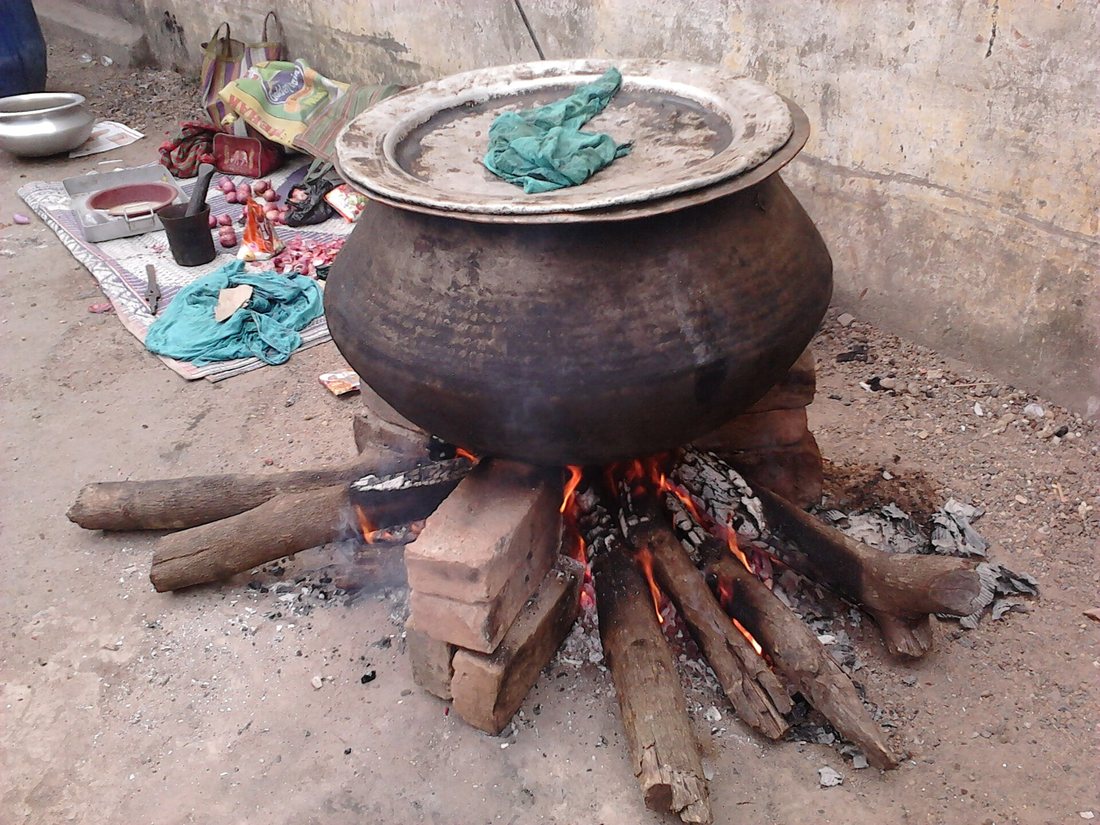
South Asia eats rice in more forms than anywhere else: absorbed, layered and sealed, boiled and drained, ground and fermented into batter, parboiled and pounded flat, puffed in hot sand. This page covers the two great festive dishes and the argument between them, basmati and the law around it, and the everyday rices that most of the subcontinent actually eats.
Two domestications and a hybrid
Rice in India is old, but its oldest date is disputed. Grains and pottery from Lahuradewa in Uttar Pradesh, dated to about 6500 BC, have been read as very early cultivation; other scholars, including the archaeobotanist Dorian Fuller, read them as rice gathered from wild stands, with settled rice farming only from the third millennium BC (UCL Early Rice Project). Fuller’s model (Rice, 2011) has domestication finishing in China around 6,500–6,000 years ago and “about two millennia later in India, when hybridization with Chinese rice took place” — the Indian indica rices received many of their domestication genes from japonica. “Rice was farmed in India 9,000 years ago” is contested, not established.
English rice runs back through Greek oryza to an Indo-Iranian word and “ultimately … Sanskrit vrihi-s” (Etymonline). The widely repeated derivation from Tamil arisi was not found in any source consulted.
Pulao and biryani
Pulao is an absorption dish. The rice goes into a measured amount of seasoned liquid with the vegetables or meat and cooks until the liquid is gone, like any pilaf. With meat, cooks often make a stock (yakhni) first and cook the rice in it.
Biryani is a layered, sealed dish — and it comes in two schools that this site previously ran together:
- Kacchi (“raw”): raw marinated meat goes into the bottom of the pot and part-cooked rice — about 75 per cent done, “the center … still slightly uncooked,” in Swasthi Shreekanth’s Hyderabadi recipe — is layered over it. The meat cooks only during the final sealed steaming. This is the classic Hyderabadi method.
- Pakki (“cooked”): the meat is cooked first, down to a thick masala, and layered with rice that is about 90 per cent done. Awadhi (Lucknowi) biryani is made this way.
Kerala’s Malabar (Thalassery) biryani is a third route. Its small-grained jeerakasala rice is not soaked or drained at all; it is sautéed in ghee and cooked by absorption, then layered with the masala.
A correction to an earlier version of this section. The Rice Around the World page described biryani as meat “cooked down into an intense spiced masala” and rice “parboiled to about 70%,” and linked the collection’s Chicken Biryani (Dum Style) as the example. That recipe layers raw marinated chicken under 70-per-cent rice — it is a kacchi biryani, and the description fitted the other school. Both pages now say so.
Whichever school, the layers are sealed and finished on low heat: dum, “to keep food on a slow fire.” A rope of dough around the lid is the classic seal; foil, a heavy wet cloth or a heavy lid work too, and the dough is optional. The layers are strewn with fried onion (birista), mint, coriander and saffron milk. The idea that the top of a biryani is lightly perfumed and the bottom soaked in masala is plausible — in a kacchi biryani the juices sit at the bottom — but no authoritative source for it was found.
The line between the two dishes is blurrier in practice than in theory. Colleen Taylor Sen writes that the difference “has been extensively debated” and that the two can be “almost impossible to tell apart”; plenty of cooks call a one-pot rice dish biryani. The distinction above is the classic one, not a rule that everyday cooks obey.
Where biryani comes from
The popular history says biryani was born in the Mughal court. The Mughal texts themselves are less helpful than that story needs.
- The Ain-i-Akbari (Abu’l-Fazl, 1590s) is a list of quantities. Among its meat-and-rice dishes is a duzdbiryán; but the dish it calls Biryán is a whole sheep with salt, ghee, saffron and spices — and no rice at all.
- Aurangzeb wrote to his son remembering “the savour of your ‘khichadi’ and ‘biryani’ during the winter.” His 1908 translator, J. H. Bilimoria, glosses biryani as “An Indian word for roasted meat.”
So the most-quoted Mughal references to biryani are ambiguous: the word may have meant a roast. The historian Lizzie Collingham places the modern dish in Akbar’s kitchens, where “the delicately flavoured Persian pilau met the pungent and spicy rice dishes of Hindustan” (as reported; the book itself could not be read). The claim that ancient South India already made pilaf — that Old Tamil pulavu was a pilaf — was checked by Charles Perry in 1994 against K. T. Achaya’s own footnote: pulavu “had nothing to do with pilaf. It meant raw meat or fish.” Rice cooked with meat and ghee is old in India; the layered, sealed technique is documented only much later. The stories that Mumtaz Mahal invented biryani to feed thin soldiers, or that Timur brought it, have no source.
A small correction to a published paper: a 2022 article in the Journal of Ethnic Foods says the Ain-i-Akbari “mentions seven variations for khichri.” The text gives one khichri recipe — rice, split dal and ghee, five ser of each — that “gives seven dishes,” meaning servings.
The regional biryanis
- Hyderabadi — kacchi, dough-sealed, the most famous. The story that the first Nizam’s cook created it on a hunt is folklore.
- Awadhi / Lucknowi — pakki, milder, scented with kewra and rose water.
- Kolkata — with potato. The usual story credits Wajid Ali Shah, the last king of Awadh, exiled to Calcutta in 1856. It is told with two opposite endings: his cooks added potato because he was poor in exile, or because potato was then an exotic luxury (the version his great-great-grandson gives, citing the king’s pension of twelve lakh rupees a year). Neither version cites a contemporary document. Potato is also standard in Sindhi biryani, in Pakistan. See Kolkata Chicken Biryani with Potatoes.
- Malabar / Thalassery — absorption-cooked jeerakasala rice, a registered GI from Wayanad (2010).
- In Bangladesh, akhni polao cooks rice in mutton stock, and Dhaka’s tehari is a spiced meat polao; “Hajir biryani” is a tehari.
Basmati
What makes a rice basmati, in India, is a test. The Seeds Act criteria published by APEDA require a milled grain at least 6.61 mm long and under 2 mm wide, a length-to-breadth ratio of at least 3.5, a cooked length of at least 12 mm and an elongation ratio of 1.7, aroma judged by a panel, amylose of 20–25 per cent — and, notably, that the sample be aged for three months before testing. Ageing is written into the definition. The preference for old rice is general in India: “Everywhere in India, rice that is at least a year old is preferred since it cooks to a firm consistency and has separate grains,” K. T. Achaya wrote in 1984.
The name is usually explained as “fragrant”; the aroma compound is 2-acetyl-1-pyrroline. APEDA lists 45 notified basmati varieties, among them Basmati 370, Type 3 (“Dehraduni”) and the long Pusa 1121.
The law, and three disputes:
- India’s geographical indication. APEDA applied in 2008 and was registered in February 2016 after years of litigation. In March 2018 the registry dismissed Madhya Pradesh’s claim to be included. The protected area is 77 districts in seven states and territories: Punjab, Haryana, Himachal Pradesh, Delhi, Uttarakhand, western Uttar Pradesh and Jammu & Kashmir. (Some references add Bihar and Odisha; the registry does not.)
- The RiceTec patent. US Patent 5,663,484, “Basmati rice lines and grains,” was granted to the Texas company RiceTec in 1997. India asked for re-examination in 2000, and the reexamination certificate of 29 January 2002 cancelled claims 1–7, 10 and 14–20, confirmed 8, 9 and 11, and amended 12 and 13. The patent never covered the word “basmati” — a patent grants no naming rights, and RiceTec’s Texmati and Kasmati stayed on sale. The fight was over claims to plants, grain and method.
- Europe and Australia. India’s application to protect “Basmati” in the EU was opposed by Pakistan’s rice exporters in 2020–21; no decision had been found at the time of writing. In August 2026 an Australian federal court refused APEDA an exclusive certification mark, finding that basmati is grown across “parts of northern India and Pakistan.”
Adulteration has been a real problem: the UK Food Standards Agency found in 2005 that about half the basmati on sale was mixed with other long-grain rice. DNA tests now catch mixing down to about 1 per cent.
The everyday rices
Fragrant long grains are for festivals. Achaya noted that in the south “these are used only for making biriyani, pilau or ghee rice, and a coarser quality is preferred for everyday use.” About half the rice grown in India is parboiled — soaked in the husk, steamed or boiled, then dried and milled — which toughens the grain and keeps more of its thiamine (72 per cent of brown rice’s, against 15 per cent in polished rice, in Achaya’s table).
- Sona masoori — a modern medium-grain cross from Andhra Pradesh and Telangana, the everyday rice of much of the south and the usual rice for dosa batter.
- Ponni — a Tamil Nadu Agricultural University variety of 1986, not an heirloom.
- Gobindobhog — short, aromatic and sticky, from West Bengal (GI 2017); the rice of Bengali payesh and khichuri.
- Palakkadan matta — Kerala’s parboiled red rice, cooked in plenty of water and drained.
- Idli rice — parboiled rice for fermented batters.
Khichdi, kheer, pongal and curd rice
Khichdi — rice and split lentils cooked soft together — is in the Ain-i-Akbari as rice, split dal and ghee in equal weights, the same one-to-one ratio as the modern Moong Dal Khichdi. Its southern relative is venn pongal; pongal means “boiling over,” and the Tamil harvest festival is named after the dish.
Kheer (from Sanskrit kṣīra, milk) is the Ain’s shír-birinj, milk rice, at ten parts milk to one of rice. A modern Rice Kheer runs nearer twenty to one — a litre of milk to 50 g of rice.
Curd rice — soft rice mashed, cooled completely, stirred with yogurt and finished with a sizzling tadka of mustard seed, dals and curry leaves — is the south’s cooling end to a meal: Curd Rice (Thayir Sadam).
Batter: idli and dosa
Idli is steamed from a thick batter of rice and black gram (urad dal) ground with water and fermented overnight; dosa is shallow-fried from a thinner one. The fermentation needs no starter: a 2019 study (Applied and Environmental Microbiology) found lactic acid bacteria dominant, “Weissella … the most important organism,” and that “the natural microbiota of the grains mainly drives the fermentation” — surface-sterilised grains did not ferment at all. The starter is the grain itself. Ratios of rice to urad vary from 2:1 to 4:1 by source; the Dosa (Fermented Rice and Lentil Batter) uses about three to one. (The theory that idli came from an Indonesian dish called kedli could not be confirmed by the researcher who looked for it.) Serve with the collection’s Sambar.
Puffed and flattened rice
Two rices that start from parboiled grain. Puffed rice (murmura, muri) is made by throwing handfuls of rice into very hot sand in a kadai and pouring it into a sieve the moment the grains swell and crack. Flattened rice (poha, chura, aval) is paddy soaked for days, boiled, parched until the grains burst, and pounded flat with a pestle — parboiled, parched and pounded, in that order, not raw rice rolled flat (Achaya, 1984).
Bangladesh, Sri Lanka and Nepal
Bangladesh is where rice meets its gravest modern problem. Tube-wells sunk to give villages clean drinking water tapped groundwater high in arsenic that no one tested: “the largest poisoning of a population in history” (Smith, Lingas and Rahman, Bulletin of the WHO, 2000). Irrigation water carries the arsenic into rice. How rice is cooked matters, in both directions: the traditional method of boiling in plenty of water and draining it lowered arsenic in parboiled rice by about 13 per cent in one study — but cooking in contaminated water raised the arsenic in cooked rice by up to 129 per cent in West Bengal. The drain-and-discard method is protective only when the water is clean. The wider arsenic story is on Nutrition, Arsenic & Health. Panta bhat, cooked rice soaked and lightly fermented overnight, is eaten with fried hilsa at the Bengali New Year.
Sri Lanka eats rice and curry as its centre: rice with a fish or meat curry and several vegetable, lentil and fruit curries, on white rices such as samba and kekulu or red rices such as suwandel and pachchaperumal. Kiribath — kiri, milk, and bath, rice — is rice cooked and then stirred with salted coconut milk until it binds, pressed flat and cut into diamonds: the first meal of the Sinhala and Tamil New Year, of each month, and of an infant’s life. The recipe is Kiribath (Sri Lankan Milk Rice). Lamprais, the Dutch Burgher dish of rice cooked in stock and baked in banana leaf with a three-meat curry, is sometimes dated to the “early 16th century”; the Dutch did not rule the Ceylon coast until 1658, so that date is impossible.
Nepal eats dal bhat tarkari — lentils, rice and vegetables — throughout the country, and marks the end of paddy planting with Khir Khane Din, “kheer-eating day.”
The recipes
Vegetable Pulao · Moong Dal Khichdi · Rice Kheer · Dosa (Fermented Rice and Lentil Batter) · Curd Rice (Thayir Sadam) · Kiribath (Sri Lankan Milk Rice) · and the collection’s kacchi-style Chicken Biryani (Dum Style).
Comments (0)