Rice · 8 of 15
Persia and Central Asia: Chelow, Polow, Tahdig and Plov
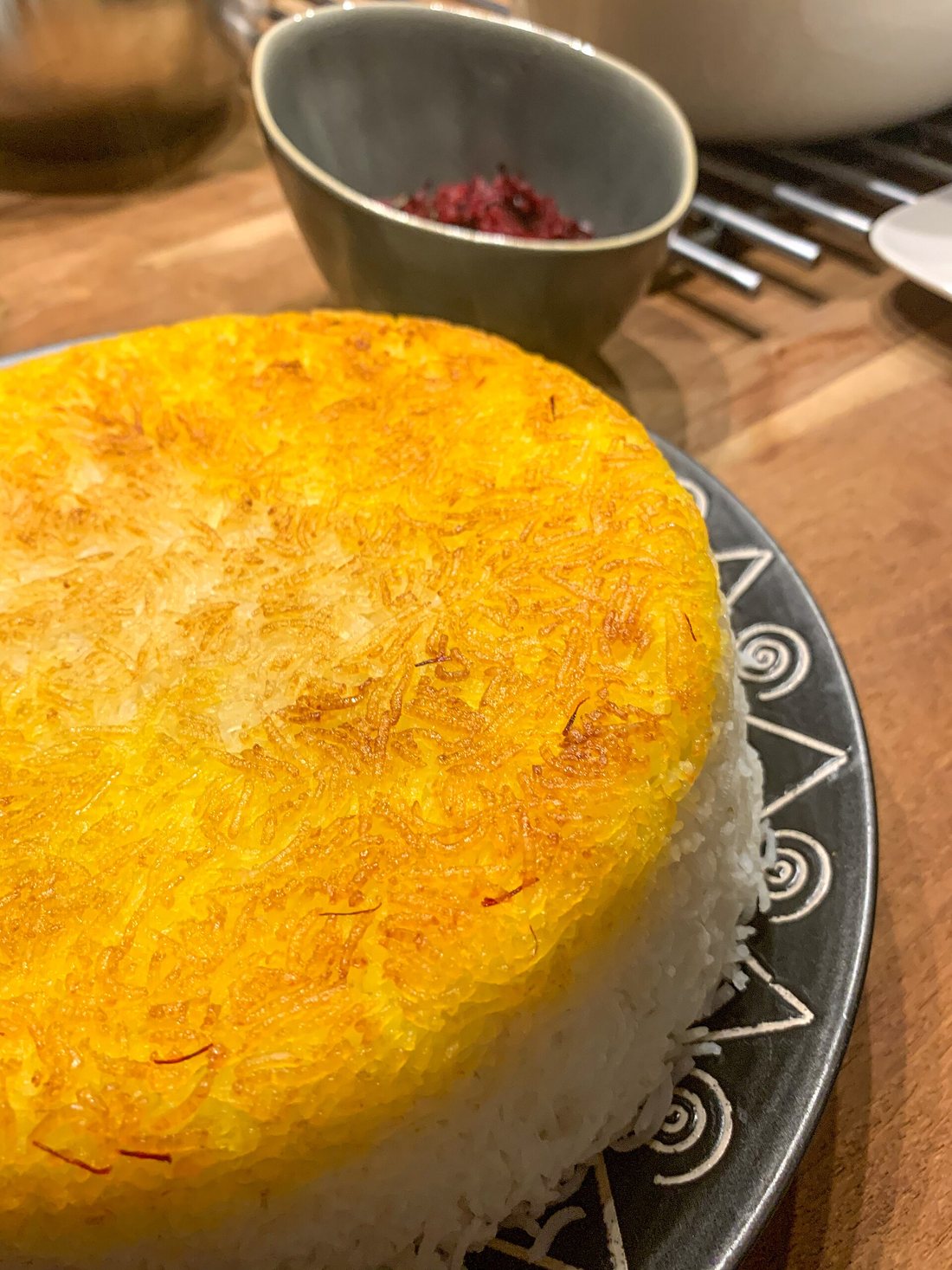
Iran and its neighbours cook rice with more care than almost anywhere, and the care is visible: long separate grains, a golden crust from the bottom of the pot, saffron sold by the gram. Much of what is presented as ancient turns out to be nineteenth-century, and the Persian and Central Asian ways of making “pilaf” turn out to be different techniques rather than one dish in two accents.
How rice reached Iran
No one knows exactly when. Encyclopaedia Iranica (Bazin and Bromberger) states plainly that information “establishing the precise era in which rice was introduced along the Caspian littoral and on the Iranian plateau does not exist.” There is no word for rice in the Avesta, and the first substantial Iranian accounts of rice farming are from the eighth century AD, though rice was eaten at court by the Sasanian period. Where it came from is settled: both the varieties and the vocabulary came from South and Southeast Asia, and the Persian word berenj derives from Sanskrit vrīhí — the same root, through Greek oryza, as English rice.
Iran is not a single rice culture. Outside the rain-soaked Caspian provinces, bread has been the staple and rice “a ‘luxury’ food.” In the Caspian provinces of Gilan and Mazandaran — about 85 per cent of the country’s crop in 1982 — a grown man ate “nearly a kilogram of rice per day,” and the Gilaki, a 1910 source reported, “does not eat bread; he considers it to be a food not fit for his constitution.”
Two Caspian details deserve to be better known:
- Gilan’s rice boom was a silk crash. Landholders had favoured silkworms for the European market until the 1860s, when the silkworm disease pébrine destroyed them; farmers turned to rice, and Russian demand multiplied exports sixfold between 1874 and 1892.
- Women did the transplanting and weeding, and were paid more than men for it, because their work was judged better. Iranica links the high status of Caspian women to “their decisive role in rice production.”
Caspian rice was sometimes smoked over wood and rice chaff as it dried, which helped it keep, gave it “an unmistakable aroma,” and stopped the grains sticking.
The rices
A 1910 survey counted sixty subvarieties in five shapes, from short, thick champa to long, thin sadri. Two corrections to the idea of “ancient Persian rice”:
- Sadri was introduced into Gilan from Peshawar in the 1850s, by the grand vizier whose title it bears (Iranica). One of Iran’s prestige rices is, by that account, a nineteenth-century import from what is now Pakistan.
- Domsiah (“black tassel”) is a twentieth-century name; the 1910 survey mentions none of the dom varieties that became the best known.
Price follows texture: sadri and mawlai are grown for sale because their grains stay separate and cost about twice as much as champa, which is kept at home because it cooks to a paste. Modern names include Tarom Hashemi, Anbarbu and Domsiah; where the names come from was not found.
Four ways to cook rice, not two
Persian cooking is usually described as chelow and polow. Iranica lists four methods:
| Method | What it is |
|---|---|
| Kateh | Absorption. Washed rice cooked in 1½ to 2 times its volume of water with salt and fat, covered, on low heat, until compact with a crisp top. It is cut with a knife. This, not chelow, is the traditional everyday rice of the Caspian, eaten even at breakfast with sugared milk or jam. |
| Chelow | Soaked, parboiled in heavily salted water and drained while still firm, then mounded in a pot over fat and steamed about an hour. Plain; served beside a stew or kabab. |
| Polow | The same parboiled rice layered with meat, vegetables, fruit or herbs before steaming. |
| Dami (dampokhtak) | Rice boiled with other ingredients — classically onion, peeled fava beans and turmeric — until the water is absorbed; “popular with less affluent families.” |
The boil-and-drain method is not ancient. Two Safavid cookbooks survive — the Kār-nāma of Haji Mohammad-Ali Bavarchi Baghdadi (1521), with six chapters on rice, and the Māddat al-ḥayāt of Nur-Allah, chef to Shah Abbas I (1590s), with four — and their polow recipes, Iranica says, “differ from those in common use today, which seem to have originated in the Qajar period” — the nineteenth century. Chelow-kabab, often called Iran’s national dish, is absent from both Safavid books and “was probably created in the Qajar period” too. Before that, rice was often soaked in salted water “for a full week, then used gradually.”
The cloth around the lid is older than Persian cookbooks. The towel wrapped around a pot lid to catch condensation — traditionally a damkoni, a flat straw-filled cushion sewn into cloth — appears in a thirteenth-century Arabic cookbook, The Book of Familiar Foods, which covers the pot “with a cloth before putting on the lid in order to keep condensed steam from dripping onto the rice” (Charles Perry, 1993). The earliest pilaf technique anywhere is in two thirteenth-century Arabic cookbooks, as ruzz mufalfal, rice “as separate as peppercorns.” In Perry’s reading, pilaf was probably invented in Iran some time after the tenth century and first written down in Arabic.
The earliest Persian use of the word polow is in ʿObayd Zakani’s poem Mouse and Cat (fourteenth century).
Tahdig
Tahdig, “bottom of the pot,” is the golden crust that forms under a steaming chelow or polow. The classic base is yogurt, saffron and egg mixed with a little of the rice and spread over the fat before the rest is mounded on top; potato slices and thin bread (lavash) are the other common bases. It is a point of honour to offer the crust to a guest, and Perry records that people “even brew a kind of tea out of tah dig.”
Two corrections:
- Tahdig is not in the old cookbooks. “Curiously, considering how important tah dig is today, the Persian cookbooks of the 16th and early 17th Centuries don’t even mention it” (Perry).
- Potato tahdig makes far more acrylamide than rice. A study by Iran’s Food and Drug Organization laboratories measured average acrylamide of 24.65 ng/g in rice tahdig, 39.48 in bread and 714.11 in potato — about twenty-nine times as much in the potato crust. It is one modelling study, and its lesson is comparative: a potato crust browned hard is the high-acrylamide version, not that tahdig is dangerous.
Tahchin is not a tahdig but a dish of its own: rice set with yogurt, saffron and egg around chicken or lamb and baked or steamed into a golden cake — the Tachin (Saffron Rice Cake with Chicken).
The polows
Iranica glosses the repertoire, which reads like a calendar:
- Sabzi polow — with green herbs; served as sabzi polow mahi, with fried fish and kuku (herb omelette), on the last evening of the Persian year. The collection’s Persian Herb Frittata (Kuku Sabzi) is that kuku; the rice is Sabzi Polo (Herbed Rice with Tahdig).
- Reshteh polow — with noodles, for good fortune at Nowruz.
- Baghali polow — fava beans and dill.
- Zereshk polow — chicken, saffron and barberries. Barberries were known in Iran and the Arab world “mainly through medical and pharmacological texts” before the eighteenth century (Nader Mehravari), so zereshk polow as eaten today is most likely nineteenth-century or later — an inference from two sources, not a documented date. Iran produces about 95 per cent of the world’s dried barberries. See Zereshk Polow ba Morgh (Persian Barberry Rice with Saffron Chicken).
- Albaloo polow (sour cherries), adas polow (lentils, raisins and dates), shirin polow (“sweet,” with candied orange peel and carrot), and morassa polow, “studded” — the jewelled rice of restaurant menus.
The plain chelow’s natural partner in the collection is Persian Ghormeh Sabzi (Herb and Lamb Stew); the method is Chelow with Tahdig (Persian Steamed Rice).
Saffron
Iran supplies around 90 per cent of the world’s saffron, grown around Mashhad; under sanctions much of it was exported in bulk and repackaged elsewhere (BBC, 2017). It takes about 150 flowers to make a gram of dry threads, and a specialist seller quoted by the BBC charged $18 a gram. Persian cooks grind it, often with a pinch of sugar, bloom it in hot water, and stir it through a few spoonfuls of cooked rice for the golden garnish.
Saffron is one of the most adulterated foods. A 2025 systematic review estimated that 20–30 per cent of commercial saffron is adulterated worldwide — about 3.5 per cent in regulated EU markets and 60 per cent in India — with safflower, marigold, turmeric and sometimes illegal dyes. The ISO 3632 standard grades real saffron by its colour, taste and aroma compounds.
Arsenic and “safer Iranian rice”
Studies from Iran do not support the idea that Iranian rice is safer than imported rice: one found no significant difference in arsenic, another found Indian rice higher in arsenic and lead, and a review of fifty papers found cadmium highest in Iranian rice. What does help is the cooking: a Sheffield study found parboiling and absorbing removed 73 per cent of inorganic arsenic from white rice. Chelow’s boil-and-drain is structurally similar, though the Persian method itself was not tested. More on Nutrition, Arsenic & Health.
Afghanistan
In Afghanistan, as in most of Iran, bread is daily and rice is festive: “on festive occasions the main dish usually consists of a mounded platter of rice,” and shrines keep “mammoth cooking vessels and a staff of male cooks” to feed pilgrims (Nancy Hatch Dupree, Iranica). Afghan long-grain rice is lightly roasted before hulling, and palaw is coloured with caramelised sugar. The named palaws include “ruby” (tomato), “emerald” (spinach), and narenj palaw, with bitter-orange peel, which Iranica calls “one of the tastiest” — the Norinj Palaw (Rice with Candied Orange Peel and Lamb).
Qabuli palaw — lamb and rice topped with carrot and raisins — is usually said to mean “from Kabul.” Perry found a qabuli palaw in the household book of the Mughal emperor Akbar and suggested the name means “acceptable pilaf,” possibly because it was served to guests; the anthropologist Magnus Marsden argues it did not originate in Kabul at all (as reported; his paper could not be read). In Saudi Arabia the same dish is sold as ruz Bukhari, “Bukharan rice.”
Central Asia: plov
Across Uzbekistan and Tajikistan the dish is plov, palov or osh, cooked in a kazan — “a sort of giant cast-metal wok that was originally carried by Turkish-speaking nomads,” as Perry describes it; a household kazan is about eighteen inches across and a master’s three or four feet.
Plov is not polow cooked differently; it is a different technique. Perry sets them side by side. In Central Asia, onions, meat and carrots are fried and stewed, then rice is sprinkled over the stew, water is added “to the depth of one finger joint,” and it boils “until the only liquid left is the stew under the rice.” In Iran “the rice is usually cooked separately” and the rest is added at the steaming stage, because of “the Iranian obsession with tah dig.” Central Asia also prefers “a shorter grain” than most pilaf-cooking countries. The earlier version of this site called the two “the same family — toast, layer, absorb”; Persian polow does not toast its rice, and plov does not layer it. (Bukhara’s oshi sofi, which drains its rice, is the exception — and in Bukhara that method is called “Kabul-style.”)
The base is lamb or mutton, often fried in rendered sheep’s-tail fat, with a great deal of carrot — in Tashkent both yellow and white — onions and a whole head of garlic, seasoned principally with cumin; chickpeas and raisins are a regional touch, not a rule. In the Fergana Valley the prized rice is devzira, a lightly polished, often reddish grain (sources on it are thin, and it is best called prized rather than required). The recipe here is Joan Nathan’s Bukharan Jewish version with beef, Bukharan Plov with Beef and Carrots.
Two UNESCO listings
Plov is on UNESCO’s Representative List twice, as two separate national files inscribed in 2016:
- “Palov culture and tradition” (Uzbekistan): “Guests can only leave their host’s house after palov has been offered.” It is served for hospitality, weddings, the New Year, the needy and the dead.
- “Oshi palav, a traditional meal and its social and cultural contexts in Tajikistan”: the “King of meals,” in “up to 200 varieties.” Its sayings include “No Osh, no acquaintance” and “If you have eaten Osh from somebody, you must respect them for 40 years.” When an apprentice cook graduates, the master receives a skullcap and traditional dress — and the apprentice receives a skimmer, the cooking tool, “symbolizing the apprentice’s independence.”
“Plov is cooked by men” is half true. UNESCO’s Uzbek file says palov “is cooked by men and women regardless of age or social status,” and the Tajik file that “groups of men or women prepare the dish.” What sources support is a division of scale: at home plov is traditionally cooked by women; in restaurants and at the great occasions it belongs to a male master cook, the oshpaz — because, as one Tashkent oshpaz put it, “it’s tough physical work to produce huge quantities.” His largest kazan holds up to three tonnes.
Three popular stories are legends. That Alexander the Great’s cooks invented plov (even a Tashkent guide admits “We don’t have historical records to prove that”); that Avicenna prescribed it as medicine (unsourced); and that osh palov is an acronym of its ingredients in Uzbek — a word with a documented Persian history cannot also be an acronym.
Azerbaijan
Azerbaijani plov is served with herbs and greens in a way distinct from Uzbek plov, and its crust is called gazmakh. Shah plov seals the rice inside buttered lavash and bakes it into a dome that is turned out and sliced. No reliable source for its history was found, so none is given here — including the story that it was made for a shah.
The recipes
Chelow with Tahdig (Persian Steamed Rice) · Sabzi Polo (Herbed Rice with Tahdig) · Tachin (Saffron Rice Cake with Chicken) · Norinj Palaw (Rice with Candied Orange Peel and Lamb) · Bukharan Plov with Beef and Carrots
Comments (0)