Rice · 11 of 15
Southeast Asia: Sticky Rice, Jasmine, Nasi Lemak and the Terraces
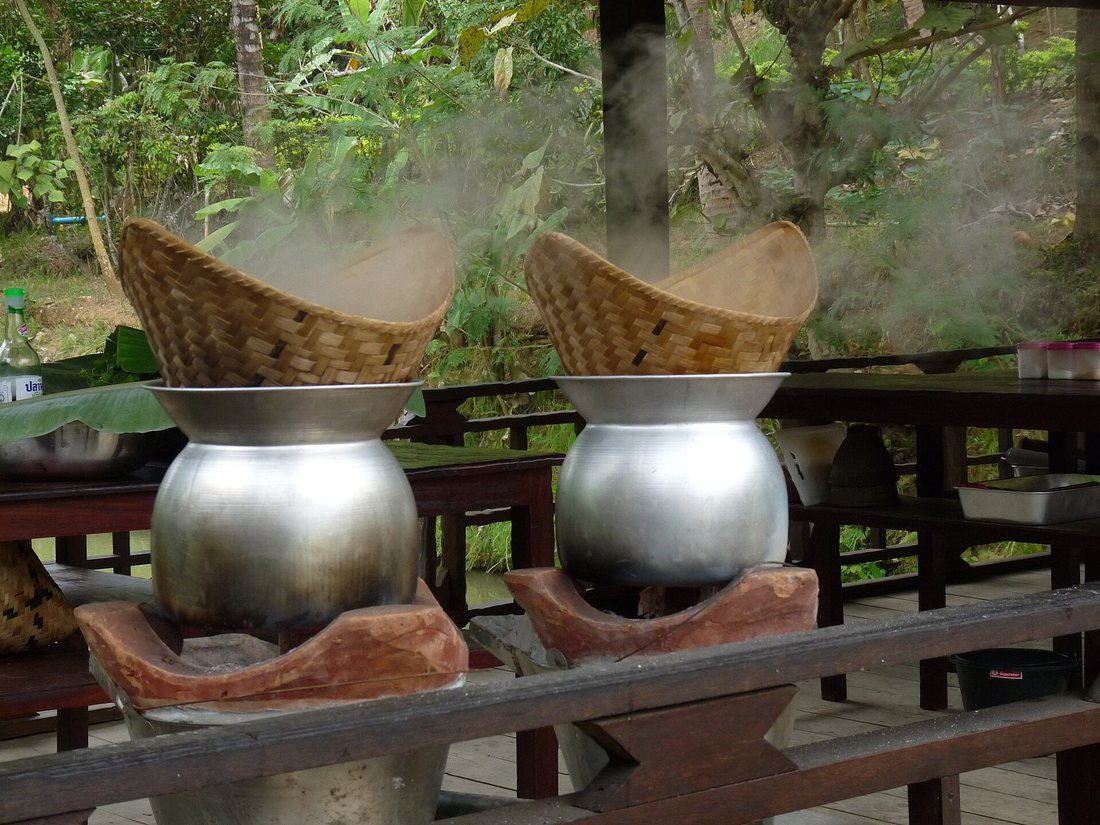
Southeast Asia is where rice was domesticated in one of its first homes, and where it is still eaten most intensely. It is also where the region’s oldest rice habit — glutinous, sticky rice eaten with the hands — survives as an everyday staple in only one country.
Sticky rice
“Glutinous” rice contains no gluten. Its stickiness comes from its starch: a single mutation in the Waxy gene, at the splice site of its first intron, switches off the enzyme that makes amylose, leaving starch that is almost all amylopectin. Olsen and Purugganan (Genetics, 2002), studying 105 traditional varieties, found “that the splice donor mutation has a single evolutionary origin and that it probably arose in Southeast Asia.” Two further findings from the same work are worth knowing:
- Many non-glutinous rices in Northeast Asia carry the same mutation, partly suppressed — which is part of why Japanese and Korean table rice is moderately sticky. The sticky rice of Laos and the rice of a Tokyo bento are related in the gene itself.
- Laos is the holdout, not the norm. “By the 18th century, sticky rice had been largely replaced across the region by varieties of non-glutinous rice. … But sticky rice is still the primary staple in Laos” (Smithsonian). About 85 per cent of Lao rice production is glutinous, and a research project there collected more than 13,000 rice samples, over 11,000 of them glutinous.
A Thai–Japanese study of rice-husk impressions in old bricks from 108 sites concluded that rice farming in what is now Thailand began with glutinous rice, and that non-glutinous khao jao came later, probably through Khmer influence, as the rice of the ruling class (as reported by the Thailand Foundation).
Khao niao: soak, steam, eat by hand
Lao khao niao is soaked for hours, then steamed, not boiled, in a woven bamboo cone — the huad — set over a pot of boiling water, turned out and worked with a paddle to release steam, and kept in a lidded basket, the thip khao. The two baskets are often confused, even in print: the cone steams, the lidded basket serves. Diners close the basket when they have finished.
Pailin Chongchitnant’s method is the standard: wash until the water runs mostly clear — “necessary regardless of which method you choose, otherwise you will end up with gummy rice” — soak at least three hours, preferably four, up to twelve, then steam 20–30 minutes, flipping the mass halfway. Thailand uses long-grain sticky rice; short-grain sticky rice “is used in China and Japan, not in Southeast Asia.” The recipe is Thai Sticky Rice (Soaked and Steamed).
It is eaten with the right hand, rolled into a ball and used to pick up the rest of the meal. Toasted and ground sticky rice, khao khua, is what gives laab and nam tok their nutty crunch. The Lao call themselves luk khao niao, “children of sticky rice” — though the historian Grant Evans noted that some city Lao associate it with “country bumpkin ways of eating.”
How much sticky rice Laos eats is a journalistic number, not a statistic. The Smithsonian gives “more than 345 pounds per year” per person; Wikipedia gives 171 kilograms — two figures 32 pounds apart, and neither traced to an agricultural statistics office. Laos very probably eats more sticky rice per head than anywhere else; how much has not been measured in any source found.
Jasmine rice
“Jasmine rice” is not one variety. It is a trade name for two Thai rices, Hom Mali 105 (KDML105) and RD 15. KDML105 was found in 1945 by a farmer, Jaroon Tanthawut, in Chon Buri province, trial-grown in the 1950s, and named “Khao Dawk Mali 105” by the Ministry of Agriculture’s rice committee in 1959; it grew best in the northeast and became the crop of the Thung Kula Ronghai plain, about 3,200 square kilometres across five provinces (Thailand Foundation). Its scent is the same compound as basmati’s, 2-acetyl-1-pyrroline. Thailand describes it as a geographical indication; the details of its foreign registrations could not be confirmed and are not given here.
Malaysia: nasi lemak
Nasi lemak is rice cooked in coconut milk with pandan, served with sambal, fried anchovies (ikan bilis), roasted peanuts, boiled egg and cucumber. Lemak means “fat” — that is, rich. It is attested in a French–Malay dictionary of 1875 and in R. O. Winstedt’s Circumstances of Malay Life (1909); the story that it was named when a girl called Seri spilled coconut milk into the rice — “nasi le, mak” — is a legend.
UNESCO did not inscribe nasi lemak. In 2024 it inscribed “Breakfast culture in Malaysia: dining experience in a multi-ethnic society,” which names nasi lemak alongside roti canai and teh tarik. Calling nasi lemak the “unofficial national dish” is fair; calling it UNESCO-listed is not. The recipe is Nasi Lemak (Malaysian Coconut Rice with Sambal).
Indonesia
Indonesia has more than one official answer to “the national dish.” In 2014 the Ministry of Tourism and Creative Economy named tumpeng — a cone of rice, plain, coconut or turmeric-yellow, moulded in woven bamboo and ringed by side dishes, central to the Javanese slametan — as the dish “that binds the diversity of our various culinary traditions” (Jakarta Post). In 2018 the Tourism Ministry named five national foods, among them nasi goreng (Kompas). Nasi goreng, darkened and sweetened with kecap manis, is generally believed to descend from Chinese fried rice, though the historian Fadly Rahman argues that is unproven.
Rice cooked in leaves and bamboo runs through the region: ketupat, rice packed into a pouch woven from young palm leaves and boiled into a firm cake (mentioned as kupatay in the ninth-century Old Javanese Ramayana), and lemang, glutinous rice and coconut milk cooked in a green bamboo tube — Lao khao lam is the same idea.
The Philippines
- Sinangag — garlic fried rice from day-old rice, the si in tapsilog (tapa, sinangag, itlog); making it from fresh rice is frowned upon, for the reasons given on How to Cook Rice.
- Arroz caldo — “rice broth”: a chicken-and-ginger rice porridge, yellow from safflower (kasubha), topped with fried garlic, spring onion and egg and served with calamansi and fish sauce. It is a Chinese-style congee with a Spanish name. The recipe is Arroz Caldo (Filipino Chicken Rice Porridge). Its relative is the collection’s Pork and Ginger Congee (Jook).
- Arroz a la valenciana — the Philippine paella, made with glutinous rice.
- Puto — the steamed rice-flour cakes in the Flour section: Puto (Filipino Steamed Rice Cakes).
The terraces, and how old they are
The Rice Terraces of the Philippine Cordilleras were inscribed as a World Heritage Site in 1995: five clusters in four municipalities — Nagacadan, Hungduan, central Mayoyao, and Batad and Bangaan. They were on the List in Danger from 2001 to 2012.
Two corrections:
- The famous “Banaue Rice Terraces” seen from the town’s viewpoint are not part of the World Heritage property; they were left out because of the modern buildings among them. They are a Philippine National Cultural Treasure instead.
- “Two thousand years old” is contested. UNESCO’s text repeats that figure, which goes back to the early twentieth-century anthropologists H. Otley Beyer and Roy Barton. Radiocarbon work by the Ifugao Archaeological Project under Stephen Acabado found that wet-rice terracing came later, after 1650, soon after the Spanish reached the region — people moving uphill, away from the colonisers, growing taro first and rice after. Beyer’s and Barton’s dates, Acabado says, “were not based on any archaeological or scientific evidence.” Most of the terraces are therefore probably three to four hundred years old: a living landscape of real antiquity, but not two millennia.
Vietnam
Cơm is cooked rice, and a southern home meal is plain rice with cá kho (kaw · [kʰɔ˧˧]) tộ (fish caramelised in a clay pot), canh chua and fish sauce. Cơm tấm (kuhm tuhm · [kəːm˧˧ təm˦˥]), broken rice, began as the food of Mekong Delta farmers who ate the broken grains they could not sell, and became a Saigon staple; the collection has Cơm Tấm Sườn Nướng (Broken Rice with Grilled Pork Chop), from the Vietnam section.
The recipes
Thai Sticky Rice (Soaked and Steamed) · Nasi Lemak (Malaysian Coconut Rice with Sambal) · Arroz Caldo (Filipino Chicken Rice Porridge)
Comments (0)