Rice · 10 of 15
West Africa and the Carolinas: Jollof, Ceebu Jën and Carolina Gold
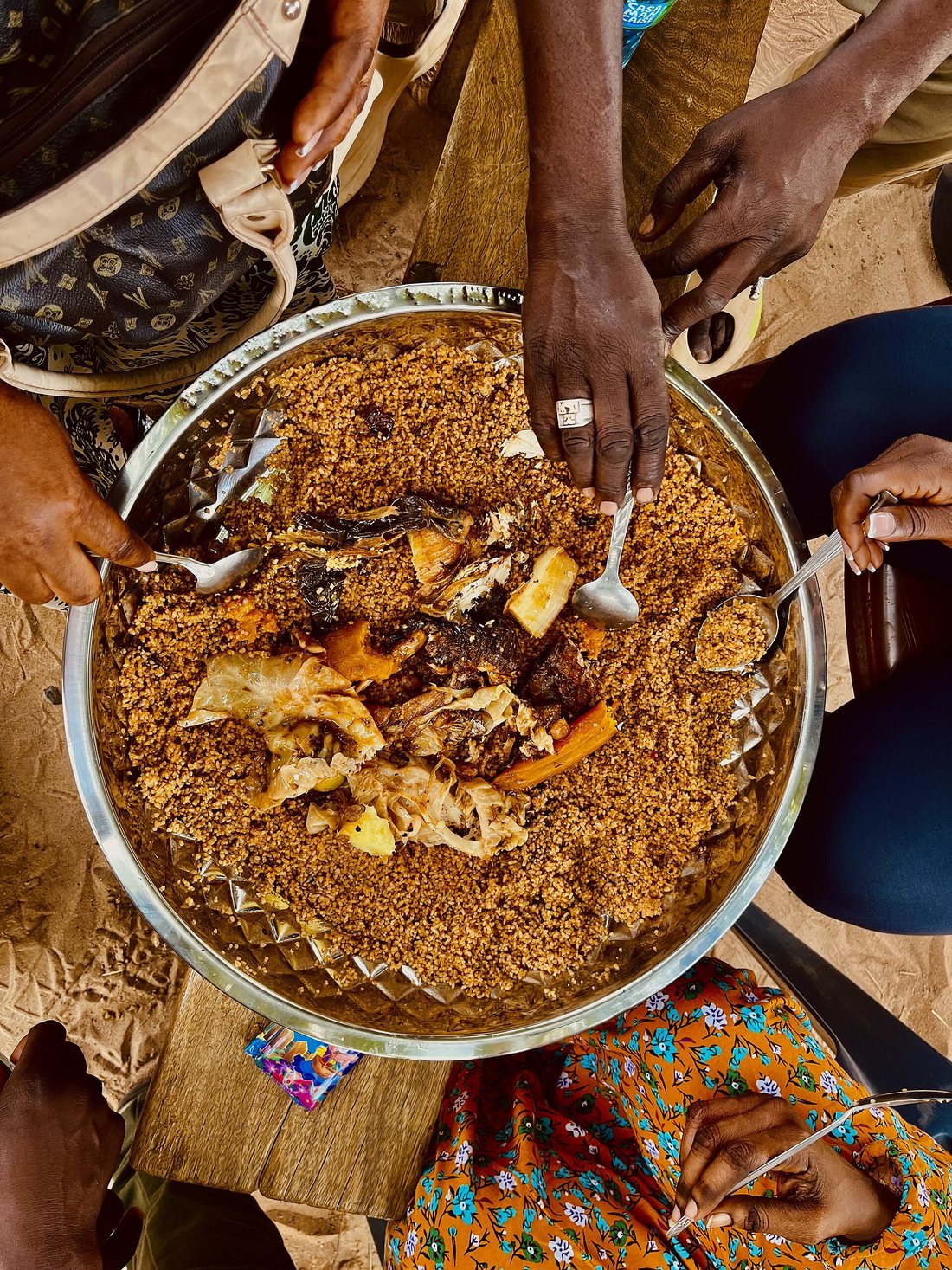
Rice was domesticated twice, and the second time was in West Africa. This page follows that African rice, the one-pot rice dishes of the Senegambian coast, and the rice kingdom of the Carolina and Georgia Lowcountry, which enslaved Africans built — and it tries to keep three things apart that are usually run together: which rice, whose knowledge, and whose labour.
African rice
There are only two domesticated rices in the world: Asian rice, Oryza sativa, and African rice, Oryza glaberrima, domesticated from the wild African grass O. barthii “by peoples living in the floodplains at the bend of the Niger River some 2,000–3,000 years ago” (Olga Linares, PNAS, 2002). The two went through “an independent but convergent evolution” — both, for example, lost the same sprawling-growth gene and stand upright — and unlike almost every other cereal, African rice ended up with smaller seeds than its wild ancestor.
Where exactly is still argued. The inland Niger delta in Mali is the classic centre, supported by a 2018 study of 246 genomes; other genome studies argue for a diffuse origin across several places, or a second centre in the Guinea Highlands. A 2021 review concluded that “studies continue to report contradictory findings.” Linares notes that firm archaeological evidence is lacking.
African rice looks much like Asian rice in the field. Its grains are small, pear-shaped and red-branned; it shatters easily, is brittle to mill and yields less — but its wide leaves shade out weeds, and it tolerates floods, iron toxicity, poor soil “and human neglect.” The Portuguese introduced Asian rice by the mid-sixteenth century, and it has been replacing African rice ever since; the Jola of Casamance, who still grew several glaberrima varieties in the 1960s, kept them mainly for ritual. NERICA (“New Rice for Africa”), bred at the West Africa Rice Development Association and first described in the scientific literature in 1997, crosses the two species; how widely it was adopted is not assessed here.
West Africans were skilled wet-rice farmers long before Europeans arrived. Portuguese accounts from 1446, 1455 and the 1590s describe it — the last with dikes and transplanting. The Jola built dikes and bunds with a long fulcrum shovel, the kajandu, to hold the tide out of their fields.
African rice did cross the Atlantic. It was widely grown in the plantation Americas before Asian rice replaced it, and Maroon communities in Suriname and French Guiana still grow it, as “black rice”; genomic work links their seed to a variety from Côte d’Ivoire (Pinas and others, Human Ecology, 2024). Their own accounts of how it arrived differ — enslaved women carried it, it was taken from the plantations, or it was found growing wild.
Jollof, and what the name means
“Jollof” does not mean “one pot.” The word names the Jolof state of the Wolof people, founded around 1360 and broken apart after the Battle of Danki in 1549. The Wolof word that does mean “one pot” is benachin, the dish’s name in the Gambia. In francophone West Africa it is riz gras.
Jollof is not a medieval dish. Its tomatoes and chillies are New World plants, so a tomato-red rice cannot be as old as the empire it is named after; food historians put the dish at the nineteenth century or later. “Traced to the 1300s,” a line repeated even by BBC Travel, confuses the age of the state with the age of the dish.
The jollof wars are a real and cheerful rivalry, above all between Nigeria and Ghana: Sister Deborah’s 2016 song “Ghana Jollof,” the storm over Jamie Oliver’s 2014 recipe (#jollofgate), a World Jollof Day on 22 August since 2015, and a nickname for Nigeria–Ghana football matches. Ghanaians generally cook it with basmati, Nigerians with long-grain parboiled rice. The Senegalese chef Pierre Thiam: “I wish all wars were fought like the Jollof war … nothing compares to the original one: Senegal Jollof.”
The prized version is party jollof, cooked outdoors over wood in a large pot, where it picks up smoke and a crust at the bottom — another member of the crust family, with tahdig and socarrat, described on How to Cook Rice. Yewande Komolafe’s oven method in the Nigerian Jollof Rice does without the crust and says so, suggesting smoked paprika to replace its flavour.
Ceebu jën
Ceebu jën (thieboudienne, “rice and fish”) is on UNESCO’s Representative List (2021). UNESCO names its origin plainly: “the fishing communities on the Island of Saint-Louis in Senegal.” It is made with “fish steak, broken rice, dried fish, mollusc and seasonal vegetables,” passed “from mother to daughter,” and eaten from a shared bowl by hand, with rules: no raised knee, the bowl held with the left hand, and not a grain dropped. The crust at the bottom of the pot is xoñ.
Two stories explain why it uses broken rice. Senegalese oral tradition credits a cook in colonial Saint-Louis, Penda Mbaye, with using rice when barley ran out — a legend with no documentary source. The agronomist Marc Dufumier’s account is economic: French colonial policy pushed peanut farming at the expense of millet and sorghum and made up the shortfall with cheap broken rice imported from Southeast Asia (as reported). The recipe here is Komolafe’s home adaptation, which omits the dried fish and molluscs: Thieboudienne (Senegalese Fish and Rice).
Ghana’s waakye — rice and black-eyed peas cooked together and coloured red-brown with dried sorghum leaf sheaths, eaten from the roadside with stew and shito — comes from northern Ghana; the name is Hausa, from shinkafa da wake, “rice and beans”. The collection’s Waakye (Ghanaian Rice and Black-Eyed Peas) is Zoe Adjonyoh’s, with baking soda as the stand-in when the leaves cannot be found.
Carolina Gold
Carolina Gold is Asian rice, not African rice. “Genetic analysis reveals that the rice’s ultimate source was South Asia,” David Shields writes, but whether it came “directly from Indonesia, or indirectly from Madagascar, West Africa, or even Europe, remains a mystery.” It is named for the golden colour of the ripe fields in autumn.
The 1685 Madagascar ship is a legend. The familiar story has a storm-damaged ship from Madagascar paying for repairs in Charleston with a bag of seed rice, which Dr Henry Woodward planted. No contemporary document for it was found, and the South Carolina Encyclopedia’s own entry on Woodward says nothing of rice and places him in the backcountry that summer. No one knows how Carolina Gold reached Charleston.
The industry it built was enormous. Exports rose from about 270,000 pounds a year around 1700 to more than 66 million by 1768–72. Rice moved in three stages — upland fields, then inland freshwater swamps by the 1720s, and only after 1750 the tidal rivers, where fields ten to twenty miles inland could be flooded and drained by the tide through miles of levees, ditches, floodgates and wooden “trunks.” Disease and death among the enslaved workers were “extremely high.”
“From seed to table, Carolina gold was the domain of the enslaved” (South Carolina Encyclopedia): clearing, diking, planting with the “traditional African heel-and-toe,” flooding, bird-minding, harvesting, winnowing in coiled fanner baskets, and hulling in wooden mortars. The Lowcountry ran on the task system — a set daily task, after which the rest of the day was the worker’s — which the same source describes as somewhat greater independence within the context of slavery, and nothing kinder than that.
Whose knowledge? The “Black Rice” debate
That the labour was African is not in dispute. Whether the knowledge that built the rice industry was African is.
- Judith Carney, Black Rice (2001), argued that the standard account — Europeans bringing rice cultivation to West Africa and then to the Americas — is “a fundamental fallacy,” and that enslaved Africans from the rice coast brought “the seed, the cultivation skills, and the cultural practices.”
- David Eltis, Philip Morgan and David Richardson (American Historical Review, 2007 and 2010) answered that most Africans shipped to the rice colonies were not from the rice coast — the largest single group at Charleston came from Angola — and that planters and markets shaped the system: “Was it possible for a rice export economy to have existed in the Americas without input from the rice-growing cultures of Africa? We think the answer is yes.”
- Walter Hawthorne’s reply was titled “From ‘Black Rice’ to ‘Brown’”; the South Carolina Encyclopedia concludes that the black-rice view “may be correct” in a technical sense, but that the industry combined “European and Euro-American aspirations and entrepreneurship along with African technology and labor.”
At the very least it was their labour; many historians argue it was their knowledge too, and that argument is still being had. An earlier version of this site stated the knowledge claim as settled fact; it is not.
Collapse and revival
Carolina rice was already losing Europe to cheaper Burmese, Javanese and Indian rice before the Civil War, which “hastened its demise.” In the 1880s production moved to Louisiana, Arkansas and Texas, where machines could replace labour — “the swampy lowcountry could not bear the weight of the new equipment.” A run of hurricanes beginning in 1893 finished the tidal fields: nearly 120 million pounds in 1859, about 4 million by 1919.
In the mid-1980s a Savannah optometrist, Richard Schulze, planted Carolina Gold for waterfowl on his South Carolina land from seed in the USDA germplasm bank — fourteen pounds planted, sixty-four harvested. Glenn Roberts of Anson Mills and Merle Shepard at Clemson bred a stronger line, and it went on sale to the public in 1998. The Carolina Gold Rice Foundation followed in 2004 (not 1998, as sometimes given). Its aromatic descendant is Charleston Gold.
A brand trap: the supermarket Carolina® brand sells a parboiled rice under the name “Carolina Gold” that has nothing to do with the heirloom. Even the New York Times jollof recipe lists “Carolina Gold” among parboiled rices — which can only mean the brand.
The heirloom is cooked the Lowcountry way — boiled in plenty of salted water like pasta, drained, then dried and buttered in a low oven so every grain stays separate: Carolina Gold Rice (Lowcountry Boil-and-Dry).
The Lowcountry rice kitchen
Perloo, purloo and pilau are the Lowcountry’s spellings and pronunciations of pilaf — English pilau is recorded from 1609 — so the Carolina one-pot rice belongs to the same family as the dishes on Persia and Central Asia. There were two registers: the everyday pot of rice with shrimp, chicken or sausage, cousin of the Pee Dee region’s chicken bog; and Charleston’s formal pilau, packed and baked until crusted, then turned out onto a platter. The recipe here is the Charleston food historian John Martin Taylor’s: Shrimp Perloo (John Martin Taylor’s).
Hoppin’ John is in print by 1838, nine years before its famous first recipe. In Caroline Gilman’s Recollections of a Southern Matron (1838), a hostess is embarrassed to find “an immense field of hopping John” set before European guests — “a good dish, to be sure, but no more presentable to strangers at the South than baked beans and pork in New-England” — and a footnote defines it as “Bacon and rice.” Sarah Rutledge’s Carolina Housewife (1847) then gives the recipe: “One pound of bacon, one pint of red peas, one pint of rice.” The original peas were red cowpeas, not black-eyed. The name’s origin is contested and none of the explanations is convincing; the dish is related to West African rice-and-bean dishes such as thiebou niebe. The collection’s Hopping John is the 1944 Army version.
Red rice — tomato-red rice with sausage or shrimp — resembles jollof and ceebu jën, and food historians such as Jessica B. Harris describe it as a creolised descendant of them. The earlier claim on this site that they are “the same tradition” goes further than that; both also depend on the New World tomato. The collection has Savannah Red Rice.
The Gullah Geechee people of the Sea Islands and Lowcountry, descended from enslaved Africans, kept rice at the centre of their diet and ceremonies; their coiled sweetgrass baskets descend from the rice fanners. Legislation introduced by Representative James Clyburn in 2004 led to the federal Gullah/Geechee Cultural Heritage Corridor. Rice travelled west with the industry too: New Orleans’s rice fritters, Calas, are on the Around the World page.
The recipes
Nigerian Jollof Rice · Ghanaian Jollof Rice with Roast Chicken (Zoe Adjonyoh) · Waakye (Ghanaian Rice and Black-Eyed Peas) · Thieboudienne (Senegalese Fish and Rice) · Carolina Gold Rice (Lowcountry Boil-and-Dry) · Shrimp Perloo (John Martin Taylor’s) · and the collection’s Savannah Red Rice and Hopping John.
Comments (0)