The Gluten Question
Soy sauce is not gluten-free by default. It is, for the most part, a wheat product — and the common belief that it is naturally wheat-free is one of the more consequential food myths, because people act on it.
What makes this genuinely interesting rather than merely a caution is what happens next: brewed soy sauce containing wheat often tests at almost no gluten at all, and is still barred from carrying a gluten-free label in the United States. Those two facts look contradictory. They are not, and the reason is worth understanding.
Start with how much wheat is actually in there
| Sauce | Wheat |
|---|---|
| Japanese koikuchi | Roughly equal parts soybean and roasted wheat — about half |
| Japanese usukuchi | Soy and wheat, similar proportion |
| Japanese shiro | ~90% wheat — the most wheat-heavy of all |
| Japanese saishikomi | Soy and wheat |
| Japanese tamari | Little or none — but see below |
| Chinese light and dark soy | Wheat flour is a standard ingredient |
| Korean hansik ganjang / guk-ganjang | None. Soybeans only |
🔴 The default bottle in a Western supermarket — Japanese-style koikuchi — is about half wheat. There is no version of “soy sauce is naturally gluten-free” that survives contact with that number.
The one traditional soy sauce that is genuinely wheat-free by construction is Korean hansik ganjang, which is made from soybeans, salt and water and nothing else. That is a fact about Korean practice, not a claim that any given Korean bottle is safe — most Korean bottles sold today are jin ganjang, which is blended and does contain wheat.
What fermentation does to gluten
Now the interesting half. Gluten is a protein, and the entire purpose of the soy sauce process is to take proteins apart. Months of fungal proteases at work on a mash do not leave wheat proteins intact.
Published work bears this out:
- ELISA and Western blot analyses find that fermentation removes a substantial proportion of wheat protein, with results for brewed soy sauce commonly below the limit of quantitation, and some reporting under 5 ppm — well beneath the 20 ppm regulatory threshold.
- A proteomics study measuring coeliac-active peptides specifically found them in soy sauce at 0.2 to 0.5 mg/kg.
So a wheat-containing brewed soy sauce frequently measures as though it were gluten-free.
Why it still cannot say so
On 13 August 2020 the FDA published a final rule on gluten-free labelling of fermented and hydrolysed foods — effective 13 October 2020, compliance date 13 August 2021. It covers yoghurt, sauerkraut, pickles, cheese, olives, beer and wine, and hydrolysed plant proteins.
Its reasoning is a measurement problem, stated plainly by the agency: sandwich ELISA methods do not adequately detect gluten in fermented and hydrolysed foods. The assays are built to recognise intact protein structures. Once fermentation has cut those proteins into fragments, the test stops seeing gluten that may still be immunologically active. A low reading may mean there is little gluten — or it may mean the assay has gone blind.
So the rule changes what compliance is judged on. A manufacturer claiming “gluten-free” on a fermented food must keep records demonstrating the inputs were gluten-free before fermentation. The finished-product test is no longer the evidence.
🔴 The correction, stated exactly: “it tests clean” and “it may be labelled gluten-free” were deliberately decoupled, and the decoupling is a response to an analytical limitation, not a bureaucratic quirk. A soy sauce brewed with wheat cannot be labelled gluten-free in the US however low it tests, because the test is not trusted to answer the question.
⚠ And the threshold itself is not a biological cliff. Levels above 20 ppm are taken to pose a risk to people with coeliac disease or wheat allergy; levels below 20 ppm are described as a “remote hazard” for some highly sensitive people — not zero.
Tamari is not the answer people think it is
Tamari is not automatically gluten-free, and this is the practical failure point.
The Japanese standard defines tamari as made with “little or no wheat” — not no wheat. Commercial tamari commonly contains around 10% wheat or less, and some contains none. Both are correctly labelled tamari.
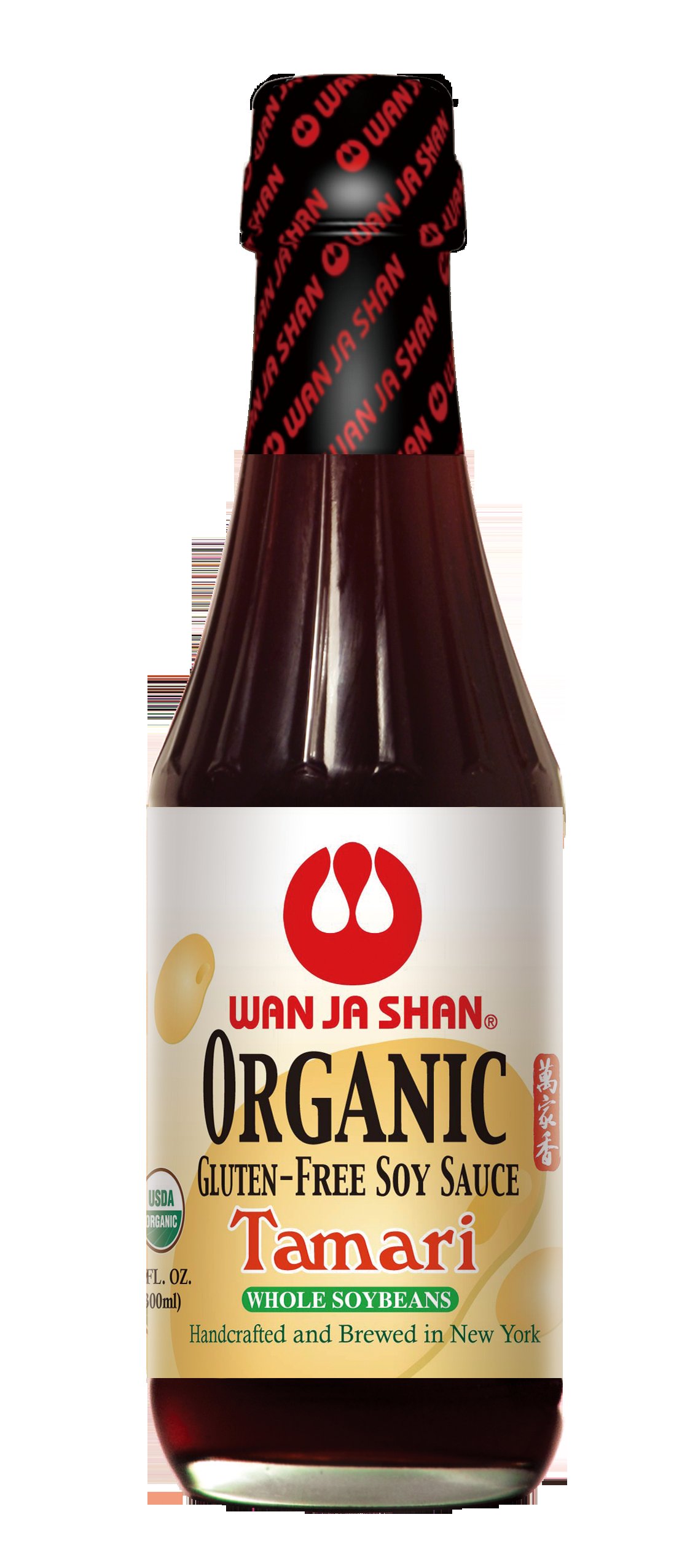
⭐ Look closely at the bottle photographed at the top of this page. It says “gluten-free soy sauce” and “tamari.” The gluten-free claim is printed as a separate, explicit statement — because the word “tamari” does not carry it. A manufacturer who could rely on the category name would not need to print the claim.
The origin and the real character of tamari — a miso run-off, the highest-glutamate of the Japanese types — are on its own page, and they are far more interesting than its wheat content.
What this means in practice
- Buy a bottle that explicitly says gluten-free. Not “tamari,” not “wheat-free style,” not an ingredient list that happens to omit wheat. The explicit claim is the only thing carrying a records obligation behind it.
- Assume any unlabelled soy sauce contains wheat, including Chinese light and dark soy.
- Korean hansik ganjang / guk-ganjang is wheat-free by construction, but verify the bottle is that type and not jin ganjang.
- Coconut aminos contain no soy and no wheat. They are also much less salty, distinctly sweeter and far lower in glutamate — a real substitute for the restriction, not a substitute for the flavour.
- In restaurants, assume soy sauce is present and contains wheat unless told otherwise. It is in marinades, dressings, stocks and glazes where it is invisible.
⚠ This page describes labelling rules and published measurements. It is not medical advice, and anyone managing coeliac disease should follow the guidance of their own clinician over anything written here.
In this dive: The story · How it is made · Tamari and shoyu · The Japanese types · Chinese soy sauces · Korean ganjang · Beyond the big three · Brewed and chemical · Salt, time and aging · The gluten question · Buying, storing and using · Corrections
Comments (0)