Tamari and Shoyu: The Distinction Almost Everything Gets Wrong
Ask what tamari is and the answer comes back, almost every time, in four words: “the gluten-free one.”
That answer is wrong in an interesting way. It is wrong about what tamari is, wrong about where it came from, and — as a practical matter at the shop — not reliably true. Tamari is not a wheat-free version of soy sauce. It is a different product, with a different origin, that happens to end up with little or no wheat in it.
The evidence for that is four hundred years old and it is a dictionary entry.

The 1603 entry
The Vocabulario da Lingoa de Iapam — the Jesuit Japanese–Portuguese dictionary printed at Nagasaki in 1603 — has this:
Tamari. Hum licor muito saboroso que se tira do Miso, & serue pera temperar o comer.
“Tamari. A very tasty liquor that is drawn from miso, and serves to season food.”
And, as a separate headword elsewhere in the same book, it has Xoyu — defined not by where it comes from but by what it is like, “a liquor that answers to vinegar, but is salty.” That entry is reproduced on the story page.
⭐⭐ Two entries. Two definitions. One book. 1603. A Jesuit lexicographer who had to explain Japanese food to Europeans treated these as two different substances and defined them by two different criteria — and he defined tamari, specifically and unambiguously, by its origin in miso.
That is the whole correction, and it is documentary rather than inferential.
What the word means
Tamari (溜まり) is a noun built from the verb tamaru, to collect, to pool, to accumulate. It is not a flavour word or a place name. It is a word for the stuff that gathers at the bottom.
Anyone who has made miso has seen it. Pack a crock with soybeans, koji and salt, weight it, and over months a dark, intensely savoury liquid rises and pools on the surface and in the wells. That liquid is tamari, and it was being skimmed and prized long before anyone set out to brew a soy sauce on purpose.
So the correct family tree is not the one usually drawn:
| Common claim | What the record supports |
|---|---|
| Tamari is a kind of soy sauce, made without wheat | Tamari is the ancestor. Soy sauce is what happened when people began brewing the run-off deliberately instead of collecting it |
| Tamari is a Japanese speciality of soy sauce brewing | Tamari is a miso product; its closest structural relative is Korean ganjang, which is still made exactly this way |
| Tamari is wheat-free by definition | Tamari is soybean-dominant by definition. Wheat is permitted and is often present |
⭐ Tamari’s true cousin is not koikuchi — it is Korean ganjang, which to this day is the liquid drawn off the jar in which doenjang paste is maturing. Japan industrialised the run-off into a separate brewing process; Korea did not. The two traditions preserve opposite halves of the same original idea.
What tamari is today
Modern tamari is a real, deliberate, brewed product — it is simply brewed to a different recipe. It is the fifth type in the Japanese Agricultural Standard classification, and it is concentrated in one part of the country: Aichi prefecture, principally the Chita peninsula around Taketoyo, and the Hatchō miso country around Okazaki.
How it differs from koikuchi in the brewhouse:
- The koji is grown on soybeans, with little or no wheat. Where koikuchi uses roughly equal parts soy and wheat, tamari is soy-dominant.
- The mash is built as balls — the misodama (味噌玉) method, in which soybeans and salt are formed into spheres or bricks and the koji culture is introduced to those, rather than to loose grain. This is a miso technique, preserved inside a soy sauce process.
- Far less brine is used. The moromi is not a liquid mash but something closer to a wet paste, which is why tamari finishes thick.
- The liquid is drawn and returned. A pipe set in the mash collects what seeps in, and that liquid is ladled back over the top — kumikake — over and over, for months or years. It is a recirculation, not a stirring, and it is the direct mechanical descendant of skimming the top of a miso crock.
- It is aged long, commonly one to three years, traditionally in cedar barrels.
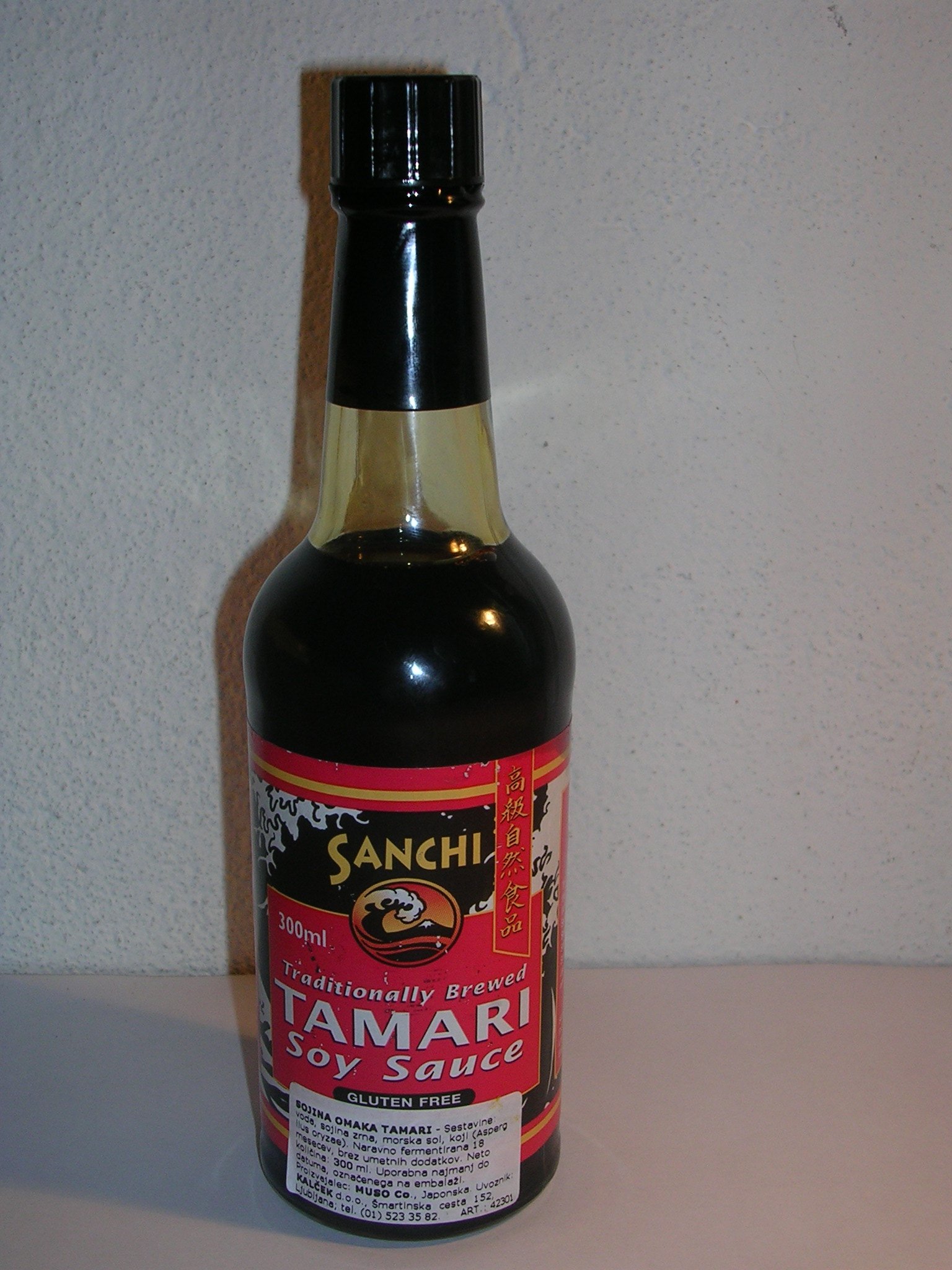
The result, in numbers:
| Tamari | Koikuchi | |
|---|---|---|
| Salt | ~16–17% | ~16–17% |
| Free glutamate | ~1,720 mg/100 g | ~980–1,680 mg/100 g |
| Texture | Noticeably viscous | Thin |
| Colour | Very dark, near-opaque | Dark, translucent red-brown |
⭐ Tamari carries the highest free glutamate of the five Japanese types. That, not the absence of wheat, is why it tastes the way it does — rounder, heavier, less sharp, with almost none of koikuchi’s aromatic top note, because the aroma compounds largely come from the wheat that isn’t there.
The part that matters at the shop
Not all tamari is wheat-free, and tamari is not automatically gluten-free.
The JAS definition of tamari says “little or no wheat” — not “no wheat.” Commercial tamari commonly contains wheat at somewhere around 10% or less, and some contains none at all. Both are legitimately tamari.
🔴 This is the practical failure of the “tamari is the gluten-free one” shorthand. It is treated as a property of the category when it is a property of the individual bottle. A bottle of tamari with wheat in it is not mislabelled, not adulterated, and not unusual — it is simply not what the person who was told “tamari is safe” thinks they are holding.
The check is the same as for anything else: read the ingredients, and look for an explicit gluten-free claim. The full reasoning, including why a wheat-containing brewed soy sauce can test at almost nothing and still be barred from the label, is on the gluten question.
Where tamari earns its place
Setting the gluten question aside entirely — which is the right way to taste it — tamari is worth owning for what it does:
- As a dipping sauce for sashimi, which is its classic use in Chūbu. It clings instead of running, and it does not compete with the fish on aroma.
- As a finishing sauce on grilled things — meat, mushrooms, aubergine — where its viscosity means it stays where it is put.
- In braises and glazes, where the high glutamate and low aromatic load survive heat better than koikuchi’s top notes do.
- Wherever a sauce would otherwise need reducing, since it arrives concentrated.
⚠ It is not a general-purpose substitute for koikuchi. Swapping it one-for-one into a dish built around ordinary Japanese soy sauce gives something heavier and flatter — more savour, less lift. That is a real change, not an upgrade, and it is the trade every cook avoiding wheat makes knowingly.
In this dive: The story · How it is made · Tamari and shoyu · The Japanese types · Chinese soy sauces · Korean ganjang · Beyond the big three · Brewed and chemical · Salt, time and aging · The gluten question · Buying, storing and using · Corrections
Comments (0)