What It Is
I keep a pair of Landjäger in my truck the way other people keep a granola bar. Flat, dark, hard, quiet — they don’t rattle, they don’t melt, they don’t need a cooler, and when I’m three hours into a deer stand or a long drive north and I want something that tastes like real food, I snap one off its twin and eat it cold. That’s the whole pitch. It’s my favorite of the German sausages, one I’ve made for years and keep coming back to and fiddling with, and it’s the one I get asked about least, because most Americans have never met the real thing — only the shrink-wrapped snack stick wearing its name.
So before I show you how I make mine, I want to be dead clear about what Landjäger actually is: what it looks like, what it eats like, what family it belongs to, and — because there’s a beloved bit of folklore I have to correct right up front — where the name really comes from. This page is the “here’s the animal” page. The craft, the German tradition, why I bother making my own, and the actual how-to each get their own chapter.
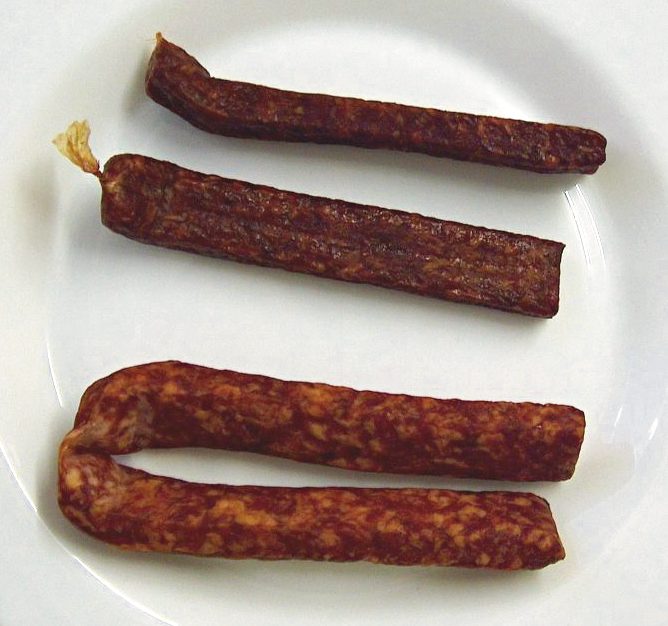
The physical thing — a flat, hard, pressed pair
Pick up a Landjäger and the first thing your hand tells you is that it’s wrong for a sausage. It’s not round. It’s a flat, dense little brick — a stick roughly 15 to 20 cm long (call it six to eight inches) pressed down to a rectangular cross-section about 2.5 by 1 centimeter. A finger’s length, a finger’s width, and thin. The corners are soft and slightly rounded, the broad faces often a touch concave, and the whole thing has the heft of something that used to have a lot more water in it than it does now.
And it comes as a pair. Two links joined at one end by a U-bend of casing, hung together over a smoke stick as one piece, pressed together as one piece, sold and carried as one piece. A pair runs right around 100 grams — so one link is a snack and the pair is a light meal. That pairing isn’t decorative. It’s how the sausage is made (the two links share the bend they were hung by) and it’s a portion built into the product: you eat one, your buddy eats the other, or you eat both and call it lunch.
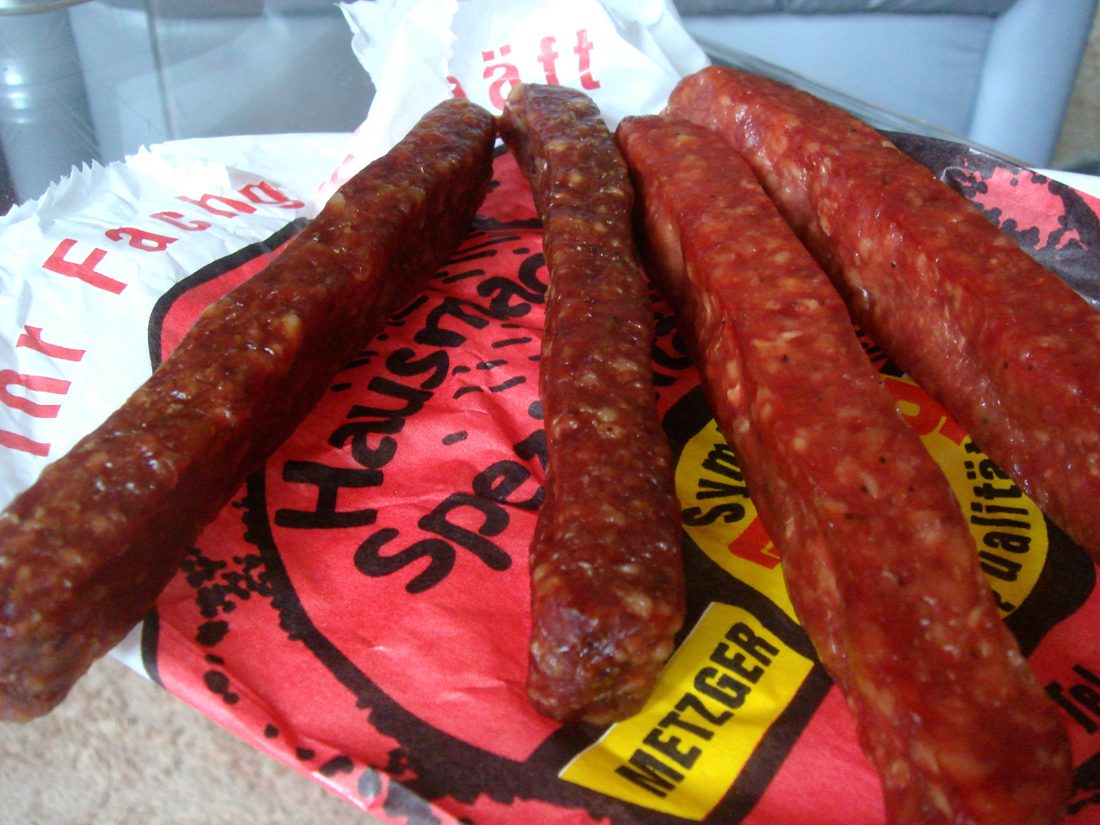
The color is deep — a dark mahogany-to-near-black casing, matte, sometimes with a faint bloom or a dusting of spice showing through. The casing is natural (hog or sheep, or a natural-fiber casing on the Black Forest style), and it clings tight to the meat because the whole stick has shrunk down onto itself during drying. When you bite in, it gives a real snap and then a firm, meaty chew — nothing rubbery, nothing greasy. Cut one across and the face is a coarse mosaic: ruddy grains of beef and pork with clean little windows of white fat, set in a matrix that’s tacky rather than wet. It smells of smoke, pepper, a little garlic, and a background tang that surprises people the first time.
That tang is the tell. Real Landjäger is fermented, and I’ll come back to why that matters, but it’s the thing that separates a proper one from a stick of seasoned jerky-meat. It reads sour-savory, closer to a good salami than to a hot dog, and it’s exactly what makes the pairing with cheese and beer sing.
Which is the other honest answer to “what is it”: it’s board food. My favorite way to eat one that I didn’t just pull out of a jacket pocket is on a cutting board — a pair of Landjäger sliced on the bias into little rectangles, a wedge of something firm and nutty like an aged Alpine cheese or a good Emmentaler, some grainy mustard, a heel of dark bread, and a cold beer. The tang cuts the fat of the cheese, the smoke plays off the malt in the beer, and the sausage does the heavy lifting because it’s the most concentrated thing on the board. You don’t need much. Two people can happily kill an hour on one pair, some cheese, and two beers, and that is the Landjäger in its natural habitat as much as any deer stand is.
The name — and the correction I have to make
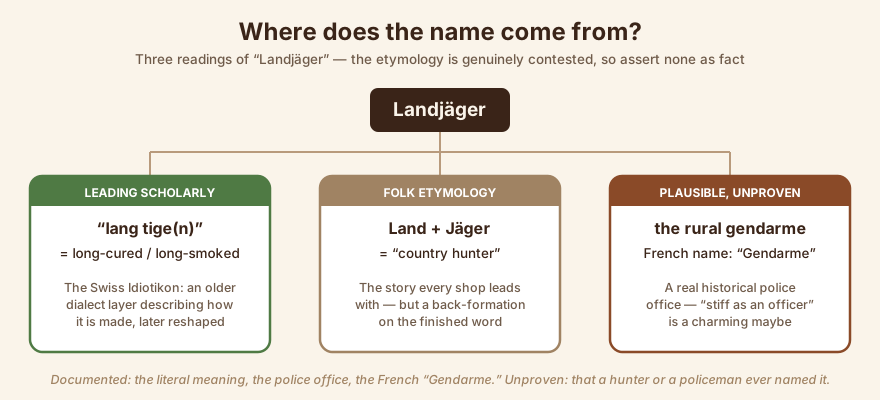
Here’s where I have to slow you down, because you have almost certainly been told a story that isn’t true, and it’s told everywhere — on shop labels, in cookbooks, by people who make wonderful sausage. The story goes: Landjäger means “country hunter,” and it was named that because hunters carried it in their pockets. Clean, romantic, and repeated as gospel.
It’s folk etymology. I don’t say that to be a killjoy — the literal translation is genuinely real. Land is country or land, Jäger is hunter, so “country hunter” is a perfectly correct word-for-word gloss. What’s not established is that hunters had anything to do with coining the name. That part is a back-formation: people heard a word that already looked like “hunter,” and built a tidy origin story to fit it.
The best source we have points somewhere else entirely. The Schweizerisches Idiotikon — the Swiss German dictionary, and about as authoritative as it gets on Alemannic word history — records that the name may derive from a dialect expression lang tige(n), meaning roughly “cured for a long time” or “long-smoked.” Say lang tige(n) out loud a few times and you can hear how the ear and the pen would tidy it into Land-Jäger over generations. If that’s right, the oldest layer of the name isn’t about a hunter at all — it just describes how the sausage is made: long-cured, long-smoked. The dictionary offers it cautiously (“possibly”), and I’ll pass that caution along, but it’s the leading scholarly account and it deserves to be the one people hear.
Now, there’s a second character in this story who’s real, and I only want to introduce him here before handing him to the next chapter. There was a genuine historical office called the Landjäger: rural mounted police — gendarmes — who kept order in the countryside across the German-speaking states and Switzerland from roughly the late 18th century into the 20th. That office is well documented; it’s not in dispute. And here’s the tantalizing bit: in Alsace and in French usage, this exact same flat smoked sausage is called Gendarme — the French word for that very rural policeman. So when the name crossed the language border, French speakers translated the policeman, not the hunter. That’s a strong hint that by then, the dominant folk reading of “Landjäger” was “country policeman,” and the joke was about a stiff, uniformed officer — a hard, straight sausage standing at attention.
But — and this is the whole point — whether a policeman or a hunter named the sausage is unproven either way. Both are stories built on top of a finished word. The office is real; the naming link is speculation (a charming “stiff as an officer” joke, nothing more). The hunter is real German; the hunter-christened-it story is almost certainly a later folk cleanup. So I’m not going to assert any single origin as fact, and you should be suspicious of anyone who does. The honest line is: the etymology is genuinely contested, the “hunter” story is the shakiest of the bunch, and the older layer may simply mean “long-cured.”
That’s as far as I’ll take the name here. The full story of the Landjäger office — the mounted gendarmes, the Gendarme connection, the “red-skirted officer” joke — belongs on the German tradition page, where it has room to breathe. Here I just wanted to make sure you don’t leave believing the one thing everybody repeats.
Its category — a Rohwurst, raw and never cooked
If you take one technical thing away from this page, take this: traditional Landjäger is a Rohwurst. Literally “raw sausage.” And it means exactly what it says — the classic stick is never cooked. Not by the smoke, not by an oven, not ever. You eat it raw.
That sounds alarming to an American ear trained on “cook your meat to 160,” so let me explain why it’s safe, because the whole identity of the sausage rides on it. A Rohwurst isn’t kept safe by heat. It’s kept safe by a stack of hurdles that each make life impossible for the things that would spoil it or hurt you:
- It’s cured — salt plus nitrate/nitrite curing salt, which suppresses botulism over the weeks it hangs.
- It’s fermented — lactic-acid bacteria eat a little added sugar and drop the pH, giving both the tang I mentioned and the first real safety barrier.
- It’s cold-smoked — smoke below about 20 °C / 68 °F, which adds flavor and a protective surface but crucially does not cook the meat.
- It’s air-dried — hung cool for weeks until it’s lost a big chunk of its starting water.
That last one is the heavyweight. Water is what bacteria need, and drying pulls the available water — the water activity — down below where trouble can grow. Between the acid, the cure, and above all the drying, the finished sausage is stable and safe with no cook step anywhere in the process. This is the correct and important line between Landjäger and a hot dog or a summer sausage that got cooked in a smokehouse: Landjäger’s safety comes from low water activity and acidity, not from heat.
Two footnotes I’ll keep short here, because the numbers and the safety science live on the craft page where I can show the arithmetic:
First — yes, there’s also a popular cooked American home version that uses a different cure and gets heated to a real kill-step. It’s a legitimate, beginner-friendly reinterpretation, and it’s a genuinely different product from the traditional raw stick, not just a spelling variant. I make and respect both, and I keep them straight, which is more than a lot of write-ups do.
Second — Landjäger gets called “semi-dry,” and that word needs a small asterisk. It’s semi-dry in the sense that matters to your mouth: it stays pliable. You can bend a good Landjäger; it’s softer and moister than a snap-hard salami, and that suppleness is part of its charm. But don’t let “semi-dry” fool you into thinking it barely lost any water. The traditional stick is dried to something like 30 to 40 percent weight loss — which by the numbers is squarely into genuinely dry territory. So “semi-dry” here is describing the eating texture, not a modest drying. It’s dry by the scale and semi-dry to the bite. That distinction is a safety point too, and I nail it down properly on the craft page — for now, just hold both ideas at once: bendable, but seriously dried.
The family it belongs to — the great keeping sausage
Landjäger isn’t a lone invention. It’s the German-Swiss member of a whole clan of sausages that all solve the same old problem: how do you carry good meat into a place with no refrigerator? Every culture that spent long days away from a cold cellar — up a mountain, out in a vineyard, on a trail, on a march — invented some version of the portable, shelf-stable, portioned sausage. Landjäger is one of the best of them.
Its close cousins are worth knowing, because they’re all built on the same idea:
| Relative | Where | What makes it kin |
|---|---|---|
| Cervelat | Switzerland | The Swiss “national sausage” — portioned, keeping, deeply everyday. |
| Kantwurst | Austria / South Tyrol | Fermented and pressed flat with edges — the nearest thing to a Landjäger twin, and the clearest proof the flat shape is a real technique, not a quirk. |
| Gendarme | Alsace / eastern France | Literally the same flat smoked stick under the French name for the rural cop — the same sausage across a language line. |
| Myśliwska | Poland | The thin, smoky “hunter’s sausage” of the Polish and eastern tradition — a keeping sausage built for the pocket and the pack. |
What unites the whole family is simple and it’s the emotional core of the thing: portioned, packable, shelf-stable without a fridge. Not a marketing line — genuine preservation engineering. Each of these is a self-contained ration you can slip in a coat and forget about.
And that flat brick shape of the Landjäger is preservation logic made visible. A round sausage rolls, bulges in a pocket, and packs badly. A flat one lies still, stacks neat against the others in a pack, and slips into a jacket pocket without announcing itself. Preservation and portability, in one form.
Now let me correct two flourishes that always attach themselves to this history, because getting the family right means not overselling it. You will hear that Napoleon’s soldiers carried Landjäger, or that it’s “one of the oldest sausages in the world.” I’ve looked, and neither one holds up — there’s no reliable source for the Napoleon claim and no primary source for the “oldest” superlative. They’re the kind of romantic barnacle that grows on any old food, and I’m not going to repeat them as fact. The dating is genuinely murky: some say the tradition runs back to the early 1700s, others place the name and the product’s rise in the 19th century (which fits neatly with that gendarme office and the Gendarme translation). No one date is nailed down, so I won’t pretend otherwise.
What is solidly documented — and it’s a better story anyway, because it’s true — is that Landjäger was carried as “very durable provisions for field and vineyard work.” That’s the real heritage, out of the Baden-Württemberg regional food tradition: Alemannic farm and vineyard laborers who needed food that would ride in a pocket through a long day’s work and still be good. On top of that honest base, the modern reputation as a hiker’s, skier’s, hunter’s, and traveler’s snack — and the general “soldier’s food because it keeps unrefrigerated” rep — is fair and widely reported. I just keep it general. Farm and vineyard workers, hikers, hunters, travelers: solid. Named armies and oldest-in-the-world trophies: folklore.
Why pressed flat into pairs
I’ve circled the flat pair a few times now, so let me land it as identity rather than gimmick, and then hand the mechanism to the craft page.
Landjäger starts life round. When you stuff it, it’s an ordinary tube of sausage in a hog casing, linked into pairs. What makes it a Landjäger — the single defining move — happens next: the fresh pairs are laid between two boards and weighted, and left to ferment and set that way for several days. As the meat acidifies and begins to firm up, that gentle press flattens each link into its signature rectangular cross-section. The round tube becomes the flat brick. Pull the boards away and separate the two links, and you’ve got the shape everyone recognizes.
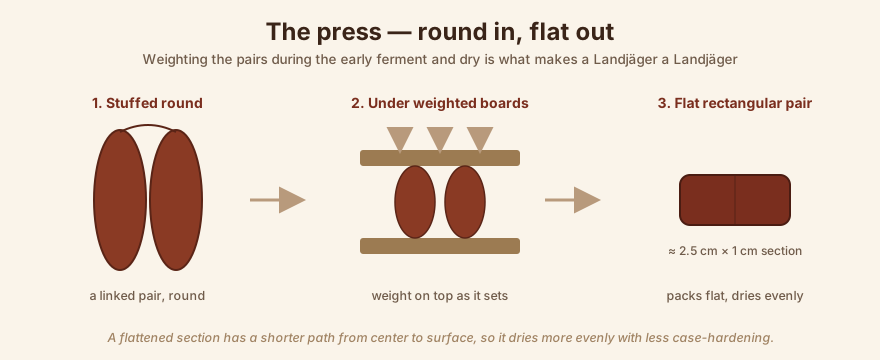
So the flat shape isn’t a stylistic choice made at the counter; it’s baked in during fermentation, and it does real work. It packs and carries the way I’ve described. And — this is the part the craft page gets into properly — a flattened stick also dries better: squash a round section flat and the distance from the wet center to the drying surface gets shorter and more even, so moisture leaves the whole stick at a steadier pace and you’re less likely to get the dreaded case-hardening, where a dried skin traps a wet core. Form serving function, all the way down.
That’s the thing itself, then. A flat, hard, dark, pressed pair of raw fermented sausage, deeply smoked and seriously dried, kept safe by acid and dryness instead of heat, built by people who needed to carry good meat into places without a fridge — and named, most likely, not for a hunter at all but for how long it was cured. If you already knew Landjäger only as a gas-station snack stick, I hope that reframes it. And if you want to know how far the good stuff has drifted from that stick, and why I finally started making my own, the rest of this dive is waiting.
You can see where Landjäger already earned a paragraph in the broader German sausage story, pull up every Landjäger recipe I’ve got over on the recipe collection, or step back up to the sausage hub to see where it sits in the whole tradition.
Next: The German Tradition — the mounted gendarmes, the Gendarme connection, the Black Forest, and the world the sausage was born into.
Comments (0)