Japan: Chawanmushi, and What Dashi Changes
茶碗蒸し — “tea-bowl steamed.” The name is literally the vessel and the method, which tells you how plainly the Japanese think about this dish.
It came from China through Nagasaki about three hundred years ago (the story is on the first page), and Japan changed three things: more liquid, dashi instead of water, and everything placed rather than stirred.
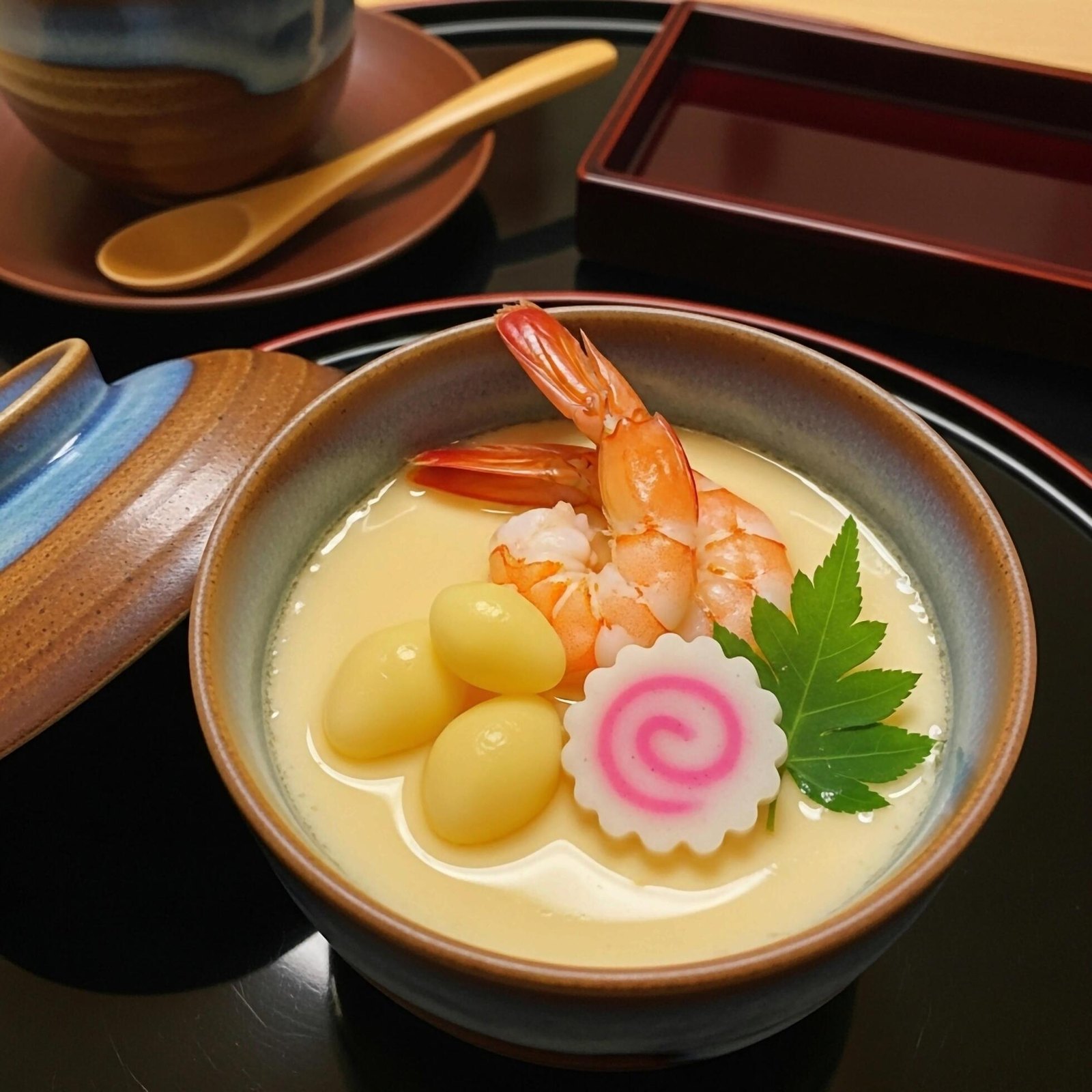
Dashi is the whole difference
I want to be blunt about this because it’s the thing people skip. You cannot make chawanmushi with water and salt. You can make a perfectly nice Chinese steamed egg that way, and it will be good, and it will not be chawanmushi.
Dashi — kombu and katsuobushi — brings glutamates and inosinates, which is savouriness of a kind that salt alone does not produce. In a dish this mild, that’s not a garnish-level difference. It’s the entire flavour.
⭐ And the ratio goes up to about 2:1 or even 3:1 dashi to egg, which is why chawanmushi is so much softer than its Chinese parent. It barely holds. A spoon goes through it with no resistance at all, and it should almost seem like it shouldn’t have set.
The seasoning is otherwise nearly nothing: light soy (usukuchi, which is saltier and paler than regular soy), a little mirin, a pinch of salt. That’s it. Anything more and you’re fighting the dashi.
What goes in it
The classic set, and the reason each one is there:
- Shrimp — one or two, for sweetness and a bit of bite.
- Chicken — a couple of small pieces, marinated briefly in soy and sake.
- Shiitake — fresh or rehydrated, for depth. Use the soaking liquid in the dashi.
- Kamaboko — the pink-and-white fish cake, sliced. Mostly for colour and the tradition of it.
- Ginkgo nuts (ginnan) — the signature. Slightly bitter, faintly resinous, a startling jade green. ⚠ Ginkgo nuts should be eaten in moderation — they contain a compound that is genuinely problematic in quantity, and this is not a superstition. A few in a cup is the traditional serving and is the right amount.
- Mitsuba — Japanese wild parsley, added at the end for a fresh, faintly celery-ish lift. Flat-leaf parsley is not a substitute; leave it out rather than swap it.
- Yuzu peel — a sliver on top, if you have it.
Chawanmushi is the classic. Chawanmushi, Crab and Ginkgo is the more luxurious version, and crab and egg is one of those pairings that seems obvious once you’ve had it.
⭐ This collection already had five chawanmushi recipes before this dive existed, which is a fair measure of how often the dish turns up once you start looking. They are all worth having, and they disagree with each other in useful ways:
- Chawanmushi (Savory Egg Custard) — Masaharu Morimoto’s, from Mastering the Art of Japanese Home Cooking. The one to read if you want a chef’s proportions rather than mine.
- Chawanmushi (Japanese Savory Egg Custard) · Chawanmushi (Savory Steamed Egg Custard) · Chawanmushi — Umami Packed — three more takes, with different fillings and different ratios.
- Instant Pot Chawanmushi 茶碗蒸し — ⚠ and this one contradicts the science page head-on, which is exactly why it is interesting. I say don’t use a pressure cooker, because pressure means temperatures well past the 85 °C where egg protein wrings itself out. The Instant Pot version works by not pressurising — it runs the STEAM programme on LOW pressure with the timer set to zero minutes, then a full 10-minute natural release. The custard cooks entirely during the ~10-minute ramp-up and the slow release, and spends essentially no time held at pressure temperature. The rule stands; the appliance has a mode that sneaks under it.
⭐ It also runs a 2.5:1 ratio, which is what caught an error on the science page — see the correction there.
🔴 Place the ingredients, don’t stir them in. They go in the bottom of the cup and the custard is poured over. The dish is meant to be excavated — you find things as you go down. Stirring them through makes it a completely different eating experience and, honestly, a worse one.
The cup and the lid
Chawanmushi is served in a lidded cup — taller than it is wide, with a fitted lid, usually ceramic. The lid isn’t decoration:
- It stops condensation dripping onto the surface.
- It moderates the heat.
- It keeps the dish hot from the steamer to the table, which for something this delicate matters.
⚠ If you don’t have chawanmushi cups, use small ramekins or teacups and cover each one with foil. It works. But the lidded cups are cheap and they’re the difference between the dish looking like itself and looking like a ramekin of egg.
The technique note that catches everyone
Chawanmushi at 3:1 is right at the edge of setting, and the margin for error is smaller than with the Chinese ratio. Two consequences:
- 🔴 Even gentler heat. If Chinese zhengdan wants a bare simmer, chawanmushi wants a whisper. Many Japanese recipes have you crack the steamer lid slightly, or lower the heat as soon as the surface skins over.
- Watch the total time. 12–15 minutes for a small cup. It will still look under-set when you take it out and it will finish in the residual heat.
⭐ A trick worth knowing: put a chopstick across the pot under the lid. It vents a little steam and drops the temperature just enough, and it’s what stops the whole thing pitting.
When it’s eaten
Chawanmushi is one of the few Japanese dishes eaten with a spoon, and it turns up anywhere in a meal — it isn’t a starter or a dessert, it’s just a dish. It appears in kaiseki, in set lunches, in izakaya, in convenience stores. Hot in winter, and there’s a chilled summer version that’s genuinely good.
I first ate it properly during my time in Japan in the eighties, and the honest truth is I didn’t understand it at first. It’s the least emphatic thing on any table it’s on. It took a while to work out that restraint was the whole design.
In this dive: The story · The science · China · Korea · Elsewhere · The espresso steam wand · Vessels and gear
Comments (0)