China: 蒸水蛋, the Everyday One
Zhengdan (蒸蛋), or zheng shui dan (蒸水蛋) — “steamed water egg.” This is the original, and it’s also the most ordinary. It is not a dish anybody dresses up. It’s what you put in front of a child, what you make for someone who isn’t well, what fills the last gap on a crowded table.
⭐ And it is the version I’d learn first, because it sits at the exact middle of the range — 1.5 parts liquid to 1 part egg — and everything else in this dive is a move away from it in one direction or the other.
The base
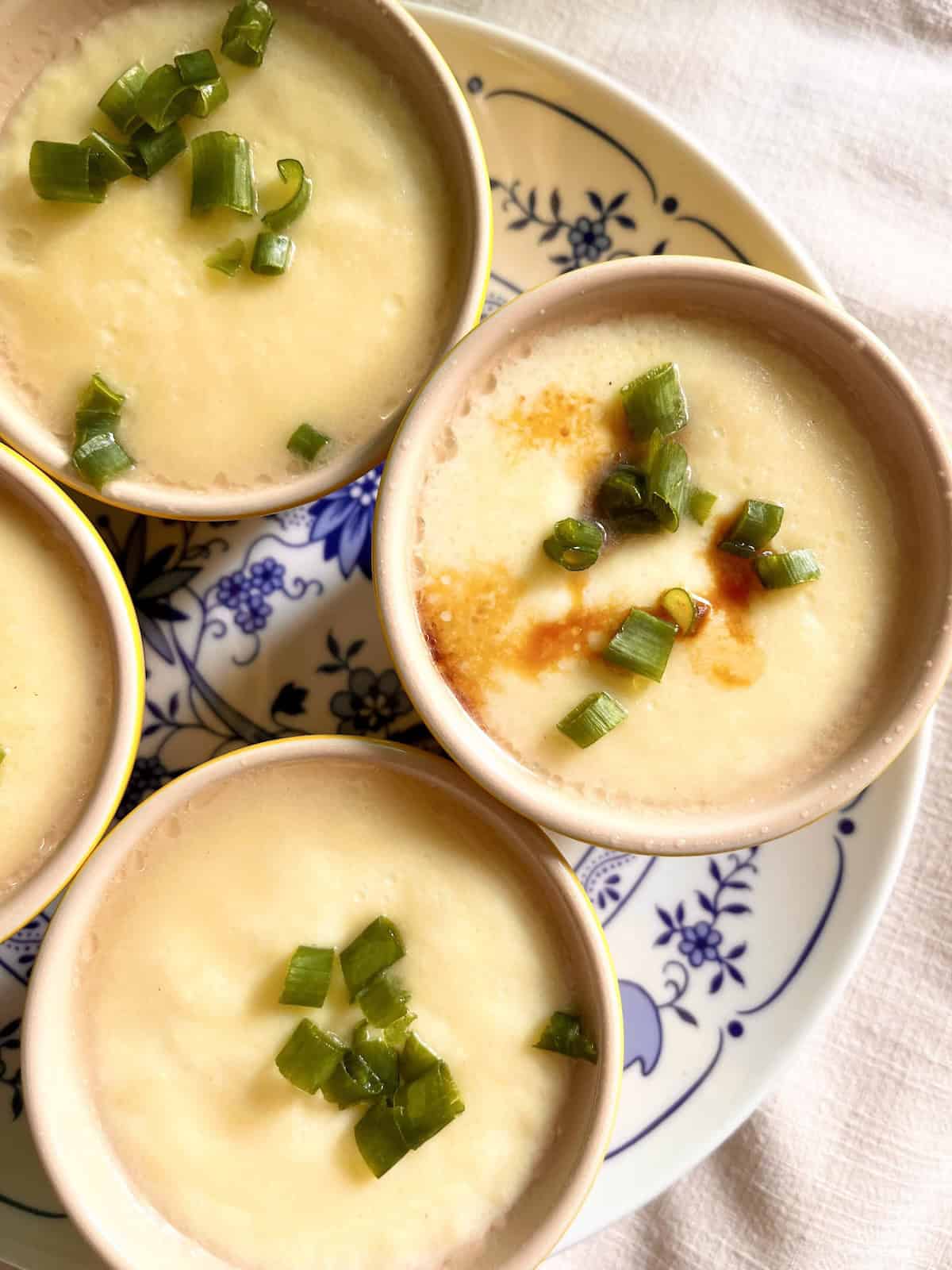
Steamed Egg, Chinese (Zhengdan) is the whole thing: eggs, warm water or light stock at 1.5:1, a pinch of salt, strained, covered, steamed gently for about twelve minutes. Finished with a thread of soy sauce, a few drops of sesame oil, and scallion.
The finishing is the part people underrate. You do not season this dish heavily in the custard — you season it lightly inside and then pour a small amount of soy and sesame oil over the top at the table, where it pools in the dimples and you get it in some bites and not others. That variation is deliberate and it’s most of the pleasure.
⚠ Light soy sauce, not dark. Dark soy is for colour and molasses depth and it will stain the custard muddy brown. Light soy (生抽) is the one.
The ones with things in them
The base is a canvas, and the classic additions are all about texture against the smoothness.
Steamed Egg with Century Egg and Pork — the Cantonese restaurant version, and the one worth going out of your way for. Century egg (皮蛋) diced through the custard gives dark, jellied, faintly ammoniac pockets against the mild set egg, and minced pork gives savour. It looks alarming and tastes wonderful.
Steamed Egg with Clams — clams nestled into the custard, which open as it steams and release their liquor straight into it. ⭐ The clams season the dish themselves, so go very light on added salt; you can always add soy at the table. This is the most impressive-looking version for the least work.
Steamed Egg with Tomato — a home dish rather than a restaurant one, and a first cousin of tomato-and-egg stir-fry, which is close to China’s national comfort food. The tomato gives acidity and colour and turns it into something that can stand as a light meal.
Regional turns
- Cantonese — the silkiest, the highest liquid ratios, and the home of the century-egg and clam versions. Cantonese cooking has the most refined relationship with steaming generally.
- Shanghainese — often a little richer, sometimes with a spoon of lard or chicken fat stirred in, which is very good and worth trying once.
- Sichuan — the base custard stays plain and the heat arrives on top: chilli oil, a little Sichuan pepper, preserved vegetable. The contrast between the bland custard and the loud dressing is the entire idea.
- Northern — firmer ratios, sometimes with the egg mixture poured over noodles.
The stock question
Water works and is traditional. But the single biggest upgrade is replacing it with a light stock — chicken, or the liquid from soaking dried shiitake, or a mild pork broth. It doesn’t make the dish taste of chicken; it makes it taste of more.
⚠ Whatever you use, warm it to about body temperature first. Cold liquid sets unevenly; hot liquid starts cooking the egg while you stir.
This is, incidentally, exactly the move Japan made permanent — they replaced the water with dashi and never went back. That’s the next page.
How it’s eaten
With rice, always, in my experience — the custard is soft and mild and it wants something to sit on. It’s a side, not a centrepiece, and it’s usually one of several dishes.
It’s also served at any temperature. Hot from the steamer is best, but nobody minds it warm, and leftovers eaten cold from the fridge with a spoon is a legitimate thing to do.
In this dive: The story · The science · Japan · Korea · Elsewhere · The espresso steam wand · Vessels and gear
Comments (0)