Three Thickeners, Three Ancestors
I have been making gumbo for a long time and refining it the whole way — from a simple sausage gumbo with shrimp in it out to a full seafood gumbo — and the question I could never get a straight answer to was the simplest one. What actually makes a gumbo a gumbo?
Not the roux, it turns out. Not okra either. Here is the answer I arrived at, and the rest of this section is the working-out:
Gumbo never had one origin, so it has no one authentic version. And the thickener you choose tells you which ancestor you are cooking from.
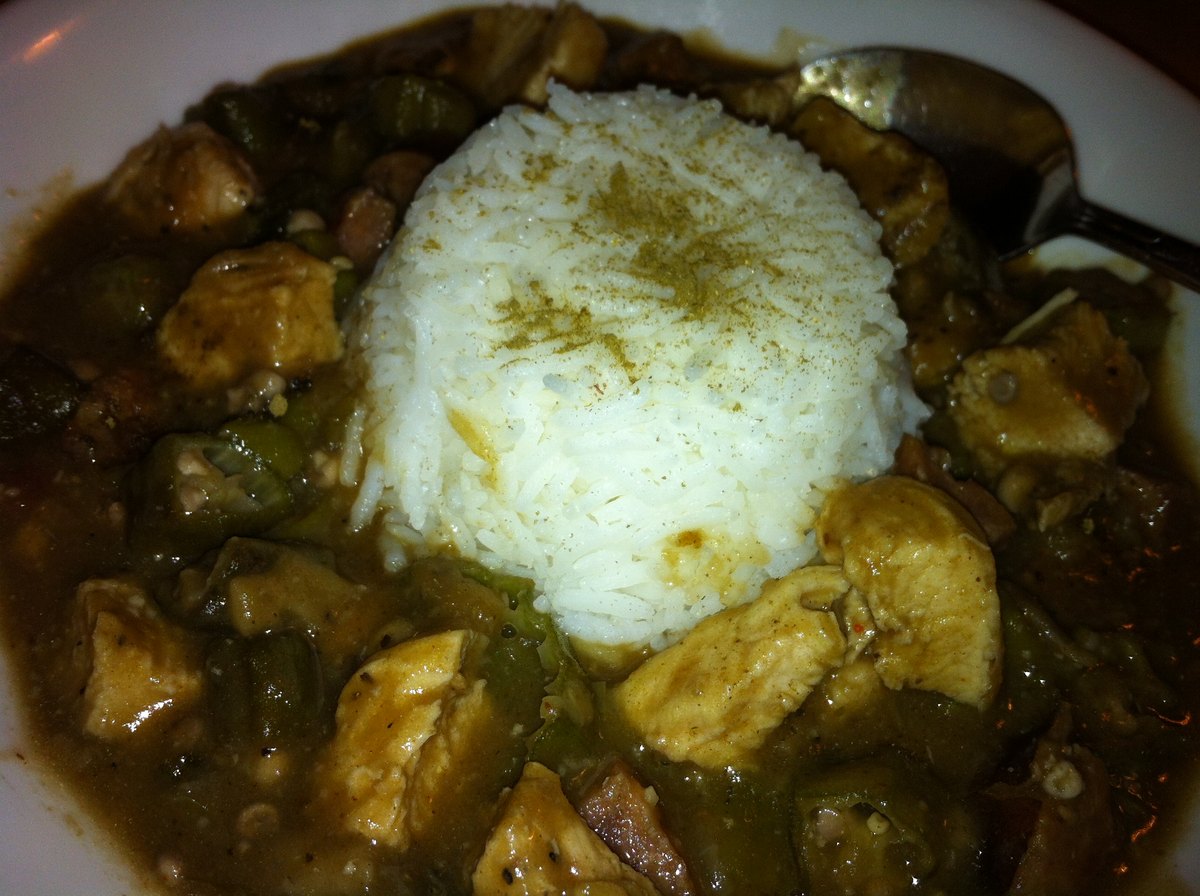
Three thickeners, and each one is from a different continent
This is the whole idea, and once you see it you cannot unsee it:
| Thickener | Where it comes from |
|---|---|
| Okra | West Africa — and it gave the dish its name |
| Filé (ground sassafras leaf) | The Choctaw, and other Gulf peoples |
| Roux (flour cooked in fat) | France |
Three ways to thicken one pot, arriving from three directions, none of which knew about the others. Choosing one is choosing a lineage — and that is why the “authentic gumbo” argument is unwinnable. There is no original to be authentic to. There are three, and they met in Louisiana.
⭐ Even the name can’t settle it. Gumbo is traced either to a West African word for okra (ki ngombo and its relatives) or to the Choctaw kombo for filé. Both candidates are thickeners, and neither is French. Whichever way the word actually went, the naming came from the African or the Native side, and the French contributed the technique that got top billing later.
🔴 The rule everybody states — and what the primary source actually shows
You will read everywhere that you never use okra and filé in the same gumbo. It’s stated as an iron law.
I have a primary source to test it against, and it is in my own library: The Picayune’s Creole Cook Book, the 1916 fifth edition, the oldest printed Creole gumbo collection I can point at. It prints three gumbos, and reading them side by side is the most useful hour I have spent on this dish.
| The Picayune’s gumbo | Roux | Okra | Filé |
|---|---|---|---|
| Gumbo Filé | no | no | yes |
| Gombo Févi (okra) | no | yes | no |
| Gombo aux Huîtres (oyster) | yes | no | yes |
⭐⭐ Look at the third row. The book DOES combine two thickeners — roux and filé, in the same pot. So the popular rule, stated as “never two thickeners,” is simply wrong.
🔴 What the pattern actually shows is that OKRA is the exclusive one. In all three recipes, okra never appears alongside anything else. Roux and filé shake hands quite happily; okra works alone.
And that is a better rule, because it has a reason behind it. Okra doesn’t just thicken — it thickens by being in the pot as a vegetable, in quantity, contributing body and its own flavour and texture. Two pints of it, in the book’s okra gumbo. You are not adding a thickening agent, you are building the dish around a vegetable. Filé is a spoonful stirred in off the heat; a roux is a base you start from. Those two are seasonings-with-a-job. Okra is a main ingredient.
⚠ I’ll be precise about what I’ve shown: this is one cookbook, however authoritative, not a survey of Louisiana practice. Plenty of modern cooks use okra and filé together and report no disaster. What I can say is that the most-cited primary source treats okra as the exclusive one and does not treat filé and roux that way — which is the opposite of how the rule is usually taught.
What the three actually do, mechanically
They are not interchangeable, and knowing why saves a lot of disappointment.
Roux thickens with starch, and loses that power as it darkens. The further you cook it, the more the starch breaks down — so a very dark roux is nearly all flavour and hardly thickens at all. ⭐ This is why a dark gumbo is often a thin gumbo, and why the darkest pots lean on okra or filé for body. The roux has its own page.
Okra thickens with mucilage — the soluble fibre that makes it slippery. That’s the same property people complain about, and managing it rather than fighting it is the skill.
Filé thickens by hydrating, and it is the fussiest: 🔴 it goes stringy and gritty if it boils. It goes in off the heat, at the end, or it’s ruined. More here.
The one rule I’d actually defend
Almost everything about gumbo is contested. Roux dark or blond, tomato or none, okra or filé, rice under or over, chicken or seafood or both. I have opinions on all of it and none of them are laws.
But there is one:
🔴 Never undercook the roux.
An underdone roux tastes pasty, and of raw flour, and there is nothing you can do later to fix it. That flat, floury note in a disappointing gumbo is almost always this and almost never the seasoning. It is the single most common failure in the dish and the only one I’d call a genuine mistake rather than a preference.
Start here: The Roux — three variables, not one.
Comments (0)