Sister Pei's Chongqing Hot Pot
11 March 2026, Shenzhen, from ten past six until half past seven in the evening. Fourteen photographs, and the best story of the whole trip.
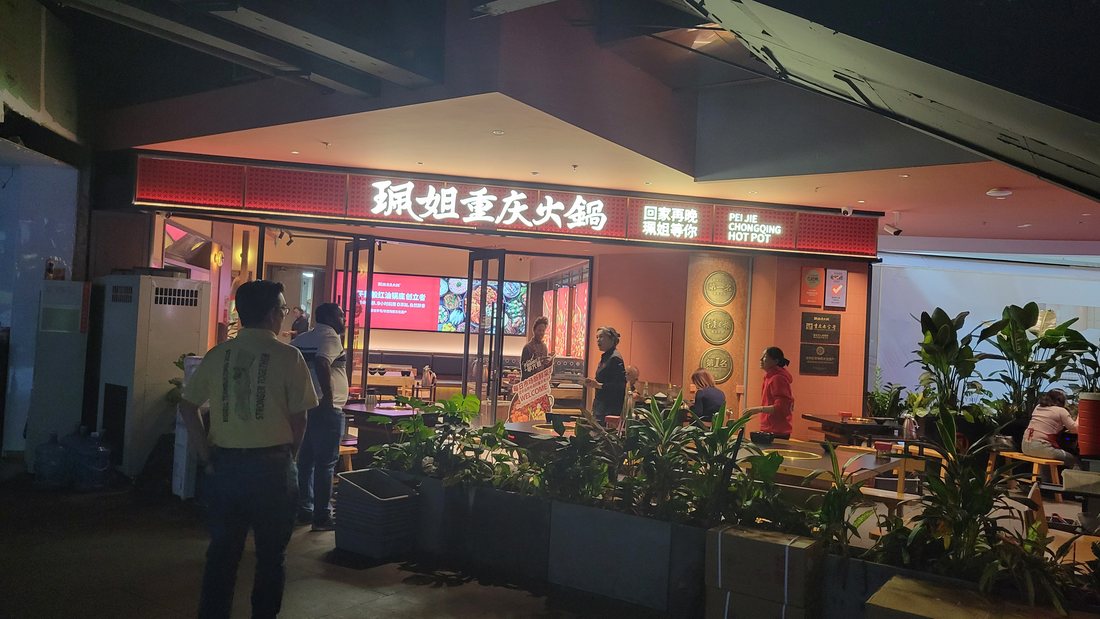
The sign reads 珮姐重庆火锅 — Pèi Jiě Chóngqìng Huǒguō, “Sister Pei’s Chongqing Hot Pot” — with the English on the right-hand panel, so this one needs no detective work at all. It is a real Chongqing chain, not a generic hotpot house.
⭐ And the tagline underneath is worth the price of admission: 回家再晚,珮姐等你 — “However late you come home, Sister Pei is waiting for you.”
That is a late-night restaurant telling you exactly what it is for. Hotpot in Chongqing is not primarily a dinner; it is the thing that is still open, still loud, and still going when everything else has shut. The sign is doing the same job as a neon OPEN ALL NIGHT, but with a personality attached and a suggestion that somebody is expecting you.
The pot
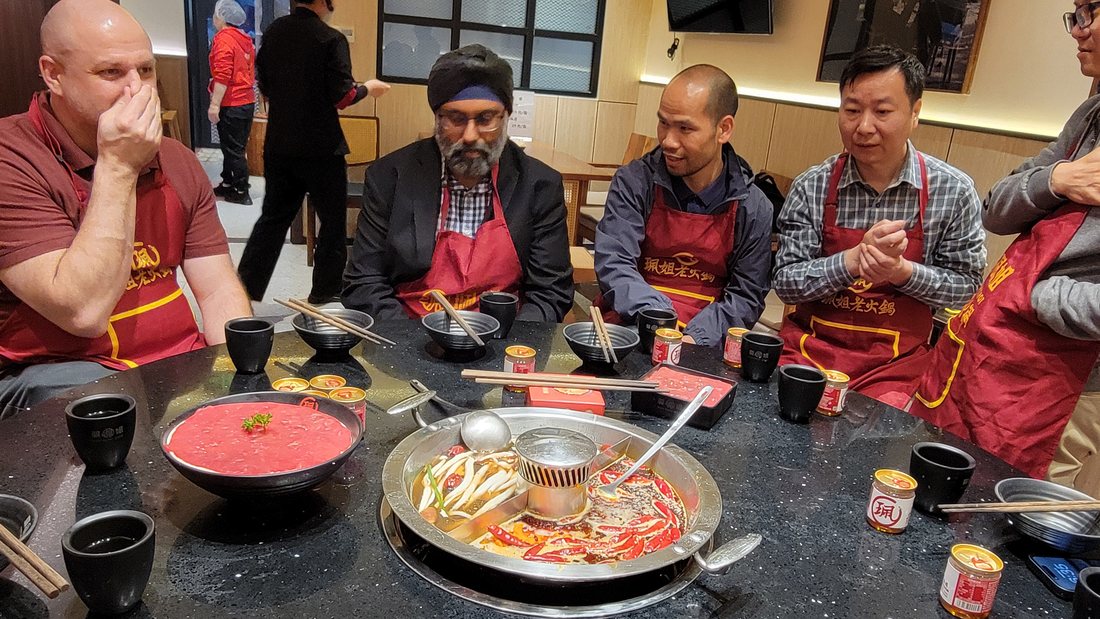
This is a 鸳鸯锅 — a yuānyāng pot, which translates as “mandarin duck pot.”
The name is not about food. Mandarin ducks pair for life and are the standard Chinese shorthand for a couple, so a yuanyang anything means two things joined that are not the same — you also get yuanyang in Hong Kong meaning coffee mixed with milk tea. Here it is one pan divided down the middle: fierce red málà broth on one side, clear broth on the other.
Málà (麻辣) is itself two words doing two jobs, and this is the distinction that took me the longest to actually feel rather than read about:
- 麻 má — numbing. That is Sichuan pepper, and it is not heat at all. It is a physical buzz on the lips and tongue, closer to a mild electric tingle than to spice.
- 辣 là — hot. That is chilli.
They are separate sensations from separate ingredients, and a Chongqing broth runs both at once. The red side of that pot is a deep bed of beef tallow, dried chillies and Sichuan peppercorns that has been simmering long before anyone sat down.
⭐ The divided pot is a social technology, not a culinary one. It exists so that a table with different tolerances can eat the same meal — which is exactly why it was on our table, a group of visitors and hosts with no shared baseline for how much málà is enjoyable. Nobody has to negotiate or opt out. You dip on your own side.
The theatre
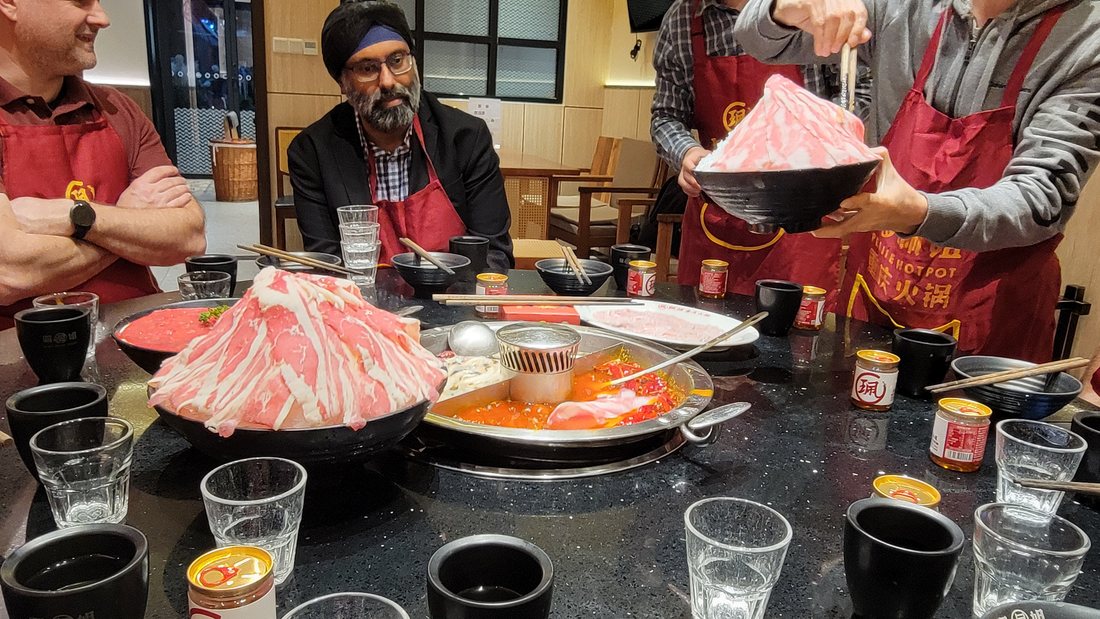
The sliced meat comes to the table as a presentation. It is mounded high, paper-thin, arranged, and shown to you before a single piece is cooked — and then it goes in a few slices at a time and is out again in seconds.
That is the whole rhythm of hotpot and it is why it takes ninety minutes. You are not served a meal. You are given raw materials and a heat source and left to run it, and the pace is set by how fast people talk.
The aprons
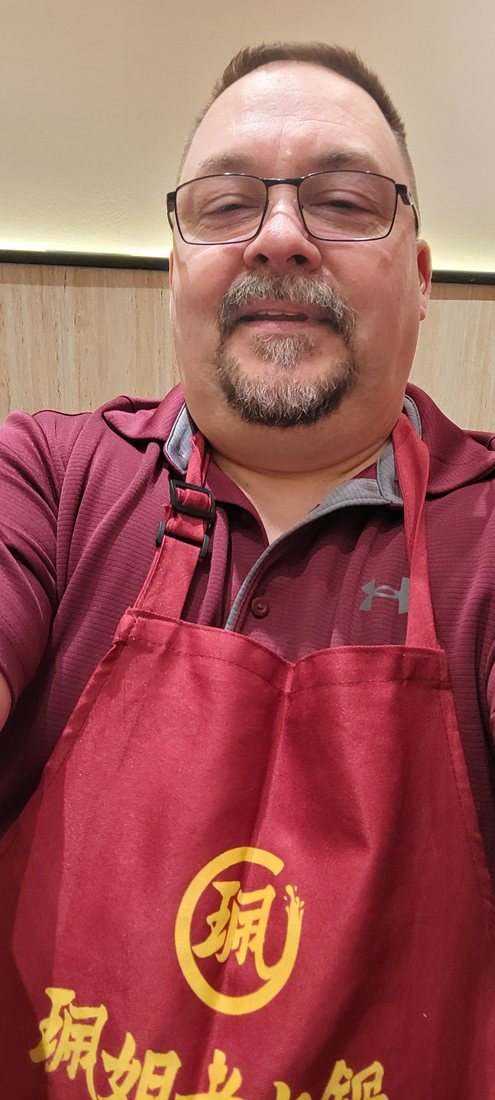
Every person at that table is wearing one of these in the photographs. The restaurant hands them out, they carry the house logo, and they are not a novelty — a rolling pot of beef tallow spits, and you are leaning over it repeatedly for an hour and a half.
I have cooked over open fires, in smoke, in kitchens, and I have owned a lot of aprons. This is the only restaurant I have ever eaten in that dressed the customers for the job. It tells you the restaurant knows precisely what is about to happen to your shirt.
What I would need to build it
The broth base is the whole thing, and it is genuinely a project rather than a recipe: beef tallow, dried chillies, Sichuan peppercorns, doubanjiang, aromatics, fried slowly and long enough to bloom without scorching, then held.
The dipping bowl is the other half and it is the part people skip. In Chongqing the standard is sesame oil with raw garlic, and its job is not flavour so much as temperature and grip: it cools what you have just fished out of a boiling pot and it carries the fat-soluble chilli away from your mouth rather than into it. Ordering a hotpot and then dipping into soy sauce is missing the mechanism.
Next: Breakfast at the Hotel — the most honest picture I have of how China actually feeds a mixed room.
Comments (0)