The Tea Egg Pot
I bought a 茶葉蛋鍋 — a Taiwanese commercial tea egg pot — and it arrived from Changhua in August 2026. It is the machine you have stood next to at a 7-Eleven in Taipei without ever looking at: a stainless drum on a hotplate, two lamps, two switches, and a smell that fills the shop. This page is what I learned taking it apart, translating its manual, and working out how to put my recipes in it instead of the sixty-egg commercial load it was built for.
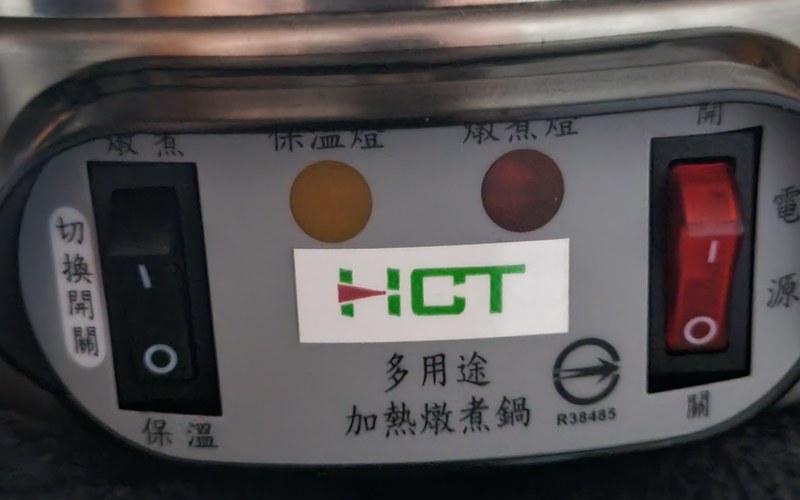
The whole interface. Left switch picks cook or keep-warm, right switch is power, and the two lamps tell you which element is drawing current. There is no thermostat dial and no timer — the temperatures are fixed in the base and the timing is your problem.
Read the full manual in English · Download it as a PDF — I translated it from the Traditional Chinese booklet that came in the box, because there is no English edition and the machine ships with exactly one page of operating instructions.
⭐ Revision 2 (25 August 2026) added the half the booklet leaves out. The printed manual is an appliance manual — it documents the machine and assumes you already know how tea eggs are made. Revision 2 keeps every word of that translation and adds seven sections in front of it: what “cold boiled water” actually means, what the 吸渣布 physically is, how the eggs are cracked and why, a full walkthrough of both the commercial and the marbled method, scaled marinade ratios, how to keep the marinade between batches, and how long the eggs may be held. Those come from Taiwanese convenience-store practice and Taiwanese home cooking, and every one is sourced in the back of the document.
What it is
HCT WJ-1501, made by 禾久代股份有限公司 (Ho Chiu Tai Co., Ltd.) of Tianwei, Changhua County. The full name on the cover is 全不鏽鋼分離式茶葉蛋鍋 — all-stainless-steel separable tea egg pot — and the word doing the work is 分離式, separable. Inner pot, outer pot and heater base all come apart. That matters more than it sounds like it does, and I will come back to it.
| Capacity | 5 litres |
| Power | 110 V / 60 Hz — 800 W cooking, 600 W keep-warm |
| Inner pot | Food-grade 316L stainless |
| Outer pot | SUS-304 stainless |
| Size | 35 cm across, 32.5 cm tall |
| Approval | Taiwan BSMI R38485 |
⚠ None of those numbers are in the manual. The printed booklet gives no wattage, no voltage rating and no dimensions — they come from the manufacturer’s published specification, and I’ve marked them as such in the PDF too.
110 V, 60 Hz is why this one works in Michigan. Taiwan runs the same domestic supply the US does, which is the entire reason a Taiwanese appliance can be shipped here and plugged in. Buy the equivalent Chinese or Japanese machine and you are buying a transformer as well.
The two switches, and the thing that looks like a fault
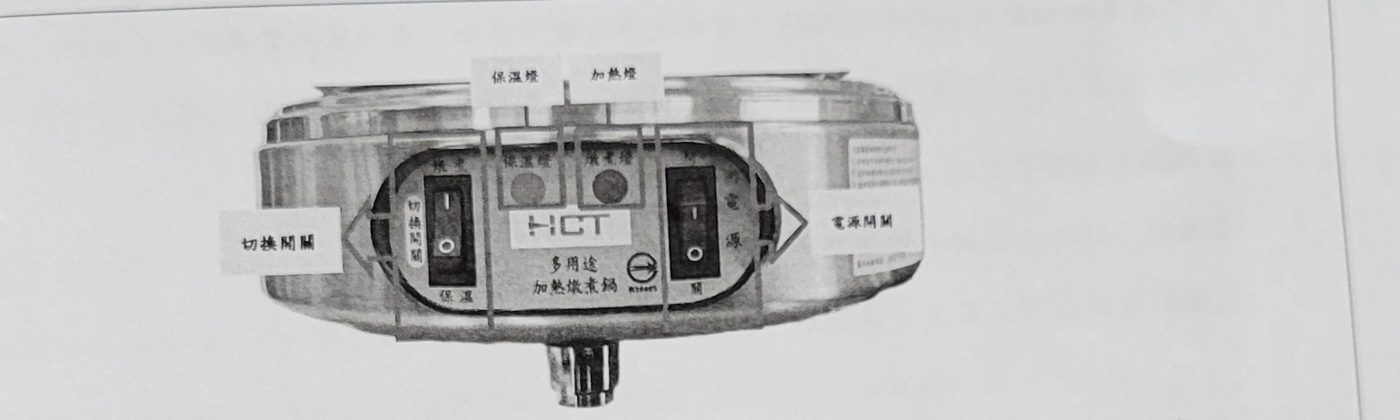
From the manual: 切換開關 selector, 保溫燈 keep-warm lamp, 加熱燈 heating lamp, 電源開關 power.
Power on the right. The selector on the left picks 燉煮 (cook/stew, up) or 保溫 (keep warm, down). Red lamp means it is cooking. Amber lamp means the keep-warm element is drawing.
Here is the part worth knowing before you own one, because it looks exactly like a broken machine:
When you flip to keep-warm, the pot cuts all power for thirty minutes and both lamps go dark. Then it holds the inner pot between about 70 °C and 80 °C — amber lamp on at 70, off at 80, cycling.
Thirty minutes of a dead-looking appliance is a long time to stand there wondering. It is doing what it was designed to do: a pot that has just been at a rolling boil does not need any help staying above 70 °C for half an hour, so the designers simply don’t feed it.
The other dark-lamp case is real, and the manual is refreshingly blunt about it. There is a thermal cut-out in the base. If the red lamp won’t light and the power switch does nothing, the cut-out has tripped: switch off, wait thirty minutes, switch on. All four entries in the troubleshooting section — no power, won’t heat, trips the breaker, and the fourth one about buttons — resolve to that same instruction. It is a machine with one failure mode and one remedy.
The sixty-egg problem
The manual’s operating procedure, in full, is three lines:
- Place 60 commercial-grade eggs in the inner pot and pour in 2 packets of tea-egg marinade.
- Add cold boiled water to cover, lay the sediment cloth over the top, and heat.
- After it reaches a rolling boil, cook 4 hours, then manually switch to keep-warm for holding and selling.
Two packets of a proprietary Taiwanese marinade concentrate I do not have, and sixty eggs.
Sixty eggs do not fit. I did the arithmetic rather than guess. Eggs pack like ovoids at
roughly 62% solid, so each egg occupies about volume ÷ 0.62 of pot:
| Egg | Weight | Pot space each | Fits in 5 L |
|---|---|---|---|
| Taiwan SS | 45 g | 70 ml | ~64 |
| Taiwan S | 51 g | 80 ml | ~56 |
| US large | 57 g | 89 ml | ~50 |
| US extra-large | 60 g | 94 ml | ~48 |
Sixty eggs needs eggs of 53 g or less. Taiwan grades hens’ eggs SS (42–48 g), S (48–54), M (54–60), L (60–66), LL (66–72) — so the manual’s 業務用蛋, its foodservice eggs, are S grade or smaller. A US large egg is 57 g and sits in Taiwan’s M band, which is why the manufacturer’s own spec sheet says the 5 L pot holds 40–50 eggs while the manual says 60. Both are right. They are describing different eggs.
⚠ I could not confirm which grade 業務用蛋 formally denotes — the term means “for business use” and I found no standard defining it by weight. The packing figure is also an estimate: 62% is a reasonable random-packing fraction for ovoids, not a measurement of eggs in this pot.
Plan on 48 with US large. That leaves headroom, and headroom is not optional — the eggs have to stay under the liquid.
Scaling my recipes into it
Here is the thing that catches people, and it is the opposite of what scaling usually means.
Chinese Tea Eggs Method 2 makes 12 eggs in 2½ cups of marinade — about 49 ml of liquid per egg. But in a packed pot, the liquid only has to fill the gaps between the eggs, which is about 38% of the bed. At 48 eggs that is 1.6 litres, or 34 ml per egg. Scale the recipe by egg count and you will mix twice the marinade you can physically fit.
Scale the marinade to the WATER, not to the eggs. Work out how much liquid it takes to cover them, then multiply the whole seasoning list by
that volume ÷ 2½ cups.
That is the correct rule because flavour here is driven by concentration, not by total quantity — the eggs are sitting in a bath, and what matters is how salty the bath is.
| Batch | Liquid to cover | × Method 2 |
|---|---|---|
| 12 eggs | 1¾ cups (400 ml) | 0.7× |
| 24 eggs | 3½ cups (800 ml) | 1.4× |
| 36 eggs | 5 cups (1.2 L) | 2× |
| 48 eggs (full pot) | 7 cups (1.6 L) | 2.75× |
Worked out for a full pot, from the Method 2 list:
- 11 tbsp light soy sauce (⅔ cup + 1 tbsp)
- 5½ tbsp dark soy sauce — this is the marbling; don’t cut it
- 6 bay leaves
- 1 tbsp Sichuan peppercorns
- 3 star anise
- 3 small cinnamon sticks (cassia)
- 2 tbsp sugar
- 1 tbsp salt
- 6 black tea bags, or 6 tbsp loose
- 7 cups water
Put the tea and whole spices in a muslin bag. The recipe steeps tea at fridge temperature or boils it for ten minutes. This pot boils it for four hours and then holds it at 75 °C for however long the pot is on, and black tea held like that goes flatly, mouth-drying astringent. Bag it and pull the tea after the first hour; leave the spices in.
⚠ I originally guessed the manual’s 吸渣布 — its “sediment-absorbing cloth” — was quietly doing this job. It is not. The 吸渣布 is a disposable food-grade non-woven sheet that lies flat on top of the eggs: it is a drop lid, the same object as a Japanese 落し蓋, and Taiwanese cooks call it exactly that. It keeps the top layer of eggs wetted so they colour evenly, soaks up the scum that rises through a long boil, and stops spatter. Tea leaves sink; the sheet never touches them. Keeping the tea out of a long braise is a job for a bag and a timer, and every Taiwanese recipe says so outright — 把茶包拿起來(因為煮久會苦), take the tea bag out, because a long boil makes it bitter. Best home substitute for the sheet: parchment cut to fit with holes punched in it.
How long, really
This is where the pot stops being an appliance and starts being interesting, because
the science page already gives us the tool: salt moves into egg
white by diffusion, x ≈ √(2·D·t), about 3 mm overnight in the fridge.
The pot is not a fridge. Diffusion runs on D, D scales with T/η, and water’s viscosity
collapses as it heats. At 75 °C D is about 5× the fridge value; at a boil, about 7×.
Run the same arithmetic at the pot’s actual temperatures:
| In the pot | Penetration | Same as, in the fridge |
|---|---|---|
| 1 h at boil | 2.3 mm | 7 hours |
| 2 h at boil | 3.2 mm | 14 hours |
| 4 h at boil (the manual) | 4.5 mm | 28 hours |
| 4 h boil + 8 h holding | 7.1 mm | 3 days |
| 4 h boil + 24 h holding | 10.5 mm | 6½ days |
The white is 5–10 mm thick. So the manual’s four hours salts most of the way through it, and a pot left holding overnight is running eggs into territory the science page calls trading texture for salt you can’t taste anyway.
⭐ And that reframes the manual’s number. Four hours is not a cooking time, it is a vending time. The pot is designed to sit in a shop all day, and a commercial operator wants the eggs saturated early, because the batch has to still taste of something at 4pm. The recipe’s own sweet spot — the 12–24 hour fridge window where you get maximum flavour for minimum damage — lands at about two hours in this pot.
So: two hours if you’re eating them tonight. Four if you’re feeding a party across an afternoon. And if the pot has been holding since yesterday, expect the outer white to be genuinely salty.
⚠ Honesty flag, and it’s a real one. This extends an estimate that the science page already
flags as crude — constant D, semi-infinite slab, no spherical geometry, no yolk membrane — and
adds a further assumption on top, that Stokes-Einstein scaling holds for a solute moving through
a hot protein gel. Nobody has measured this. The direction is certainly right and the order
of magnitude is defensible; the third significant figure is decoration. What I’d actually
trust is the ratio: this pot is roughly five to seven times faster than your fridge, so
divide your usual marinating time by about five.
Cracking them, and what “separable” buys you
The manual’s procedure puts raw eggs in with the marinade and cooks the lot. That works, and it is obviously what a shop wants — one loading, one operation.
🔴 I had this wrong, and the correction is the most useful thing the Taiwanese sources gave up. I wrote that raw eggs cannot be cracked. They are cracked, and it is the step store staff treat as the whole job — one tap at the blunt end, over the air cell, listening for a single clean 喀. But the purpose is not what you would guess: the tap is a vent, not a flavour channel. As the egg heats, the air in the cell expands, and with nowhere to go it splits the shell and dumps white into the pot. Pre-venting gives the gas an exit.
The flavour goes in through the shell itself. A four-year convenience-store veteran puts it plainly: 雞蛋殼本身就有毛細孔,滷久了滷汁一定會滲透進去 — the shell has its own pores; over a long braise the marinade will certainly seep in. Four hours is long enough that the crack contributes very little, which is why a shop tea egg comes out uniformly dark rather than marbled.
So the two crack operations are genuinely different jobs:
| Store crack | Marble crack | |
|---|---|---|
| Egg state | Raw | Boiled 6 min, then iced |
| Where | One tap, blunt end only | All over, evenly |
| Purpose | Vent the air cell — stop bursting | The 大理石紋 pattern, faster penetration |
| Result | Uniformly dark | Marbled |
Chilling before the marble crack matters mechanically, not just for handling: the cooled white firms and pulls slightly away from the shell, so the shell crazes without the white tearing with it. Finer, denser crazing gives a finer marble.
The separable inner pot gives you the marbled version in one machine:
- Boil. Inner pot, eggs, water to cover. Power on, selector to 燉煮. Follow whatever timing you want from Eggs, Cooking by Temperature.
- Lift the inner pot straight out, drain, and dump the eggs into ice water. This is the step the 分離式 design exists for.
- Crack every shell all over with the back of a spoon. Don’t peel.
- Return them to the inner pot, pour in the scaled marinade, water to cover, spice bag on top, and run the cook phase.
⚠ Dry the bottom of the inner pot before it goes back on the base, every time. The manual says this twice and the label on the pot says it a third time, which is usually a sign that somebody’s warranty department got tired of the same phone call.
Holding it safely
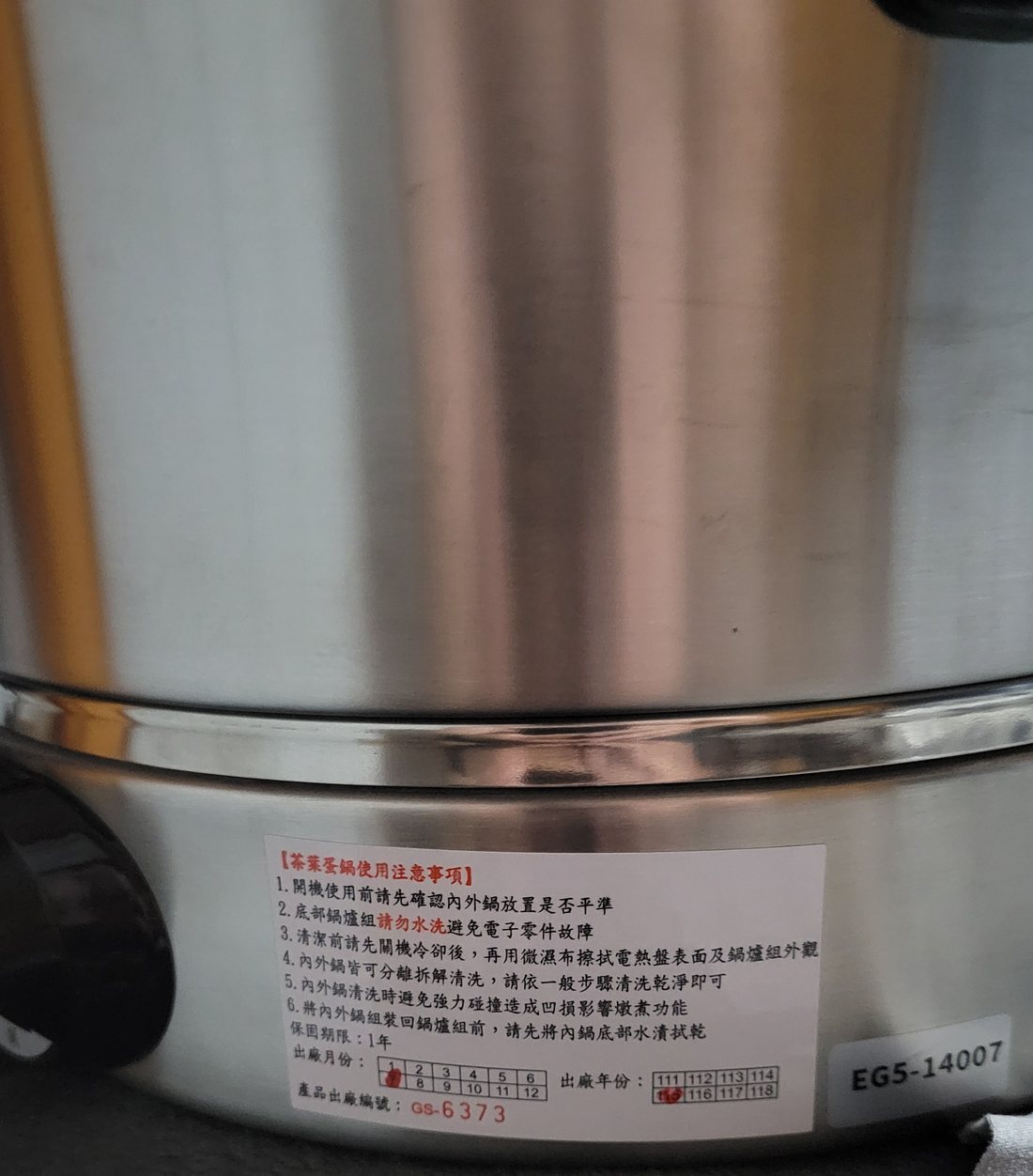
The label on the outer pot. Mine is serial GS-6373, made in month 7 of ROC year 115 — July 2026. One-year warranty from delivery.
The keep-warm band is 70–80 °C, and that is comfortably above the 60 °C / 140 °F hot-holding line. A pot on keep-warm is microbiologically safe more or less indefinitely; what it is doing to the eggs is a quality problem, not a safety one.
🔴 The hazard is switching it off and walking away. Cracked eggs in a warm, low-acid, barely-aerobic liquid, cooling slowly through the danger zone, is not a situation you want to leave on a counter overnight. That is the same physics that put a man on a ventilator in the keeping them page — different dish, identical conditions. Either it stays on keep-warm, or the eggs and the marinade go in the fridge. There is no third option and the pot will not warn you.
Two smaller things:
- Top up with hot water, not cold. Four hours of boiling evaporates a surprising amount, and a jug of cold water will drop the whole pot out of its hold band.
- The thirty-minute dead window matters more on a small batch. Five litres of near-boiling liquid coasts through half an hour easily; two litres in the same uninsulated pot loses heat a good deal faster. On a 12-egg batch I’d check it with a thermometer rather than trust it.
Cleaning
Pots come apart and wash normally. The base never touches water — damp cloth only, and unplug it first. The manual and the body label between them say this five separate times.
The one instruction worth repeating: don’t swap the inner pot. It is machined to sit on that heating plate, and a dent in the base is a dent in the thermal contact, which the label warns will “affect the stewing function.” Given that the whole appliance is a hotplate with no thermostat you can see, I believe it.
The recipes this pot is for: Chinese Tea Eggs (茶叶蛋) for the modern spiced version, and Tea Eggs, Yuan Mei (1792) if you want to find out what the dish tasted like before soy sauce got into it — which, given that Yuan Mei’s recipe is written for a hundred eggs at a time, is arguably the one this machine was built for.
Next: tea eggs — where the 1792 text turns out to say almost nothing that the internet claims it says.
Comments (0)