The Family Tree
This is the page the rest of the section hangs off. If you only read one thing here, read this one, because once you can see the shape of it, every cheese you meet has an address.
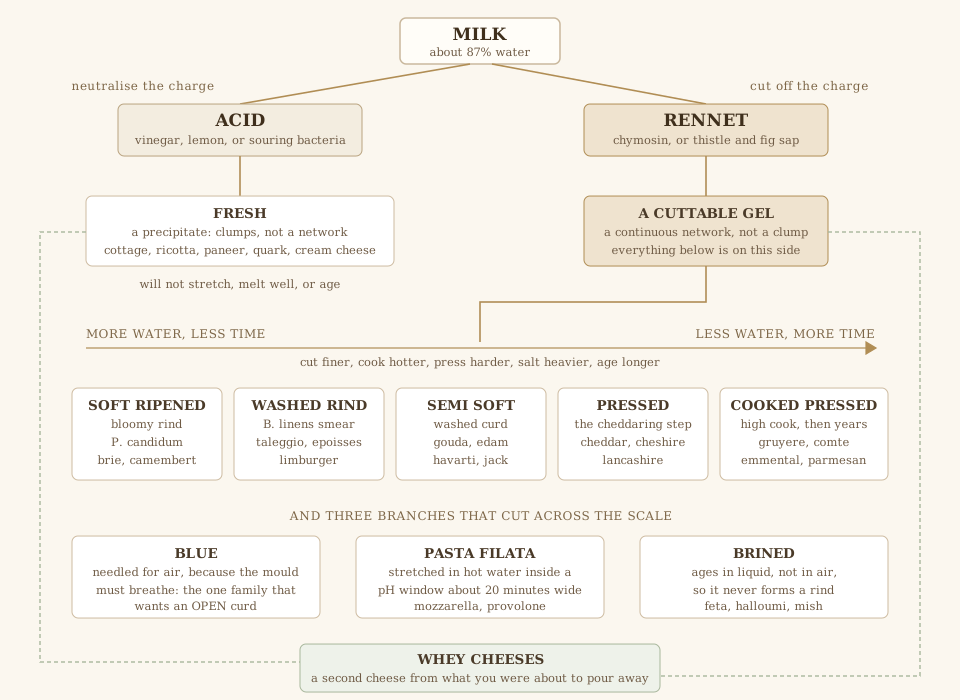
Why not soft, medium and hard?
That is the classification everybody starts with, including me, and the trouble with it is that it sorts cheeses by their symptom instead of their cause.
Take feta and cheddar. Feta is soft, cheddar is hard, so on the soft/medium/hard scheme they live about as far apart as two cheeses can. But they’re made almost the same way for the first few hours, and the real difference is that one finishes its life submerged in brine and the other finishes it dry in air. Meanwhile Camembert and Brie sit in the same “soft” bucket as fresh chèvre — but chèvre is a completely different material, made by a completely different chemistry, and no amount of aging will turn one into the other.
Firmness is an output. What you actually control is the coagulant, the water, and the time. So that’s what the tree is built on.
The first fork: two ways to break milk
Milk holds its protein — casein — in tiny bundles called micelles, which stay apart because they carry a like electrical charge and repel each other. Milk is a liquid because those bundles never touch. All of cheesemaking begins by taking that away, and there are exactly two ways.
Neutralise the charge, with acid. Add vinegar or lemon, or just let the milk’s own bacteria make lactic acid, and the repulsion falls away. The bundles clump and fall out of suspension. You get a precipitate — soft, fragile, granular.
Cut the charge off, with an enzyme. Rennet snips a specific piece off the casein — the bit that carries the charge — and leaves the rest of the protein intact and free to bond to its neighbours. So you don’t get clumps. You get a continuous network: a single gel filling the whole vat, which you can cut with a knife and watch heal at the cut face.
That difference is the most important fact in this entire section. A precipitate can be drained and eaten. A gel can be cut, cooked, stirred, pressed, and left for three years. Which is why:
- everything on the acid side is fresh — eaten within days, doesn’t stretch, doesn’t melt properly, doesn’t age;
- everything else in the world of cheese is on the rennet side.
I learned this backwards. My first mozzarella was made with vinegar, and it was excellent — but it was excellent as a fresh cheese. For a long time I assumed the rennet version was the same thing made fancier. It isn’t. It’s a different material that happens to share a name, and the reason a proper mozzarella stretches into sheets while my vinegar one tore is structural, not a matter of skill.
(A footnote that matters and gets its own page: rennet doesn’t have to come from an animal. Columella listed thistle flower, safflower seed and fig sap as coagulants in the first century AD, and Portugal and Spain still make PDO cheeses with cardoon thistle today. See the ancient world.)
The second fork: the water dial
Once you have a rennet gel, every remaining decision is the same question wearing different clothes: how much water are you leaving in, and how long will it live?
- Cut the curd finer — more surface, more whey escapes.
- Cook it hotter — the curd contracts and squeezes whey out.
- Wash the curd with water — removes lactose, so the bacteria make less acid, so the cheese ends up sweeter and more elastic.
- Press it harder — mechanical expulsion, and it knits the curds into a solid body.
- Salt it heavier — draws out more water, and slows everything down.
- Age it longer — evaporation, plus the microbes taking the proteins and fats apart.
Run that dial from wet to dry and the classic families appear in order, which is what the middle band of the diagram shows. Soft-ripened and washed-rind at the wet end, living weeks. Semi-soft in the middle. Pressed cheeses like cheddar drier still. Cooked-pressed alpine cheeses and the grating cheeses at the far end, living years.
Moisture and lifespan are the same axis. Water is what microbes need. Take it away and you have bought time — which, as the history pages argue, was the entire point of inventing the stuff.
Three branches that cut across the dial
Three families don’t sit neatly on the scale, because they’re defined by a technique rather than a moisture level. They’re the bottom row of the diagram.
Blue is the strange one, and the exception that proves the rule. Every other cheese in this section is trying to knit the curd into a closed body with no air in it, because air is where things you didn’t invite grow. Blue does the opposite on purpose: the curd is left open and loose, the wheel is needled to punch air channels through it, and Penicillium roqueforti grows down those channels — because it needs oxygen. It’s the one family where a leaky, badly-knit curd is the goal.
Pasta filata — mozzarella, provolone, scamorza — is defined by being stretched in hot water. The catch is that the curd will only stretch inside a narrow pH window, roughly twenty minutes wide. Too early and it tears; too late and it turns to grain and won’t come together. This is where “target pH, not clock time” stops being pedantry and becomes the whole job.
Brined cheeses — feta, halloumi, mish — age submerged rather than in air. Which means they never develop a rind, they stay white, and they keep for a long time without drying, because the salt is doing the preservation the air would otherwise do by evaporation. It’s a completely different answer to the same storage problem.
And then there’s the whey
Drain a cheese and roughly 80–90% of what you started with runs off as whey. It looks like a waste product. It isn’t quite — it still holds a different set of proteins that rennet and acid left behind, and heating it hard enough will bring those out as a second, much smaller curd.
That’s true ricotta — ricotta means “recooked” — and it’s how Norwegian brunost, Greek mizithra, Cypriot anari and a handful of others exist. It’s the frugal end of the craft and I have a lot of time for it: you have already got the whey, it is already hot, and the alternative is pouring it on the compost.
Where the rest of the section lives on this diagram
- The families — a page per box: what defines it, who belongs to it, and what it looks like.
- The makes — a page per box again, but from the other side: how to actually produce one, with the numbers and the recipes.
- The science — the two forks above, in proper detail. Coagulation, the curd, salt and pH, ripening, and why aged cheese crunches.
Those three wings are being written now; this page will link straight into them as they land.
If you want the shortest possible summary of the whole craft: milk, then pick a coagulant, then decide how much water to take out and how long to wait. Everything else is a variation.
Back to what cheese actually is, or start the story at how cheese was invented.
Comments (0)